
Are Hidden Transition Errors Compromising Your RF Network? Common Problems in Waveguide to Coaxial Transitions and How to Avoid Them
Avoid common waveguide to coaxial transition errors. Learn how to solve VSWR spikes, power bottlenecks, and mechanical stress in RF systems up to 110 GHz.
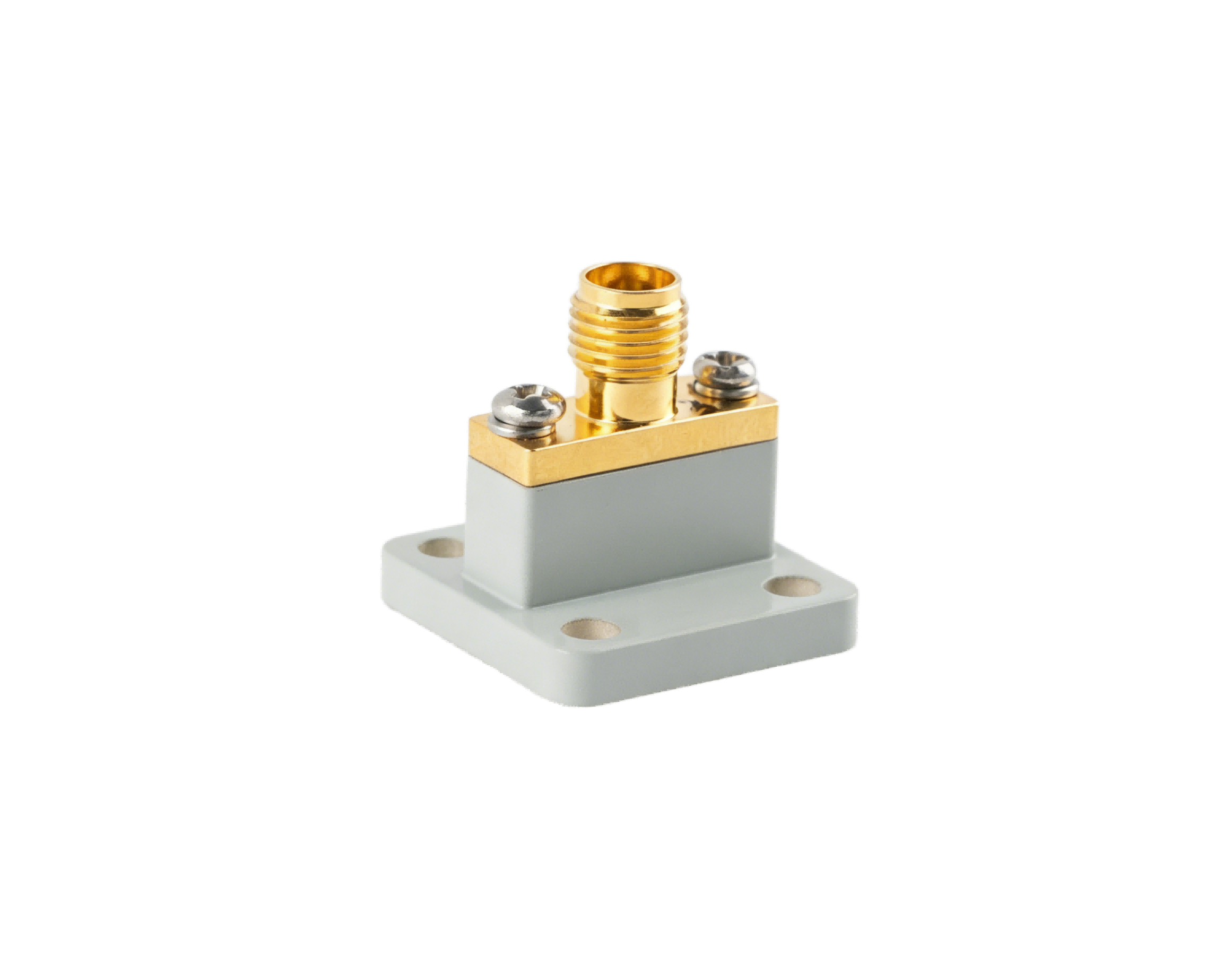
Are Hidden Transition Errors Compromising Your RF Network? Common Problems in Waveguide to Coaxial Transitions and How to Avoid Them
In the intricate architecture of modern microwave systems, the point where a rigid waveguide meets a flexible coaxial cable is often the most vulnerable link in the entire transmission chain. Whether you are calibrating a highly sensitive Vector Network Analyzer (VNA) in an EMC laboratory, or integrating a transceiver into a 5G mmWave base station, this transition must be executed flawlessly.
Converting the Transverse Electric (TE10) mode of a waveguide into the Transverse Electromagnetic (TEM) mode of a coaxial cable is a complex electromagnetic balancing act. When this transition is compromised by poor machining, incorrect connector selection, or mechanical stress, the results are immediate and detrimental: severe signal reflection, phase distortion, and corrupted measurement data.
For RF engineers and system integrators, identifying and mitigating these transition errors is critical to ensuring absolute signal integrity. In this comprehensive guide, we will explore the most common problems in waveguide to coaxial transitions, explain the physics behind these failures, and demonstrate how partnering with an agile, precision manufacturer can help you avoid these pitfalls and keep your projects on schedule.
Problem 1: Impedance Mismatch and High VSWR
The most frequent issue engineers encounter at the waveguide-to-coaxial boundary is a spike in the Voltage Standing Wave Ratio (VSWR).
A standard coaxial cable has a characteristic impedance of 50 Ohms. However, the impedance of a waveguide varies with frequency and is typically much higher. Inside the adapter, a precisely machined probe (acting as an antenna) and a shorting plate are used to match these impedances. If the probe depth is off by even a fraction of a millimeter, or if the internal cavity is poorly machined, the impedance match fails. The RF energy reflects backward, creating standing waves that degrade signal clarity and introduce massive errors in VNA measurements.
To avoid VSWR spikes, you must source adapters manufactured with uncompromising CNC precision. At AO Microwave, our waveguide to coaxial adapters are rigorously tuned to deliver exceptional broadband impedance matching. By maintaining strict manufacturing tolerances, we consistently achieve a VSWR of 1.20:1 to 1.25:1 (Max) across the operating band, ensuring your test results are accurate and your signal remains pristine.
Problem 2: The Power Handling Bottleneck
A common oversight in system design is forgetting that the two sides of the transition have vastly different power handling capabilities. A rectangular waveguide can handle kilowatts or even megawatts of peak power. A coaxial connector cannot.
When engineers attempt to push high Continuous Wave (CW) power through an adapter equipped with a high-frequency, low-power connector (like an SMA or 2.92mm), the thin center pin and dielectric cannot dissipate the heat. This leads to thermal overload, melting the connector and causing a catastrophic short circuit.
The Solution: Match the Connector to the Power Requirement
You must carefully balance your frequency requirements with your power needs. AO Microwave offers a comprehensive range of connector options to solve this exact dilemma:
- For High Power (Up to 18 GHz): Specify N-Type or 7/16 DIN connectors. Their robust center pins and larger dielectrics provide excellent thermal dissipation for radar and Satcom uplinks.
- For High Frequency / Low Power: Specify SMA, 2.92mm, 2.4mm, or 1.85mm connectors for precision laboratory testing and receiver networks where power levels are safely controlled.
Problem 3: Mechanical Stress and Flange Misalignment
In laboratory environments and dense equipment racks, coaxial cables are frequently connected, disconnected, and bent. This constant movement places severe mechanical torque on the coaxial connector of the adapter. Over time, this stress can loosen the connector, degrade the internal probe alignment, or cause microscopic air gaps at the waveguide flange joint, leading to RF leakage and phase instability.
To mitigate mechanical stress, choose the right adapter configuration for your spatial constraints. While Right-Angle Adapters are the industry standard, they can protrude awkwardly in tight spaces. If you are routing cables inside a dense UAV payload or a compact 5G transceiver, specify an End-Launch (In-Line) Adapter. This allows the coaxial cable to run parallel to the waveguide, drastically reducing torque and mechanical strain. Furthermore, ensure you select the exact matching flange (e.g., UDR, UBR, or UG series) to guarantee a flush, leak-proof mechanical seal.
Problem 4: The Millimeter-Wave Challenge (Up to 110 GHz)
As the industry pushes into the E-band and W-band for automotive radar, 6G research, and ultra-high-resolution imaging, transitioning signals becomes exponentially more difficult. At frequencies approaching 110 GHz, even microscopic surface imperfections or tiny misalignments in the adapter will completely destroy the signal.
Many legacy suppliers simply do not have the manufacturing capabilities to produce reliable adapters above 40 GHz, leaving engineers struggling to find components for their cutting-edge research.
The Solution: Advanced Manufacturing Capabilities
Your RF architecture should not be limited by your supplier's catalog. AO Microwave possesses the advanced engineering and manufacturing capabilities to support frequencies from 0.32 GHz all the way up to 110 GHz. For extreme high-frequency applications, we provide ultra-precision adapters equipped with 1.0mm female connectors and UG-387/U flanges, ensuring flawless TE10 to TEM mode conversion at the very edge of the microwave spectrum.
Overcoming Supply Chain Fragility with Agile Manufacturing
Identifying the right technical solution is only half the battle; securing the components on time is the other. For decades, system integrators have been forced to endure 16 to 24-week lead times from legacy Western manufacturers for specialized or custom adapters. In today's fast-paced telecommunications and defense sectors, waiting half a year for a critical component is unacceptable. It stalls innovation and delays your time-to-market.
We believe that your supplier should be a strategic partner, not a bottleneck. As a professional manufacturer, AO Microwave offers deep customization capabilities. Whether you need a specific right-angle configuration, a unique flange-to-connector combination, or a custom mechanical footprint, our engineering team can design and manufacture the exact adapter you need. Combined with our agile manufacturing process, we deliver these tailored, high-performance solutions rapidly, ensuring your project stays on schedule without compromising on signal integrity.
Conclusion: Ensure Flawless Transitions in Your RF Network
The transition between a waveguide and a coaxial cable is a critical juncture in any microwave system. By understanding the common problems—impedance mismatches, power handling limitations, mechanical stress, and high-frequency constraints—engineers can proactively specify the correct adapters to protect their equipment and ensure absolute measurement accuracy.
By partnering with a manufacturer that offers an extensive frequency range (up to 110 GHz), diverse connector options (from N-Type to 1.0mm), and robust customization capabilities, you empower your engineering team to innovate without limitations.
Ready to Optimize Your RF Transitions?
Don't let hidden transition errors degrade your signal, and don't let rigid supply chains delay your project launches. Whether you need robust N-Type adapters for an EMC lab or custom 1.0mm adapters for a 110 GHz millimeter-wave research project, AO Microwave has the expertise and manufacturing agility to deliver exactly what you need.
Contact our engineering team today to discuss your specific requirements, and let us provide the perfect tailored solution for your RF architecture.