
Are Microscopic Errors Ruining Your mmWave Signals? Why High-Frequency Waveguide to Coaxial Adapters Require Precision Manufacturing
Why do high-frequency waveguide to coaxial adapters require precision manufacturing? Learn how CNC accuracy prevents VSWR spikes in mmWave systems up to 110 GHz.
Are Microscopic Errors Ruining Your mmWave Signals? Why High-Frequency Waveguide to Coaxial Adapters Require Precision Manufacturing
As the RF and microwave industry aggressively pushes into the millimeter-wave (mmWave) spectrum—driven by 5G/6G telecommunications, high-resolution automotive radar, and advanced aerospace imaging—engineers are operating at the very edge of physical limits. At frequencies like 75 GHz or 110 GHz, the margin for error does not exist.
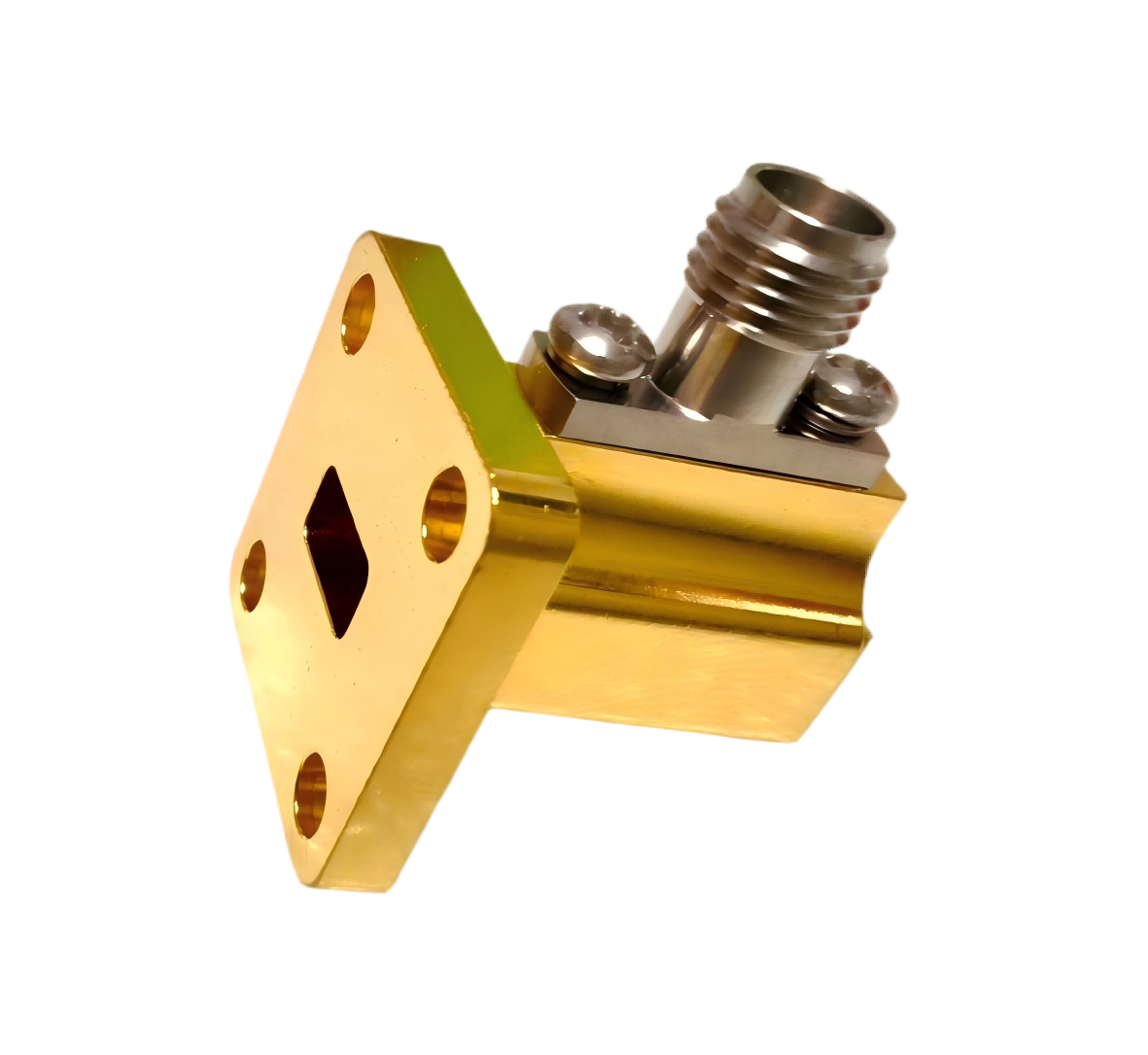
When you connect a highly sensitive Vector Network Analyzer (VNA) to a W-band waveguide system, the transition between the coaxial cable and the waveguide is the most critical juncture in your entire test setup. This transition is handled by a Waveguide to Coaxial Adapter.
At lower frequencies (like L-band or S-band), a slightly misaligned probe or a rough internal surface might only cause a negligible drop in performance. But at high frequencies, the physics change dramatically. A machining error of just a few micrometers—thinner than a human hair—will trigger massive impedance mismatches, severe phase distortion, and catastrophic Voltage Standing Wave Ratio (VSWR) spikes, rendering your measurement data completely useless.
If you are asking, "Why do high-frequency waveguide to coaxial adapters require such extreme precision manufacturing?", the answer lies in the unforgiving nature of short wavelengths. In this comprehensive guide, we will explore the electromagnetic physics of mmWave transitions, detail the three critical areas where manufacturing precision is non-negotiable, and demonstrate how AO Microwave’s advanced capabilities up to 110 GHz can safeguard your signal integrity.
The Physics of mmWave: Why Wavelength Dictates Tolerance
To understand the need for extreme precision, we must look at the relationship between frequency and wavelength. As frequency increases, wavelength decreases proportionally.
- At 3 GHz (S-Band), the wavelength in free space is approximately 100 mm. A machining tolerance of 0.1 mm is only 0.1% of the wavelength. The electromagnetic wave barely "notices" the imperfection.
- At 110 GHz (W-Band), the wavelength shrinks to a microscopic 2.7 mm. That same 0.1 mm machining error is now nearly 4% of the wavelength. To the electromagnetic wave, that tiny burr or misalignment looks like a massive brick wall.
When the wave hits this "wall" inside the adapter, it reflects backward. This failure to smoothly convert the TE10 mode of the waveguide into the TEM mode of the coaxial connector destroys the 50-Ohm impedance match, causing signal degradation that no software calibration can fully correct.
3 Critical Areas Where Precision Manufacturing is Non-Negotiable
To achieve flawless mode conversion at high frequencies, a waveguide to coaxial adapter must be manufactured with uncompromising CNC precision in three specific areas:
1. The Internal Cavity and Probe Depth
Inside the adapter, the center pin of the coaxial connector extends into the waveguide cavity, acting as a radiating antenna (the probe). The distance between this probe and the back wall of the waveguide (the shorting plate) must be calculated and machined to exact fractions of a wavelength.
If the probe is inserted even a few microns too deep, or if the shorting plate is slightly off-center, the capacitance and inductance of the transition are thrown out of balance. Premium manufacturers utilize advanced 3D electromagnetic simulation (like HFSS) combined with ultra-precise multi-axis CNC milling to ensure the internal geometry matches the theoretical design perfectly, resulting in a VSWR of < 1.25:1 even at millimeter-wave frequencies.
2. Internal Surface Finish and the Skin Effect
At high frequencies, alternating current does not flow through the entire cross-section of the metal. Due to the Skin Effect, the current is forced to the extreme outer layer of the waveguide's inner wall. At 110 GHz, this "skin depth" is incredibly thin.
If the internal surface of the adapter has CNC chatter marks, scratches, or a rough finish, the electrical path becomes longer and highly resistive. This converts your precious RF signal into heat, causing severe Insertion Loss. High-frequency adapters require a mirror-like internal surface finish (often achieved through precision electroforming or specialized polishing) and high-conductivity plating (like gold or silver) to ensure the wave glides through with near-zero resistance.
At 75 GHz or 110 GHz, standard flat flanges are no longer sufficient. If the flange faces are not perfectly flat, microscopic air gaps will form when bolted together. At these frequencies, RF energy will leak out of these gaps like water from a cracked pipe, causing massive measurement errors. High-frequency adapters must utilize precision anti-cocking flanges (such as the UG-387/U) with exact alignment pins to guarantee a flush, leak-proof mechanical seal every single time.
AO Microwave: Mastering the Spectrum from 0.32 GHz to 110 GHz
Many legacy suppliers simply do not possess the advanced machining capabilities or the rigorous quality control required to produce reliable adapters above 40 GHz. This leaves system integrators and research laboratories struggling to find components for their cutting-edge projects.
At AO Microwave, your RF architecture is not limited by our catalog; it is empowered by our manufacturing strength. We provide a comprehensive suite of Waveguide to Coaxial Adapters engineered for absolute precision across the entire spectrum:
| Frequency Band | Waveguide Size | Precision Coaxial Connectors Available | Primary Applications |
|---|---|---|---|
| Low/Mid Band (0.32 - 18 GHz) | WR-2300 to WR-62 | N-Type, SMA, 7/16 DIN | High-power radar, Satcom uplinks, EMC immunity testing. |
| High Band (18 - 40 GHz) | WR-42 to WR-28 | 2.92mm (K), 2.4mm | 5G mmWave backhaul, Ka-band satellite payloads. |
| V & E Band (40 - 75 GHz) | WR-19 to WR-12 | 2.4mm, 1.85mm (V) | 6G research, high-capacity point-to-point microwave links. |
| W Band (75 - 110 GHz) | WR-10 | 1.0mm (Female/Male) | Automotive radar testing, ultra-high-resolution imaging, VNA calibration. |
Overcoming Supply Chain Fragility with Agile Customization
Designing a flawless mmWave transition is a significant engineering achievement. However, securing these ultra-precision components on time is often the greatest hurdle. For decades, the industry has endured 16 to 24-week lead times from legacy Western manufacturers for high-frequency adapters. When you are racing to deploy a new automotive radar system or upgrade a VNA test bench, waiting half a year for a WR-10 to 1.0mm adapter is unacceptable.
We believe that your supplier should be a strategic partner, not a bottleneck. As a true source manufacturer, AO Microwave offers deep customization capabilities. Whether you need a specific Right-Angle or End-Launch configuration, a unique flange style (UDR, UBR, UG), or ultra-high-frequency support up to 110 GHz, our engineering team can design and manufacture the exact adapter you need. Combined with our agile manufacturing process, we deliver these tailored, industrial-grade solutions rapidly, ensuring your project stays on schedule without compromising on signal integrity.
Conclusion: Demand Precision, Ensure Performance
In the unforgiving realm of high-frequency microwave engineering, a waveguide to coaxial adapter is far more than a mechanical fitting; it is a highly engineered electromagnetic bridge. At frequencies up to 110 GHz, microscopic machining errors in the probe depth, surface finish, or flange alignment will inevitably lead to VSWR spikes and corrupted data.
By understanding the physics of mmWave transitions and partnering with a manufacturer that possesses the advanced CNC capabilities to support the entire spectrum—from N-Type connectors at L-band to 1.0mm connectors at W-band—you empower your engineering team to innovate with absolute confidence.
Ready to Achieve Flawless mmWave Transitions?
Don't let microscopic machining errors degrade your signal, and don't let rigid supply chains delay your project launches. Whether you need robust SMA adapters for an EMC lab or ultra-precision 1.0mm adapters for a 110 GHz VNA calibration setup, AO Microwave has the expertise and manufacturing agility to deliver exactly what you need.
Contact our engineering team today to discuss your specific requirements, and let us provide the perfect tailored solution for your RF architecture.