
Are Polarization Mismatches Degrading Your Signal? The Critical Function of Waveguide Twists in Microwave Systems
Overcome RF polarization mismatches and mechanical space constraints. Learn how continuous and step waveguide twists protect signal integrity in microwave systems.
Are Polarization Mismatches Degrading Your Signal? The Critical Function of Waveguide Twists in Microwave Systems
Picture this scenario: Your engineering team is in the final stages of integrating a multi-million-dollar satellite earth station or a complex 5G mmWave backhaul system. The High-Power Amplifiers (HPAs) are securely bolted into the equipment racks. The antenna feed horn is perfectly aligned with the reflector. But when you go to connect the transmission line, you hit a massive mechanical roadblock.
The rectangular flange of your amplifier output is oriented horizontally, but the input flange of your antenna feed is oriented vertically. They are exactly 90 degrees out of phase.
You cannot simply unbolt the 500-pound amplifier rack and turn it on its side. And if you attempt to force a connection with mismatched polarizations, your electromagnetic signal will suffer catastrophic cross-polarization loss—effectively dropping your transmission power to zero. In high-frequency RF architecture, mechanical misalignment is not just an inconvenience; it is a fatal threat to signal integrity.
To solve this complex spatial and electromagnetic puzzle, system integrators rely on a highly specialized, precision-machined component: the Waveguide Twist.
In this comprehensive guide, we will explore the critical function of waveguide twists, decode the physics of polarization rotation, and demonstrate how partnering with an agile, industrial-grade manufacturer can solve your most complex RF routing challenges while keeping your project timelines strictly on track.
The Physics of Polarization: Why You Need a Waveguide Twist
To understand the function of a waveguide twist, we must first look at how electromagnetic energy travels inside a rectangular waveguide. In the dominant operating mode (TE10), the Electric field (E-field) lines run parallel to the narrow wall of the waveguide, while the Magnetic field (H-field) lines run parallel to the broad wall.
This specific orientation of the E-field is known as the signal's Polarization (typically Horizontal or Vertical).
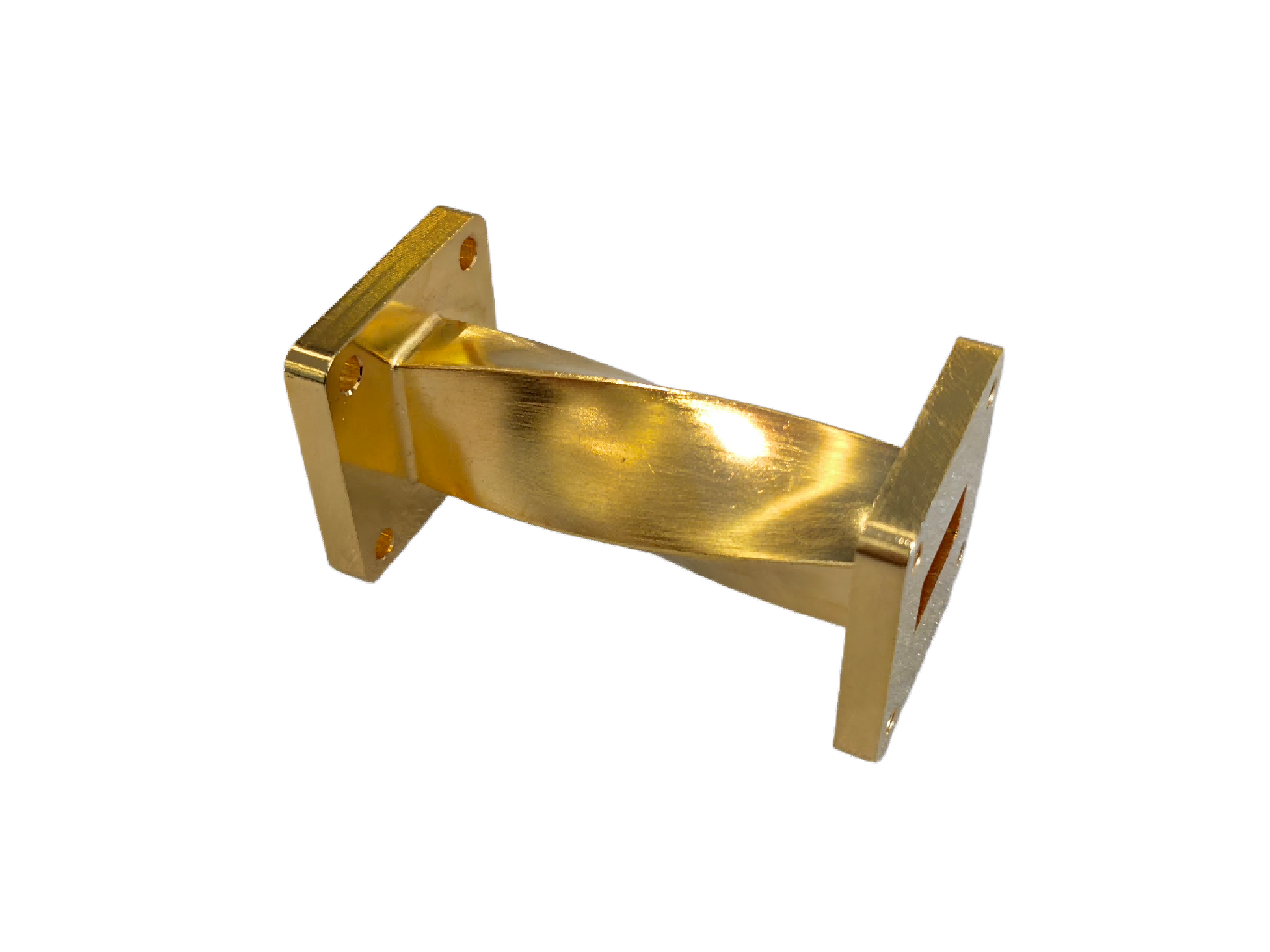
If you connect two waveguides where the broad walls do not align perfectly, the E-field hits a physical boundary it cannot pass through efficiently. A 90-degree mismatch will result in near-total signal reflection. The function of a waveguide twist is to take that electromagnetic wave and smoothly rotate its polarization plane—usually by 45° or 90°—so that it perfectly matches the orientation of the receiving component.
Rotating a hollow metal tube sounds simple in theory, but it is an engineering nightmare in practice. If the internal dimensions (the 'a' and 'b' walls) deform, flatten, or warp during the twisting process, the characteristic impedance of the waveguide changes instantly. This impedance mismatch creates severe Voltage Standing Wave Ratio (VSWR) spikes, reflecting lethal RF power back into your transmitter. A premium waveguide twist must rotate the signal while maintaining absolute dimensional perfection.
Continuous vs. Step Twists: Choosing the Right Configuration
Depending on your mechanical space constraints and bandwidth requirements, waveguide twists are generally manufactured in two distinct configurations:
1. Continuous (Swept) Waveguide Twists
In a continuous twist, the rectangular waveguide is gradually and smoothly twisted along its longitudinal axis until the desired angle (usually 90 degrees) is achieved.
- The Advantage: Because the transition is incredibly smooth, continuous twists offer the lowest possible insertion loss and the best VSWR performance across the entire waveguide frequency band. They are the gold standard for maintaining pristine signal integrity.
- The Trade-off: To ensure the wave rotates without reflecting, the twist must occur over a specific length (typically greater than two wavelengths). This means continuous twists require more physical space in your equipment rack.
2. Step Waveguide Twists
When mechanical space is severely restricted, engineers use a step twist. Instead of a smooth curve, this component consists of several short, straight waveguide sections joined together, with each section slightly rotated (offset) from the previous one.
- The Advantage: Step twists can be manufactured to be much shorter than continuous twists, making them ideal for ultra-compact enclosures like UAV payloads or dense radar arrays.
- The Trade-off: Because the rotation happens in "steps," they are more prone to impedance mismatches and typically have a narrower operating bandwidth compared to continuous twists.
Critical Industry Applications for Waveguide Twists
Waveguide twists are the unsung heroes of complex RF routing, ensuring seamless integration in environments where mechanical flexibility is zero:
| Industry | Mission-Critical Application |
|---|---|
| Satellite Communications (Satcom) | Aligning the polarization of High-Power Amplifiers (HPAs) with dual-polarized antenna feeds (Orthomode Transducers / OMTs). Twists allow engineers to seamlessly switch between horizontal and vertical polarization for uplink and downlink separation. |
| Defense & Phased Array Radar | Routing signals through the incredibly dense, multi-layered architecture of radar systems, ensuring the E-field is perfectly aligned with the radiating elements without introducing phase distortion. |
| EMC / EMI Testing Chambers | Connecting rigid test equipment to horn antennas that must be physically rotated during immunity testing, ensuring the polarization matches the specific test standards. |
| 5G mmWave Telecommunications | Navigating the cramped internal enclosures of high-frequency transceivers, allowing components to be packed tightly together regardless of their flange orientations. |
Overcoming Supply Chain Fragility with Agile Manufacturing
Designing a flawless RF routing architecture that perfectly aligns every polarization plane is a significant engineering achievement. However, the true challenge for system integrators today is securing these custom routing components on time.
For decades, the RF industry has relied on a handful of legacy Western manufacturers. While their quality is established, their rigid, bureaucratic supply chains often result in agonizing 16 to 24-week lead times. When you are deploying a new satellite earth station or upgrading a critical defense radar, waiting half a year for a specific 90-degree waveguide twist is unacceptable. It stalls projects, frustrates stakeholders, and delays your time-to-market.
You need a partner who matches your engineering rigor with manufacturing agility.
Conclusion: Align Your System for Ultimate Reliability
In the high-stakes world of microwave engineering, a waveguide twist is far more than a twisted piece of metal; it is a highly engineered component critical to maintaining the polarization, impedance, and phase stability of your entire RF architecture. By understanding the physics of E-field rotation and selecting the appropriate continuous or step configurations, engineers can overcome severe mechanical misalignments without sacrificing signal integrity.
By prioritizing critical specifications like internal dimensional stability and VSWR, and by partnering with an agile manufacturer dedicated to industrial-grade excellence, you can build a resilient, high-performance RF system that is delivered on time, every time.
Ready to Solve Your Complex Polarization Challenges?
Don't let mechanical misalignments compromise your signal integrity, and don't let rigid supply chains delay your project launches. Whether you need precision Continuous Twists for a high-power Satcom uplink or ultra-compact Step Twists for a radar array, AO Microwave delivers the reliability and responsiveness you need.
Contact our engineering team today for a technical consultation, and let us help you build a resilient, perfectly aligned RF routing architecture.