
Are Reflected Signals Threatening Your Amplifiers? Waveguide Terminations and Loads Explained for Ultimate RF Reliability
Protect your amplifiers from reflected signals. Learn how waveguide terminations and high-power dummy loads ensure RF reliability and thermal management.
Are Reflected Signals Threatening Your Amplifiers? Waveguide Terminations and Loads Explained for Ultimate RF Reliability
In the sophisticated architecture of modern RF and microwave systems, engineers spend countless hours optimizing signal transmission. Whether you are designing a 5G mmWave backhaul, a commercial satellite earth station, or a high-power defense radar, the goal is always the same: push the maximum amount of electromagnetic energy from the transmitter to the antenna with absolute precision.
But what happens to that massive RF energy when it has nowhere to go? What occurs when a port is left open, an antenna is disconnected for maintenance, or a directional coupler needs to isolate a signal path?
If high-frequency electromagnetic waves hit an unmatched boundary, they do not simply disappear. They reflect backward. This reflected energy creates severe standing waves (high VSWR) that travel directly back into your High-Power Amplifiers (HPAs). Within milliseconds, this reflected power can cause catastrophic thermal overload, internal arcing, and the complete destruction of equipment worth tens of thousands of dollars.
To prevent this engineering nightmare, system integrators rely on the ultimate "shock absorbers" of the microwave world: Waveguide Terminations and Dummy Loads.
In this comprehensive guide, we will explore the critical physics behind waveguide terminations, decode the engineering challenges of thermal management in high-power dummy loads, and demonstrate how partnering with an agile, industrial-grade manufacturer can fortify your RF architecture and ensure your mission-critical systems never go offline.
The Physics of Protection: How Do Waveguide Terminations Work?
A waveguide termination (often referred to simply as a "load") is a passive microwave component designed to completely absorb incident RF energy and prevent it from reflecting back down the transmission line. It acts as a perfect impedance match for the waveguide system.
Inside the metallic housing of the termination lies a precisely shaped absorptive material—typically a tapered ceramic element impregnated with silicon carbide, carbon, or other highly resistive compounds.
When the electromagnetic wave enters the termination, it strikes this resistive element. Instead of bouncing off, the RF energy is forced to flow through the resistive material, where the laws of thermodynamics take over. The electromagnetic energy is entirely converted into heat. The physical taper of the element ensures that the transition is gradual, minimizing any sudden impedance changes that could cause micro-reflections.
The primary metric of a waveguide termination is its Voltage Standing Wave Ratio (VSWR). A perfect termination would have a VSWR of 1.0:1 (zero reflection). In the real world, if a termination is poorly machined or the absorptive element is misaligned, the VSWR spikes. Even a small reflection in a multi-kilowatt radar system can send hundreds of watts of lethal power back into the transmitter's magnetron or solid-state amplifier. Precision CNC machining and perfect impedance matching are non-negotiable.
Terminations vs. Dummy Loads: Understanding the Distinction
While the terms are often used interchangeably in the field, RF engineers generally categorize these components based on their power handling capabilities and specific applications.
1. Low-Power Waveguide Terminations (Matched Loads)
These are typically compact, un-finned components designed to absorb very small amounts of RF power (usually ranging from 1 Watt to 50 Watts Continuous Wave).
- Primary Application: They are used to "cap off" or terminate unused ports in a microwave network to maintain system impedance. For example, the isolated port of a directional coupler or the unused output of a waveguide power divider must be terminated with a matched load to prevent signal leakage and internal reflections that would corrupt data integrity.
2. High-Power Waveguide Terminations (Dummy Loads)
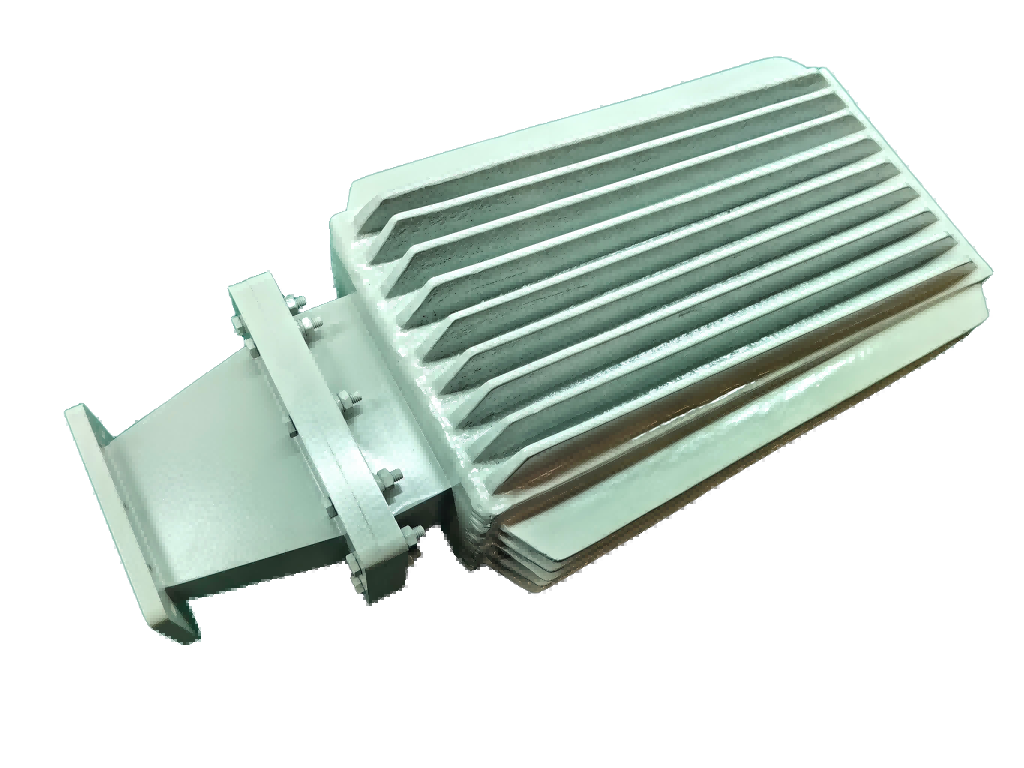
A "Dummy Load" is a heavy-duty termination engineered to absorb the full output power of a transmitter. They are physically larger and are heavily optimized for thermal dissipation, often featuring massive external cooling fins or even liquid-cooling channels.
- Primary Application: Offline testing and calibration. When engineers need to test, tune, or troubleshoot a high-power satellite uplink amplifier, they cannot broadcast the signal into the open air (which would violate FCC/ITU regulations and cause interference). Instead, they route the transmitter's output into a Dummy Load. The load safely absorbs the kilowatts of RF energy, allowing the engineers to run the system at full capacity in a controlled, safe environment.
Mastering Thermal Management: The Key to High-Power Reliability
When dealing with High-Power Dummy Loads, the engineering conversation shifts entirely from RF dynamics to thermodynamics. Because 100% of the absorbed RF energy is converted into heat, a dummy load is essentially a highly efficient industrial heater.
If a dummy load cannot dissipate heat faster than it absorbs it, the internal resistive element will crack, melt, or catch fire. Once the element fails, the load becomes an open circuit, and the lethal RF power reflects straight back into your amplifier.
To guarantee absolute reliability, premium dummy loads utilize advanced thermal engineering:
- Finned Aluminum Housings: For medium-to-high power applications, the waveguide housing is extruded or machined with deep cooling fins to maximize the surface area exposed to ambient air, facilitating rapid natural convection cooling.
- Forced Air Cooling: For higher power levels, industrial fans are integrated into the finned housing to force ambient air across the heat sinks, drastically increasing the thermal dissipation rate.
- Material Selection: While aluminum is excellent for weight reduction, extreme high-power applications often utilize Copper or Brass housings due to their superior thermal conductivity, ensuring heat is pulled away from the resistive element as quickly as possible.
Critical Industry Applications for Waveguide Loads
Waveguide terminations and dummy loads are the unsung heroes in environments where signal integrity and equipment safety are paramount:
| Industry | Mission-Critical Application |
|---|---|
| Satellite Communications (Satcom) | Integrated with DPDT Transfer Switches in 1:1 redundancy systems. The standby amplifier is continuously routed to a dummy load, allowing it to stay powered on and "warmed up" without broadcasting, ready to take over instantly if the main amplifier fails. |
| EMC / EMI Testing | Terminating the ends of high-power transmission lines inside anechoic chambers to ensure that no stray RF energy reflects back and corrupts the highly sensitive immunity test results. |
| Defense & Radar Systems | Absorbing the massive peak power (often megawatts) during the calibration of radar transmitters, ensuring the magnetrons operate safely during maintenance cycles. |
| Medical Equipment (LINACs) | Absorbing residual S-band microwave energy in linear accelerators to ensure precise, controlled radiation dosing for oncology patients. |
Overcoming Supply Chain Fragility with Agile Manufacturing
In the modern technology landscape, designing a flawless RF architecture is only the first step. The true challenge for system integrators is securing the components on time to meet strict project deadlines.
For decades, the RF industry has relied on a handful of legacy Western manufacturers. While their quality is established, their rigid, bureaucratic supply chains often result in agonizing 16 to 24-week lead times. When you are deploying a new 5G infrastructure or upgrading a critical defense radar, waiting half a year for a high-power dummy load is unacceptable. It stalls projects, frustrates stakeholders, and delays your time-to-market.
You need a partner who matches your engineering rigor with manufacturing agility.
Conclusion: Secure Your System's Integrity
In the high-stakes world of microwave engineering, a waveguide termination is far more than a simple end-cap; it is the ultimate insurance policy for your entire RF architecture. By perfectly absorbing unwanted energy and mastering thermal dissipation, these components protect your multi-million-dollar amplifiers from catastrophic reflected power and ensure pristine signal integrity across your network.
By prioritizing critical specifications like VSWR and continuous power handling, and by partnering with an agile manufacturer dedicated to industrial-grade excellence, you can build a resilient, fail-safe RF system that is delivered on time, every time.
Ready to Fortify Your RF Architecture?
Don't let reflected power threaten your critical amplifiers, and don't let rigid supply chains delay your project launches. Whether you need precision Low-Power Terminations for a Satcom routing matrix or massive High-Power Finned Dummy Loads for radar calibration, AO Microwave delivers the reliability and responsiveness you need.
Contact our engineering team today for a technical consultation, and let us help you build a resilient, high-performance RF system.