
Jun 26, 2026News & Insights
Waveguide vs Coaxial Cable: Which Is Better for High Frequency RF?
Waveguide vs coaxial cable: which is better for high-frequency RF systems? Compare loss, power handling, frequency range, and applications to choose the right solution.
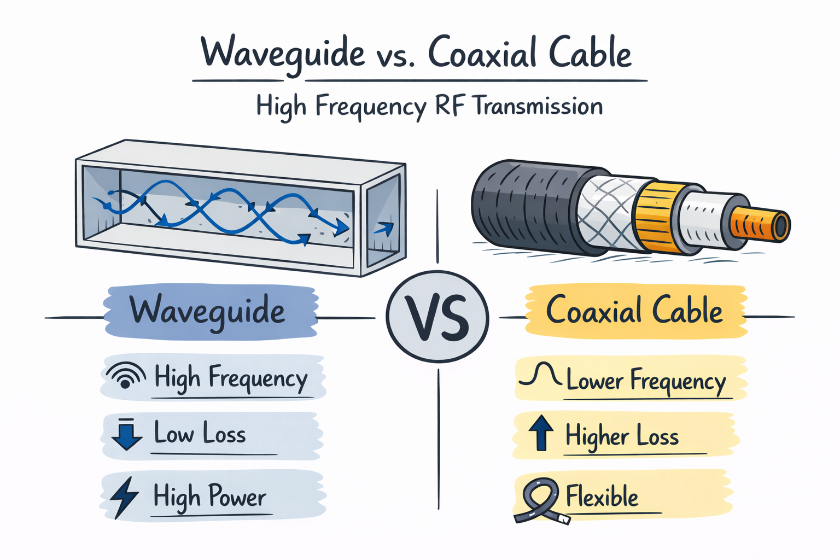
In RF and microwave system design, one of the most common engineering decisions is choosing between a waveguide and a coaxial cable for signal transmission.
Both technologies are widely used, but they serve different purposes depending on frequency, power, and system requirements.
👉 So the key question is:
Which one is better for high-frequency RF applications?
The answer depends on multiple technical factors, including frequency range, insertion loss, power handling, and system design constraints.
In this article, we provide a detailed comparison to help engineers make the right choice.
What Is a Waveguide?
A waveguide is a hollow metallic structure that guides electromagnetic waves, typically used in microwave and millimeter-wave frequencies.
Key Characteristics:
- very low loss at high frequency
- high power handling capability
- rigid structure
- excellent shielding
Waveguides are commonly used in radar systems, satellite communication, and RF testing.
What Is a Coaxial Cable?
A coaxial cable consists of:
- inner conductor
- dielectric layer
- outer conductor (shield)
Key Characteristics:
- flexible and easy to install
- supports a wide frequency range (low to mid frequencies)
- compact size
Coaxial cables are widely used in communication systems, lab testing, and general RF connections.
Key Differences Between Waveguide and Coaxial Cable
1. Frequency Range
Waveguide:
- typically used above 3 GHz
- ideal for microwave and millimeter-wave systems
Coaxial Cable:
- works from DC up to tens of GHz
- performance degrades at very high frequencies
👉 Conclusion:
Waveguides are superior for high-frequency applications.
2. Insertion Loss
Waveguide:
- extremely low loss at high frequencies
- minimal signal attenuation
Coaxial Cable:
- higher loss, especially as frequency increases
- loss increases with cable length
👉 Conclusion:
Waveguides provide better efficiency and signal integrity.
3. Power Handling
Waveguide:
- can handle very high power levels
- ideal for radar and high-power transmitters
Coaxial Cable:
- limited by dielectric breakdown and heating
👉 Conclusion:
Waveguides are better for high-power RF systems.
4. Mechanical Structure
Waveguide:
- rigid and bulky
- requires precise alignment
Coaxial Cable:
- flexible and easy to route
- suitable for complex installations
👉 Conclusion:
Coaxial cables are better for flexibility and installation convenience.
5. Cost and Integration
Waveguide:
- higher manufacturing cost
- more complex installation
Coaxial Cable:
- lower cost
- easy integration
👉 Conclusion:
Coaxial cables are more suitable for cost-sensitive applications.
Comparison Table (Quick Overview)
Feature | Waveguide | Coaxial Cable |
|---|---|---|
Frequency Range | High (GHz to mmWave) | Low to mid frequency |
Insertion Loss | Very low | Higher |
Power Handling | High | Limited |
Flexibility | Low | High |
Size | Large | Compact |
Cost | Higher | Lower |
When Should You Use a Waveguide?
Choose a waveguide when your system requires:
- frequencies above 3 GHz
- low insertion loss
- high power handling
- stable and interference-free transmission
Typical Applications:
- radar systems
- satellite communication
- millimeter-wave systems
- RF test setups
When Should You Use a Coaxial Cable?
Choose a coaxial cable when you need:
- flexibility and easy installation
- compact size
- lower cost
- moderate frequency performance
Typical Applications:
- lab testing
- communication equipment
- internal RF connections
Real Engineering Scenario
Scenario: High-Frequency Radar System
Requirements:
- frequency: 10 GHz+
- high power
- low signal loss
👉 Best Choice: Waveguide
Scenario: RF Test Lab Setup
Requirements:
- flexibility
- frequent connections
- moderate frequency
👉 Best Choice: Coaxial Cable
Can Waveguides and Coaxial Cables Be Used Together?
Yes—and in many systems, they are.
Typical configuration:
- coaxial cable for flexible connections
- waveguide for high-frequency transmission
Adapters (coax-to-waveguide transitions) are commonly used to integrate both.
Manufacturers like AO Microwave provide both waveguide components and coaxial solutions for complete system integration.
Common Mistakes in Selection
Choosing Coaxial Cable for High Frequency
Leads to excessive signal loss.
Using Waveguide for Low-Frequency Systems
Unnecessary cost and complexity.
Ignoring System Constraints
Mechanical and environmental factors must be considered.
Why the Right Choice Matters
Choosing the wrong transmission method can result in:
- signal degradation
- increased system cost
- reduced efficiency
- potential system failure
Selecting the right solution ensures:
- optimal performance
- long-term reliability
- better system efficiency
Conclusion
So, which is better for high-frequency RF systems—waveguide or coaxial cable?
👉 The answer is clear:
- Waveguides are the best choice for high-frequency, high-power, and low-loss applications
- Coaxial cables are better for flexible, lower-cost, and lower-frequency systems
In many modern RF systems, both are used together to achieve the best balance between performance and practicality.