
Jun 26, 2026News & Insights
What Is a Waveguide and How Does It Work in RF Systems?
What is a waveguide and how does it work? Learn the fundamentals of waveguides in RF and microwave systems, including structure, types, and applications in communication and radar.
In modern RF and microwave systems, efficient signal transmission is critical. As frequencies increase into the GHz and millimeter-wave range, traditional transmission methods such as coaxial cables begin to experience higher losses and reduced efficiency.
This is where waveguides become essential.
A waveguide is a specialized structure designed to guide electromagnetic waves from one point to another with minimal loss. It is widely used in high-frequency applications such as radar systems, satellite communications, 5G infrastructure, and RF testing.
In this article, we explain what a waveguide is, how it works, and why it plays a critical role in RF systems.
What Is a Waveguide?
A waveguide is a physical structure that directs electromagnetic waves, typically in the microwave and millimeter-wave frequency ranges.
Unlike coaxial cables, which use a central conductor and dielectric material, waveguides are usually:
- hollow metallic tubes
- rectangular or circular in shape
- designed to support specific electromagnetic modes
Key Characteristics:
- low transmission loss at high frequencies
- high power handling capability
- excellent shielding from interference
Because of these properties, waveguides are ideal for applications where signal integrity and efficiency are critical.
How Does a Waveguide Work?
Waveguides operate based on the principle of electromagnetic wave propagation within a confined structure.
Basic Working Principle
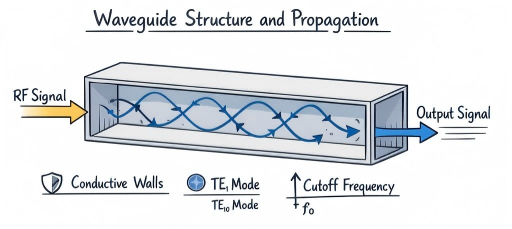
When an RF signal enters a waveguide:
- The electromagnetic wave is confined within the conductive walls
- The wave reflects internally along the structure
- Energy propagates forward with minimal loss
- The signal exits at the other end
Unlike cables, waveguides do not rely on a central conductor—instead, the signal travels as electromagnetic modes.
Waveguide Modes Explained
Wave propagation inside a waveguide occurs in specific patterns called modes.
The two most common types are:
TE Mode (Transverse Electric)
- Electric field is perpendicular to the direction of propagation
- Most commonly used mode in rectangular waveguides
TM Mode (Transverse Magnetic)
- Magnetic field is perpendicular to the direction of propagation
- Less commonly used
👉 The dominant mode in most rectangular waveguides is TE10, which provides stable and efficient signal transmission.
Cutoff Frequency
Each waveguide has a cutoff frequency, below which signals cannot propagate.
Key Insight:
- Frequency must be above cutoff to transmit
- Waveguide dimensions determine cutoff frequency
This is why different waveguide sizes (e.g., WR90, WR42, WR10) are used for different frequency ranges.
Types of Waveguides
Waveguides come in different forms depending on application requirements.
Rectangular Waveguide
Features:
- most widely used
- supports TE modes efficiently
- easy to manufacture
Applications:
- radar systems
- satellite communication
- RF testing
Circular Waveguide
Features:
- supports multiple modes
- lower loss in some applications
Applications:
- rotating joints
- specialized RF systems
Flexible Waveguide
Features:
- bendable structure
- easy installation
Applications:
- systems requiring mechanical flexibility
Ridge Waveguide
Features:
- extended bandwidth
- lower cutoff frequency
Applications:
- broadband RF systems
Manufacturers such as AO Microwave provide a wide range of waveguide components tailored for different applications.
Advantages of Waveguides in RF Systems
Low Transmission Loss
Waveguides offer significantly lower loss than coaxial cables at high frequencies.
High Power Handling
They can handle much higher power levels without overheating.
Excellent Shielding
Metallic structure prevents external interference.
High Efficiency at Microwave Frequencies
Ideal for frequencies above 3 GHz, especially in mmWave systems.
Waveguide vs Coaxial Cable
This comparison is critical for SEO and user understanding.
Feature | Waveguide | Coaxial Cable |
|---|---|---|
Frequency Range | High (GHz to mmWave) | Low to mid frequency |
Loss | Very low | Higher at high frequency |
Power Handling | High | Limited |
Size | Larger | Compact |
Flexibility | Low | High |
Key Takeaway:
- Use waveguides for high-frequency, high-power systems
- Use coaxial cables for lower frequency and flexible setups
Applications of Waveguides
Radar Systems
Waveguides are used to transmit high-frequency signals with precision.
Satellite Communications
Ensure low-loss signal transmission between components.
5G and Millimeter-Wave Systems
Support high-frequency communication infrastructure.
RF Test and Measurement
Provide stable and accurate signal transmission.
Common Mistakes When Using Waveguides
Operating Below Cutoff Frequency
Results in no signal transmission.
Incorrect Waveguide Size
Leads to inefficiency and signal loss.
Poor Mechanical Alignment
Can cause reflections and performance degradation.
Why Choose High-Quality Waveguide Components?
High-quality waveguide components provide:
- lower insertion loss
- better impedance matching
- higher reliability
- longer lifespan
AO Microwave offers precision-engineered waveguide solutions for demanding RF applications.
Conclusion
A waveguide is a fundamental component in RF and microwave systems, enabling efficient transmission of high-frequency signals with low loss and high reliability.
By understanding how waveguides work and selecting the right type for your application, engineers can significantly improve system performance.
As RF systems continue to evolve toward higher frequencies, waveguides remain a critical technology for achieving optimal results.