
Struggling with High Power RF Transmission? Why Are Waveguides the Ultimate Solution for Preventing System Failures?
Struggling with high power RF transmission? Discover why waveguides prevent voltage arcing and thermal melting, and how industrial-grade parts save BOM costs.
Struggling with High Power RF Transmission? Why Are Waveguides the Ultimate Solution for Preventing System Failures?
If you are an RF engineer, a system integrator, or a procurement manager working in defense radar, EMC testing, satellite uplinks, or medical linear accelerators, you know that transmitting high-frequency signals is only half the battle. The real challenge begins when you need to push massive amounts of RF power through your system.
As the global RF and microwave power market accelerates—driven by the deployment of high-power 5G base stations, advanced UAV jamming systems, and next-generation satellite communications—engineers are constantly pushing the limits of their hardware. When transmitting hundreds of watts, kilowatts, or even megawatts of peak power, standard transmission lines become the weakest link in your architecture.
Have you ever experienced a catastrophic system failure because a coaxial cable melted under continuous wave (CW) power? Or watched an expensive transmitter get damaged due to internal voltage arcing (corona discharge) during a high-peak-power pulse?
These are not just technical inconveniences; they are expensive disasters that cause severe system downtime and blow up project budgets. In this comprehensive guide, we will explore the physics behind high-power RF transmission, explain why waveguides are the undisputed champions of power handling, and reveal how you can optimize your Bill of Materials (BOM) without sacrificing reliability.
The High-Power Bottleneck: Why Coaxial Cables Fail Under Pressure
To appreciate the advantages of a waveguide, we must first understand why traditional coaxial cables fail when subjected to high RF power. A coaxial cable consists of a solid center conductor, a dielectric insulator (usually PTFE/Teflon), and an outer metallic shield.
When you pump high power through a coaxial cable, two destructive phenomena occur:
- Thermal Meltdown (Average Power Failure): Due to the "skin effect" and dielectric losses, a significant portion of your RF energy is converted into heat. Because the center conductor is buried inside an insulating dielectric and an outer jacket, this heat has nowhere to go. Under high continuous power, the center conductor heats up until the dielectric melts, causing a dead short and destroying the cable.
- Voltage Breakdown and Arcing (Peak Power Failure): High RF power generates intense electric fields. In a coaxial cable, the distance between the center conductor and the outer shield is very small. If the voltage exceeds the dielectric strength of the insulator, an electrical arc (spark) will jump across the gap. This is known as voltage breakdown, and it instantly destroys the cable while potentially reflecting lethal power back into your amplifier.
4 Unbeatable Advantages of Waveguides for High Power RF
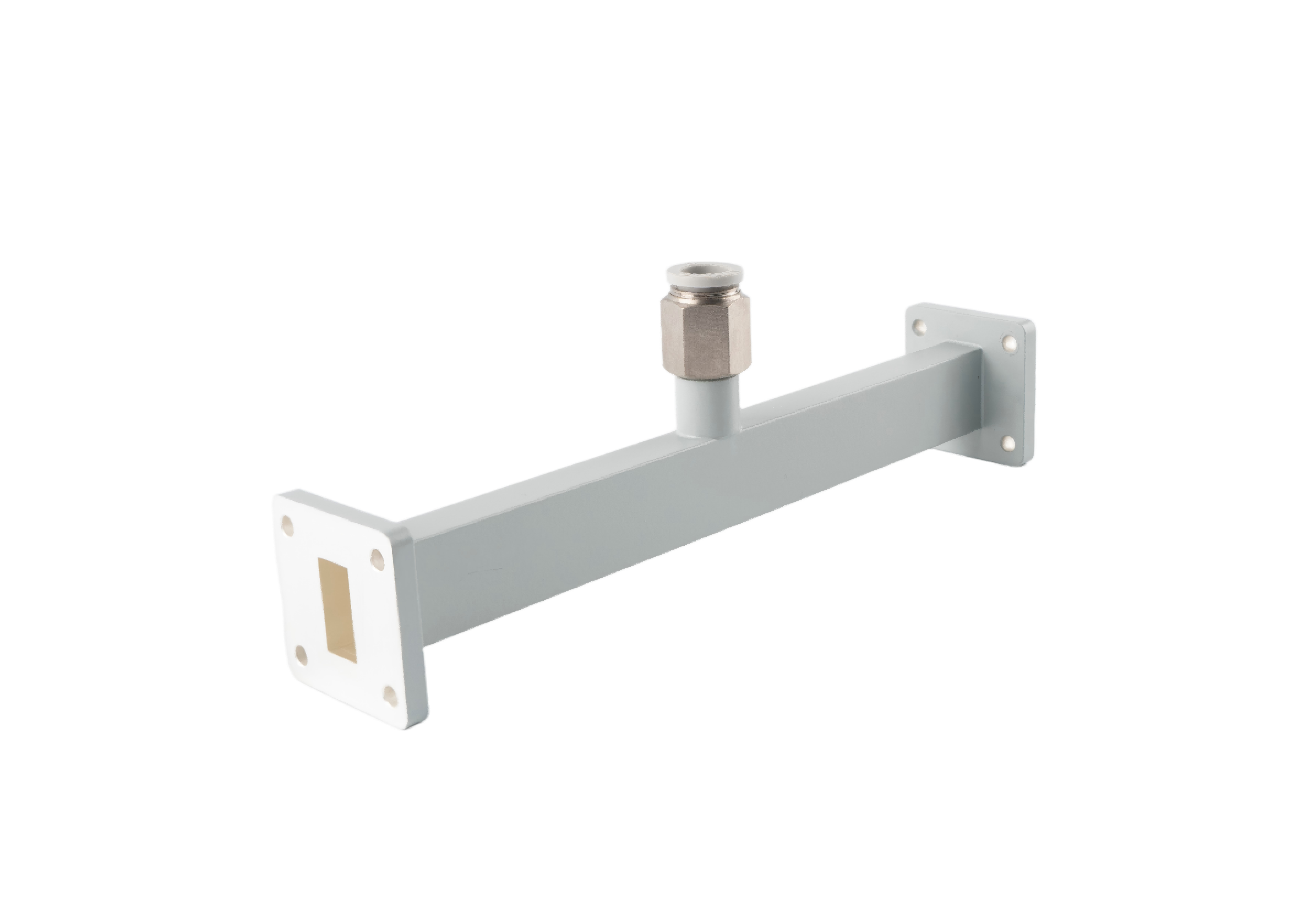
A waveguide solves the high-power dilemma through its fundamental geometry. It is a hollow metallic pipe (usually rectangular) with no center conductor and no solid dielectric. The electromagnetic wave travels through the air (or gas) inside the tube. This simple yet brilliant design offers four massive advantages.
1. Massive Cross-Sectional Area for Peak Power Handling
Because a waveguide lacks a center conductor, the electric field is distributed across the entire internal volume of the hollow tube. The distance between the top and bottom walls (the narrow dimension 'b') is significantly larger than the gap in any coaxial cable operating at the same frequency.
A larger gap means a lower voltage gradient. Therefore, a waveguide can handle exponentially higher peak voltages before the air inside breaks down and arcs. While a high-end coaxial cable might handle a few kilowatts of peak power, a standard WR-90 (X-band) waveguide can easily handle hundreds of kilowatts, and larger waveguides (like S-band or L-band) can handle megawatts of peak power.
2. Zero Solid Dielectric to Melt
In a waveguide, the dielectric is simply air (or a pressurized gas). Air does not melt. Because there is no solid Teflon or plastic to degrade under extreme heat, waveguides are immune to the thermal dielectric failures that plague coaxial cables. If an arc does occur in a waveguide due to an extreme power spike, the air simply ionizes momentarily and then recovers, whereas a coaxial cable would be permanently destroyed.
3. Exceptional Thermal Dissipation
When transmitting high average power (Continuous Wave - CW), heat generation is inevitable due to the resistance of the metal walls. However, a waveguide is essentially a large, thick piece of metal (usually aluminum, copper, or brass) exposed directly to the ambient environment.
This large surface area acts as a natural heatsink, dissipating heat rapidly into the surrounding air. For extreme power applications, waveguides can even be manufactured with external cooling fins or liquid-cooling channels—something impossible to do with the center conductor of a coaxial cable.
4. Ultra-Low Insertion Loss
Power handling and insertion loss are directly related. The more loss a component has, the more RF energy it converts into heat. Because waveguides have no dielectric loss and a massive surface area for current to flow (minimizing skin effect resistance), their insertion loss is a fraction of that of coaxial cables. Less loss means less heat, which directly translates to higher power handling capabilities.
Industry Applications: Who Needs High Power Waveguides?
If your project falls into any of the following categories, utilizing waveguides for your transmission lines is not just recommended—it is an absolute engineering necessity:
- Defense and Weather Radar: Radar systems rely on transmitting massive pulses of RF energy (often in the Megawatt range) to detect distant objects. Only waveguides can handle these extreme peak voltages without arcing.
- EMC / EMI Testing Chambers: Electromagnetic Compatibility testing requires generating intense, uniform RF fields to test product immunity. High-power amplifiers (HPAs) in these labs rely on waveguides and high-power horn antennas to deliver the signal without melting the test setup.
- Satellite Earth Stations (Uplinks): Transmitting signals to geostationary satellites requires high continuous power (often hundreds of watts to several kilowatts) in the C, Ku, and Ka bands. Waveguides ensure maximum power reaches the antenna feed with minimal thermal loss.
- Medical Linear Accelerators (LINACs): Used in radiation therapy for cancer treatment, LINACs use high-power microwaves (typically S-band) to accelerate electrons. Waveguides are the only components capable of handling the extreme power levels required for this life-saving technology.
The "Aerospace-Grade" Trap: Saving Your BOM Budget
When engineers realize they need waveguides for high-power applications, they often panic about the budget. There is a pervasive myth in the RF industry that all waveguides must be manufactured to ultra-expensive "aerospace-grade" standards, costing thousands of dollars per section.
This is a costly misconception.
Unless your system is being launched into orbit on a satellite, you do not need to pay the exorbitant premium for aerospace-grade certification, deep-space outgassing tests, or exotic lightweight alloys. For terrestrial applications—such as 5G base stations, commercial radar, EMC labs, and industrial microwave heating—high-quality industrial-grade waveguides are the perfect solution.
At AO Microwave, we specialize in manufacturing premium industrial-grade waveguides, high-power horn antennas, and RF coaxial components. By focusing on the precise mechanical tolerances and surface finishes required for high-power handling, we provide components that perform flawlessly under extreme stress, but at a fraction of the cost of aerospace components. We help procurement teams slash their BOM costs while keeping engineers happy with rock-solid reliability.
If you are pushing the absolute limits of peak power and are worried about voltage breakdown (arcing) inside the waveguide, you can pressurize the waveguide system. By sealing the waveguide with pressure windows and filling it with dry air or Sulfur Hexafluoride (SF6) gas at 15-30 PSI, you can increase the dielectric strength of the atmosphere inside the tube, effectively doubling or tripling its peak power handling capacity!
Critical Factors When Sourcing High-Power Waveguides
When purchasing waveguides for high-power applications, pay close attention to these three factors:
- Flange Quality: The most common point of failure in a high-power waveguide system is the connection between two flanges. If the flanges are not perfectly flat, microscopic air gaps will form. Under high power, these gaps will cause intense arcing and RF leakage. Ensure your supplier guarantees high-precision machining on all flange faces.
- Internal Surface Finish: Rough internal walls increase electrical resistance (skin effect), which increases insertion loss and heat generation. Look for manufacturers who provide excellent internal surface finishes and appropriate plating (like silver plating for brass waveguides) to maximize conductivity.
- Material Selection: While aluminum is lightweight and cost-effective, Copper or Brass waveguides offer superior thermal conductivity and lower electrical resistance, making them the preferred choice for the highest continuous wave (CW) power applications.
Conclusion: Power Up Your System with Confidence
When it comes to high-power RF transmission, there is simply no substitute for a well-engineered waveguide. By eliminating the center conductor and solid dielectric, waveguides provide the ultimate protection against thermal meltdowns and voltage arcing, ensuring your system operates reliably under the most demanding conditions.
More importantly, upgrading to waveguide technology doesn't have to destroy your project budget. By choosing high-quality industrial-grade components, you can achieve world-class power handling and efficiency while maintaining a lean, cost-effective supply chain.
Ready to Solve Your High-Power RF Challenges?
Stop wasting money replacing melted coaxial cables and overpriced aerospace components. Whether you need high-power rectangular waveguides, precision flanges, or custom horn antennas for your EMC lab or radar system, AO Microwave has the industrial-grade solutions you need.
Contact our engineering team today for a technical consultation or a custom quote, and let us help you build a robust, high-power RF system that won't break the bank.