
Can You Really Trust a Custom Coaxial Bandpass Filter to Hold Spec When Everything Else Changes?
What really happens when a custom RF bandpass filter order hits unexpected scope changes mid-production? A real project story with honest takeaways for engineers and buyers.
Can You Really Trust a Custom Coaxial Bandpass Filter to Hold Spec When Everything Else Changes?
If you have ever sourced custom RF components, you know the drill. You send out an RFQ with your specs. You narrow down suppliers. You pick one. Then, somewhere between PO and delivery, something changes. Maybe your system architect revises a frequency plan. Maybe the integration team finds an unexpected spur. And suddenly you are on a call asking a manufacturer to do something their quote never covered.
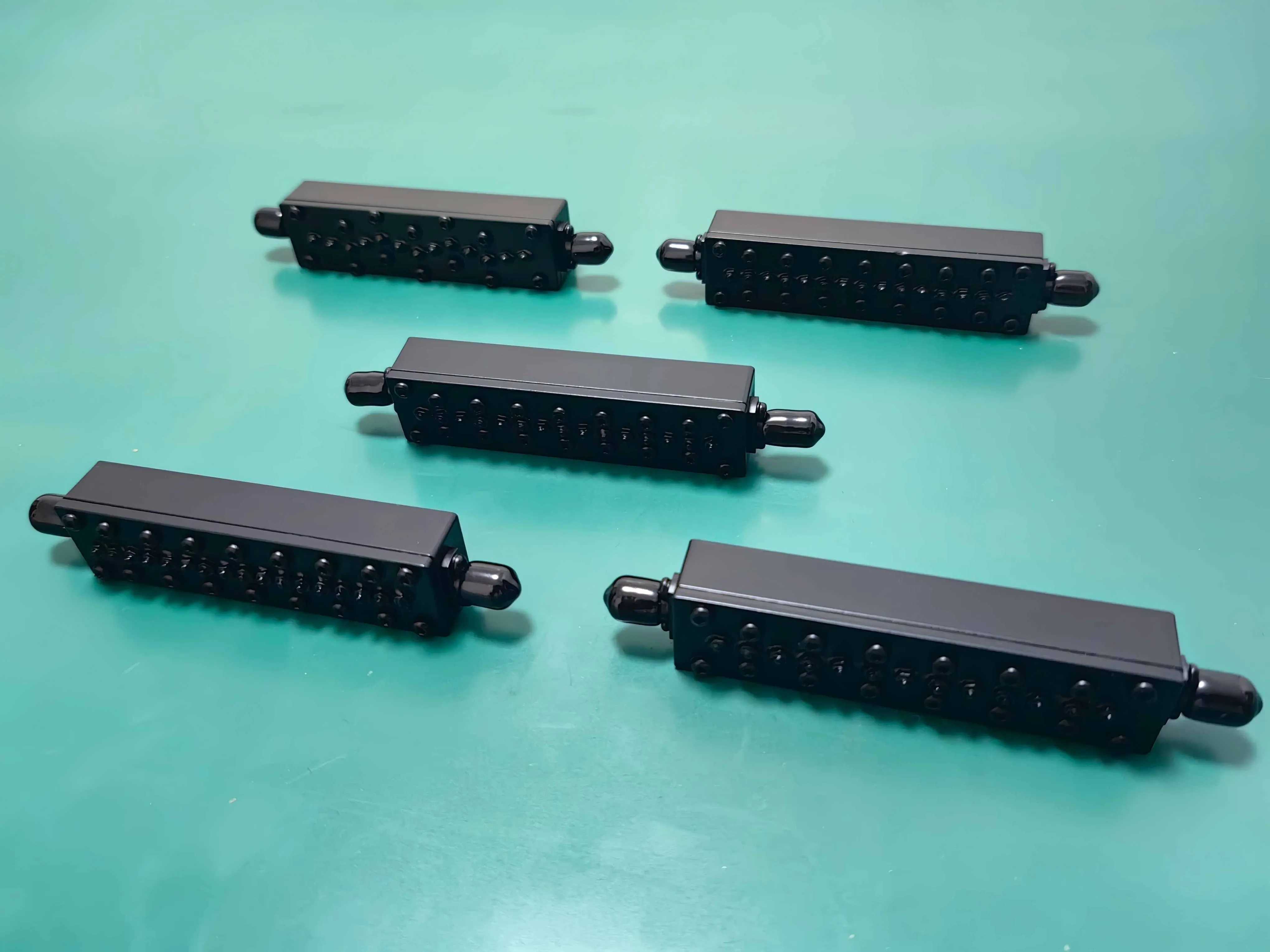
This is not a hypothetical. It happened on a real order—five custom coaxial bandpass filters, each with different center frequencies, all sharing the same tight constraints: insertion loss had to stay low and out-of-band rejection needed to hit 60 dB minimum. The filters were already in production when the first curveball arrived.
First, the Normal Part
The inquiry came in through the website. Five filter specs, each a variation on a theme—different passbands, similar topology. The requirements were clear but not trivial: the combined insertion loss and rejection targets meant the resonator count and coupling structure had to be right on the first or second iteration. No third chances without blowing the timeline.
The engineering team ran EM simulations and sent back S-parameter predictions within two days. The customer reviewed them, flagged a few concerns about the upper band-edge roll-off on two of the five units, and we went through a second design round to tighten the coupling. By the end of the second review, both sides were aligned. Production started.
Then, the "Small Request"
Halfway through the build, the customer emailed with what they called "just a quick question." Could we sweep the filters out to 25 GHz instead of stopping at 20 GHz? They wanted to see the stopband behavior further out—there was a concern about harmonic content from an adjacent stage in their system.
Anyone who has designed a cavity filter knows this is not a small ask. The physical dimensions—cavity depth, iris width, tuning screw penetration—were already fixed. You cannot re-machine a part that is already machined. You measure what you have and hope the margins you built into the original design are enough.
When the test data came back, the results were better than expected. Across all five units, the 20–25 GHz stopband performance held up—insertion loss stayed within a few tenths of a dB of the in-band spec, and rejection showed no unexpected degradation. The customer asked us to update the formal specification document to reflect 25 GHz capability going forward. What started as a "quick question" became the new baseline.
The Thing Nobody Planned For
With testing done, the filters went through thermal cycling and accelerated aging. Electrically, everything passed. But when we pulled them out of the chamber, the silver-plated connector bodies had yellowed noticeably around the mating surfaces.
Let me be clear about what this means—and what it does not mean. Silver tarnish is silver sulfide. It forms when atmospheric sulfur compounds react with the silver surface, and heat speeds it up. It looks bad. But electrically, it is irrelevant: the contact force of an RF connector pushes straight through the sulfide layer, and conductivity remains unchanged. Stäubli's own technical documentation on silver-plated connectors makes the same point—tarnish is cosmetic, not functional.
Still, the customer was not happy with the appearance, and frankly, neither were we. If you are paying for a precision RF component, you should not have to explain to your own team why the connectors look aged before they are even installed.
We proposed adding a protective paint coating over the housing—fully covering the connectors—at no extra charge. This was not in the original quote, but it solved two problems at once: it restored the visual quality and added a genuine environmental barrier against humidity and handling wear. The filters were re-tested after painting, re-photographed, and the full data package went to the customer.
Why This Matters If You Are on the Buying Side
The global RF filter market is worth over USD 17 billion in 2025 and growing at roughly 17% CAGR (Intel Market Research, 2025), driven by 5G rollout, satellite constellations, and defense modernization. There is no shortage of manufacturers. What is harder to find is a supplier that absorbs scope changes without padding the lead time or walking away from problems that fall outside the original statement of work.
In this case, despite the extended testing, the repainting, and the re-testing, the filters shipped on time. They landed before the customer's integration deadline. That is what actually matters—not the marketing copy.
If you are sourcing custom filters and want to avoid surprises, here is what I would suggest: ask your supplier upfront how they handle mid-production changes. Not in the abstract—ask for a real example. The answer will tell you more than any datasheet.
Questions Engineers and Buyers Often Ask
Q: What is a realistic lead time for a custom coaxial bandpass filter?
For a typical multi-section coaxial BPF with standard connector interfaces, expect 4–8 weeks from final spec approval to shipment. Simple designs can ship in 2–3 weeks. The biggest variable is not machining time—it is how many design iterations are needed to converge on the target S-parameters. A supplier that gets it right in one or two simulation rounds will beat one that needs four.
Q: How much insertion loss is "too much" for a coaxial BPF?
It depends on what comes after the filter. Every dB of IL becomes heat. At 10 W, 1 dB IL means roughly 2 W dissipated inside the filter—manageable. At 100 W, that same 1 dB becomes 20 W, and now you need to think about thermal rise, connector rating, and long-term drift. Narrowband filters (below 5% fractional BW) often run 2–4 dB IL. Wideband designs can go below 1 dB. Always confirm the IL spec is quoted at your operating temperature, not just 25°C on a benchtop.
Q: Can a coaxial bandpass filter work beyond its specified frequency range?
Sometimes. If the design has conservative coupling margins and no structural spurious modes close to the upper band edge, you may get usable performance 10–20% beyond the nominal upper cutoff. But this is never guaranteed—it depends on the specific topology, the resonator geometry, and how hard the original design was pushed. The only way to know is to measure it. Do not count on it unless the test data is in your hands.
Q: Does silver plating tarnish affect RF connector performance?
No—electrically, silver tarnish is a cosmetic issue. The sulfide layer that causes yellowing is thin (nanometer to sub-micron scale) and the mating force of RF connectors penetrates it without measurable change to insertion loss or VSWR. This is well-documented by connector manufacturers including Stäubli. However, if the appearance matters for your end customer or your internal quality standards, a protective paint or conformal coating eliminates it entirely.
Q: What should I ask a custom filter supplier before placing an order?
Three things. One: ask for S-parameter simulation data before production—not a generic plot, but the simulation for your exact specs. Two: ask what happens if you need to change a parameter mid-build. A good supplier will tell you honestly what is feasible and what is not, without overpromising. Three: ask whether full test data (not just a pass/fail sheet) is included with shipment. If the answer to any of these is vague, keep looking.
Q: Is there a price break between custom and off-the-shelf coaxial filters?
At low volumes (1–10 units), off-the-shelf filters are usually cheaper because the NRE is already amortized. At 50+ units, a custom design can become cost-competitive—or even cheaper—because the BOM, tuning labor, and test time are optimized for your exact spec rather than a general-purpose design. The crossover point depends on complexity. Ask for a volume pricing curve from both approaches before deciding.
Have a Filter Spec That Might Shift? Let's Talk About It Honestly.
Send your requirements and we will tell you what is realistic—not what sounds good in a quote.
Contact Our Engineering Team