
Why Are Waveguides Preferred Over Coaxial Cables in Microwave and Satellite Systems?
Why use waveguides instead of coaxial cables? Discover how waveguides offer ultra-low loss and high power handling for microwave, 5G, and satellite systems.
Why Are Waveguides Preferred Over Coaxial Cables in Microwave and Satellite Systems?
If you are an RF engineer designing a new satellite earth station, or a procurement manager sourcing components for a 5G telecommunications network, you face a critical architectural decision early in the project: Should you use coaxial cables or waveguides to transmit your high-frequency signals?
For lower frequencies, coaxial cables are the undisputed champions of convenience. They are flexible, relatively inexpensive, and easy to route through complex system enclosures. However, as the global demand for bandwidth explodes—driven by the rapid expansion of Low Earth Orbit (LEO) satellite constellations, 5G mmWave deployments, and advanced UAV data links—operating frequencies are pushing higher into the Ku, K, and Ka bands.
At these microwave and millimeter-wave frequencies, traditional coaxial cables begin to fail. They suffer from severe signal attenuation, overheating, and power limitations. This is exactly where waveguides step in to save the day.
But why exactly are waveguides used in microwave and satellite systems? What makes this rigid, hollow metal pipe superior to a flexible cable? In this comprehensive guide, we will explore the physics, the practical engineering benefits, and the cost-saving strategies you need to know when specifying RF components for your next project.
The High-Frequency Dilemma: Why Coaxial Cables Fall Short
To understand the value of a waveguide, we must first understand the limitations of a coaxial cable. A standard coaxial cable consists of a solid center conductor, surrounded by a dielectric insulator, a metallic shield, and an outer jacket.
When transmitting low-frequency signals (like VHF or UHF), this design works perfectly. But as you move into microwave frequencies (typically above 3 GHz, and especially above 10 GHz), two major physical phenomena begin to destroy your signal:
- The Skin Effect: At high frequencies, alternating current tends to flow only on the outer surface (the "skin") of the center conductor. This drastically reduces the effective cross-sectional area of the wire, causing electrical resistance and signal loss to skyrocket.
- Dielectric Loss: The insulating material (dielectric) between the center pin and the outer shield absorbs electromagnetic energy at high frequencies, converting your precious RF signal into useless heat.
3 Core Reasons Why Waveguides Dominate Microwave Systems
A waveguide eliminates the center conductor and the solid dielectric entirely. It is simply a hollow metallic tube (usually rectangular or circular) that confines and guides electromagnetic waves through the air (or a pressurized gas) inside it. This fundamental design difference provides three massive advantages.
1. Ultra-Low Insertion Loss
Because a waveguide uses air as its dielectric, dielectric loss is virtually zero. Furthermore, without a thin center conductor, the "skin effect" occurs over the massive inner surface area of the waveguide's broad and narrow walls. This results in an incredibly low resistance path for the electromagnetic wave. In satellite communications and radar systems, where every fraction of a decibel (dB) matters, waveguides ensure that the maximum possible signal reaches the antenna.
2. Massive Power Handling Capabilities
In defense radar, medical linear accelerators, and satellite uplinks, transmitters often push hundreds or even thousands of watts of RF power. If you push that much power through a coaxial cable at high frequencies, the thin center conductor will literally melt, and the dielectric will break down, causing catastrophic arcing and system failure.
Waveguides, being robust metal structures with large internal volumes, can handle exponentially higher power levels. The risk of voltage breakdown (arcing) is drastically reduced, making them the only viable choice for high-power microwave transmission.
3. Complete Shielding and High Isolation
In dense RF environments—such as 5G base stations or EMC (Electromagnetic Compatibility) testing chambers—interference is a major concern. The thick metal walls of a waveguide provide 100% shielding. No external signals can leak in to corrupt your data, and no internal signals can leak out to interfere with adjacent equipment. This level of isolation is nearly impossible to achieve with standard braided coaxial cables.
Waveguide vs. Coaxial Cable: A Quick Comparison Guide
To help procurement teams and system integrators make quick decisions, here is a side-by-side comparison of waveguides and coaxial cables in industrial applications.
| Feature | Coaxial Cable | Waveguide |
|---|---|---|
| Optimal Frequency Range | DC to ~18 GHz (High-end up to 65GHz but with high loss) | ~1 GHz to 100+ GHz (Excellent for Ku, K, Ka bands) |
| Insertion Loss (Attenuation) | High at microwave frequencies | Extremely Low |
| Power Handling | Low to Moderate (Prone to melting/arcing) | Extremely High (Ideal for radar and satcom) |
| Physical Flexibility | High (Easy to bend and route) | Rigid (Requires precise mechanical planning) |
| Bandwidth | Broadband (Operates from DC upwards) | Band-limited (Acts as a high-pass filter) |
Bridging the Gap: Coaxial-to-Waveguide Adapters
It is important to note that modern RF systems rarely use waveguides exclusively. Most signal generation and processing equipment (like network analyzers, transceivers, and SDRs) output signals via coaxial connectors (such as SMA, N-Type, or 2.92mm).
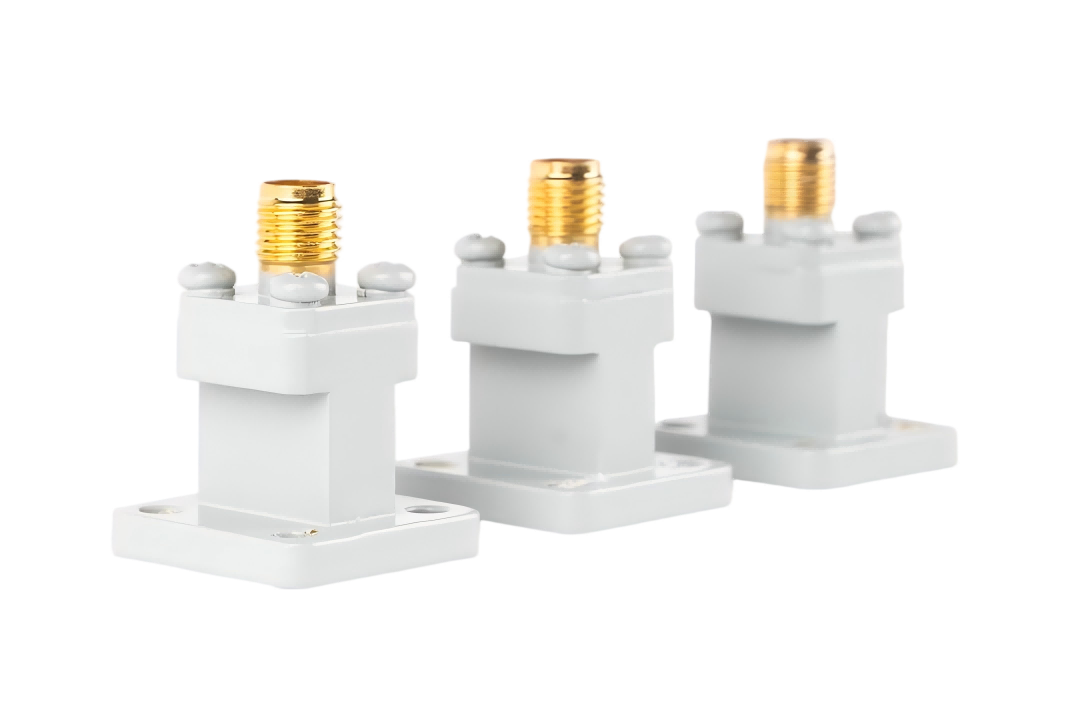
To integrate these systems, engineers rely on precision waveguide to coaxial adapters. These critical components act as the electromagnetic bridge, taking the signal from the flexible coaxial domain and launching it efficiently into the low-loss waveguide domain for transmission to the antenna.
However, system integration often comes with severe mechanical space constraints. While standard right-angle adapters are common, densely packed systems—such as UAV payloads, phased array radar modules, or compact 5G transceivers—often require end-launch waveguide to coaxial adapters. These in-line configurations allow the coaxial cable to run parallel to the waveguide, saving critical space while maintaining a flawless impedance match. Sourcing high-quality adapters is crucial, as a poorly machined transition will introduce VSWR spikes and ruin the efficiency of your entire waveguide run.
The "Aerospace-Grade" Myth: How to Optimize Your BOM Costs
While the technical superiority of waveguides at high frequencies is clear, many procurement managers hesitate to specify them due to perceived high costs. There is a common misconception in the industry that all waveguides must be manufactured to ultra-expensive "aerospace-grade" tolerances.
This is a budget-killing trap.
Unless your component is being bolted onto a satellite and launched into deep space, you likely do not need to pay the premium for aerospace-grade certification. For the vast majority of terrestrial applications—including commercial satellite earth stations, 5G telecom towers, UAV ground control stations, and EMC testing facilities—high-quality industrial-grade waveguides are the perfect solution.
At AO Microwave, we specialize in bridging this gap. We manufacture premium industrial-grade waveguides, horn antennas, and RF coaxial components tailored for the telecom, defense, and commercial satellite sectors. We help our clients in Europe and the Americas slash their Bill of Materials (BOM) costs without sacrificing a single decibel of system reliability.
Conclusion: Making the Right Choice for Your RF Architecture
In the world of microwave and satellite systems, the choice between coaxial cables and waveguides comes down to frequency, power, and efficiency. While coax offers flexibility, waveguides are the undisputed choice for minimizing insertion loss, maximizing power handling, and ensuring signal integrity at high frequencies.
More importantly, optimizing your system doesn't have to mean blowing your budget. By partnering with a reliable manufacturer of industrial-grade RF components, you can achieve world-class performance while keeping your supply chain agile and cost-effective.
Ready to Upgrade Your RF System Architecture?
Don't let high-frequency signal loss or overpriced components compromise your next project. Whether you need standard rectangular waveguides, custom coaxial-to-waveguide adapters, or high-performance horn antennas, AO Microwave is here to help.
Contact our engineering sales team today for a technical consultation, a custom quote, and discover how our industrial-grade solutions can optimize your BOM and accelerate your time-to-market.