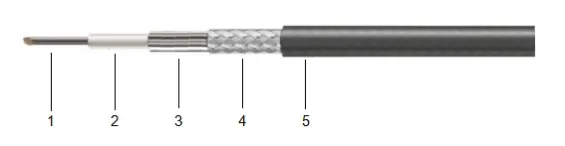
CA Series: Ultra Low Loss & Amplitude/Phase Stable Flexible Coaxial Cable
CA Series Coaxial Cable is engineered for high-precision RF and microwave measurement systems requiring extremely low insertion loss and exceptional amplitude and phase stability. This high-performance RF cable assembly is widely used for vector network analyzer testing, antenna measurement systems, radar electronics, satellite communication equipment and 5G mmWave RF test environments where stable signal transmission and repeatable measurement accuracy are essential.
Ultra Low Loss & Amplitude/Phase Stable Flexible Coaxial Cables
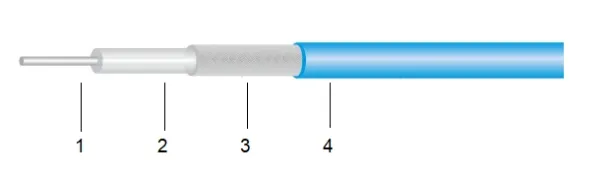
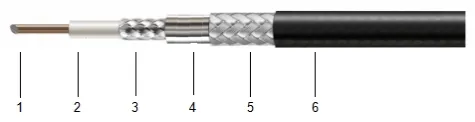
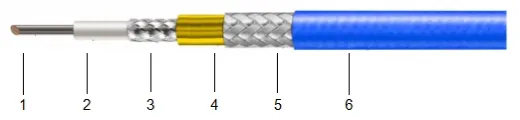
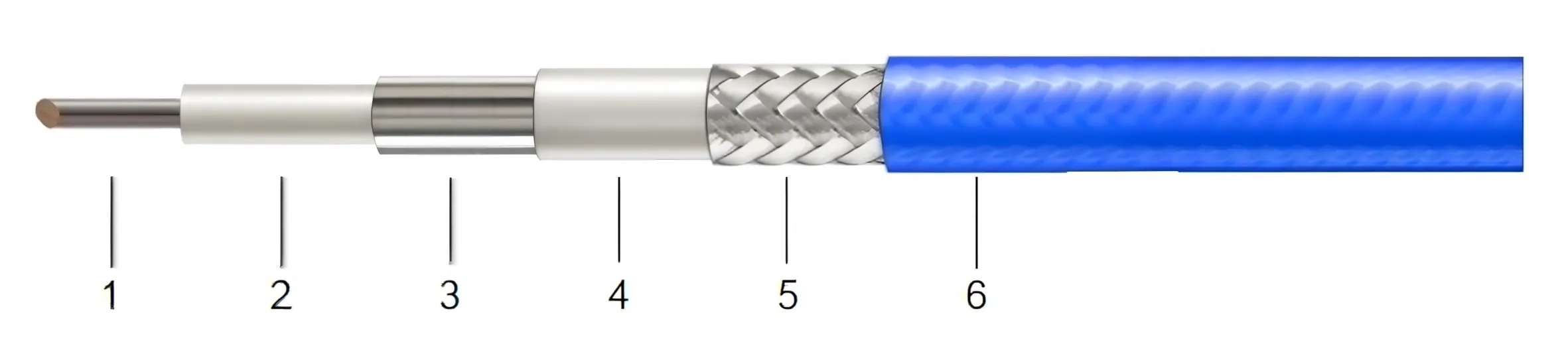
AO Microwave’s newly upgraded CA Series flexible coaxial cables are engineered for high-precision RF, microwave, and millimeter-wave systems requiring extremely low insertion loss and exceptional amplitude and phase stability under flexure. Operating up to 67 GHz, these premium cable assemblies utilize an advanced, low-density expanded microporous PTFE (ePTFE) dielectric to achieve a high velocity of propagation (Vp) of typically 80% to 83%. To guarantee superior shielding effectiveness (>90 dB) and stable electrical performance, the core is wrapped with a helically wound silver-plated copper tape shield, overlaid with a silver-plated copper wire outer braid.
To satisfy diverse mechanical routing, power handling, and extreme phase-tracking requirements, the newly iterated CA Series is divided into three distinct sub-series:
- Standard High-Flexibility Series (CA150, CA200, CA300, CA360, CA400, CA480, CA500): Features a compact outer diameter (1.50mm to 5.00mm) paired with high flexibility. This sub-series is optimized for tight-radius internal cabinet routing, high-density system integrations, and precise laboratory patch leads.
- High-Power & Ultra-Low Attenuation Series (CA550, CA600, CA750, CA760s, CA800, CA810, CA830, CA1000, CA1200): Designed with larger physical outer diameters (up to 12.00mm) and thick, highly conductive silver-plated copper center pins. It is engineered to handle high average power and deliver minimum signal attenuation over long transmitter runs and antenna feeds.
- Ultra-Phase-Stable "W" Series (CA360W, CA400W, CA480W, CA500W, CA750W): Features an additional intermediate layer made of premium Low-Density PTFE (LD-PTFE) on top of the standard CA construction. This specialized LD-PTFE layer functions as both an electrical and mechanical buffer, significantly reducing dielectric deformation during movement and ensuring superior phase stability and low phase drift under mechanical bending.


CA Series Coaxial Cable Selection & Engineering Guidelines
When choosing the optimal CA Series coaxial cable for your high-frequency layout, balancing physical flexibility, maximum average power, and out-of-band insertion loss constraints is critical:
Understanding Cable Outer Diameter (OD)
The numerical designation in our model numbers represents the outer diameter in hundredths of a millimeter (e.g., CA150 is 1.50 mm OD, while CA1200 is 12.00 mm OD). Smaller diameter cables like CA150/CA200 offer extreme flexibility but exhibit higher insertion loss, making them suitable for short jumpers. Larger models like CA1000/CA1200 maximize conductor surface area, delivering ultra-low attenuation for high-power long runs.
Selecting Phase-Stable "W" Versions
For applications with strict phase-tracking requirements, such as multi-channel array systems and VNA test ports, standard flexible cables are highly susceptible to phase drift when bent. Our "W" series (such as CA400W or CA750W) integrates an additional low-density PTFE intermediate layer, which acts as a stable mechanical buffer to prevent concentricity shifts and secure superior phase stability.
Overcoming Key RF & Millimeter-Wave Design Pain Points
Modern RF systems face tight phase, amplitude, and insertion loss budgets. We optimize our CA Series cables to eliminate common installation bottlenecks:
Dampening the "PTFE Phase Knee" Drift
Solid PTFE dielectrics undergo a molecular phase transition around 19°C (the PTFE knee), causing a sharp change in electrical length and phase drift during thermal cycling. AO Microwave’s CA Series utilizes an advanced expanded microporous PTFE (ePTFE) dielectric. This porous air-and-polymer matrix dampens this phase transition, flattening the phase-temperature curve to <500 ppm across a wide -55°C to +125°C range.
Preventing Mechanical Torque at Connector Junctions
In flexible cable runs, repeated bending can exert severe mechanical torque at the connector-to-cable boundary, shearing internal contacts and causing VSWR spikes. AO Microwave combats this physical stress by incorporating ruggedized strain relief boots and direct-solder inner conductor joints. This design distributes bending forces evenly and prevents connector pull-off.
Eliminating Microphonic Noise under Vibration
Under high vibration (such as airborne radar setups), friction between the outer copper braid and the dielectric can generate electrostatic static charges (microphonic noise), disrupting signal reception. Our CA Series uses tightly bound double-shielded copper tape and braids, minimizing internal friction and ensuring stable amplitude and low noise floor under vibration.
Target Applications & Operational Advantages
By combining ultra-low attenuation with consistent phase and amplitude stability, our CA Series flexible cables secure critical signal paths:
High-Precision VNA Test Benches
Function: Connects devices under test (DUT) to Vector Network Analyzers and high-frequency test receivers up to 67 GHz.
Advantage: The "W" series with its specialized low-density PTFE intermediate layer delivers superior phase-temperature and phase-bend stability, preventing calibration drift under continuous movement.
Phased Array Radar Systems
Function: Connects multi-channel antenna arrays to active transceiver modules in scanning radars.
Advantage: Exceptional phase tracking of the phase-stable "W" series (e.g., CA360W, CA400W) prevents phase mismatch between channels, securing accurate beam steering.
Active Satellite Ground Stations
Function: Routes high-frequency transmit and receive signals in portable Satcom terminals and outdoor runs.
Advantage: Symmetrical double-shielded outer wire braids provide high shielding effectiveness (>90 dB) to prevent cross-talk, while large-diameter models (CA1000/CA1200) handle high average power.
CA Series Coaxial Cable FAQs
Need high-performance CA Series Coaxial Cables?
Specify your connector interface (N/SMA/3.5mm/2.92mm/2.4mm), required size (CA150 to CA1200), overall length, and armoring — we'll quote in 24 hours.