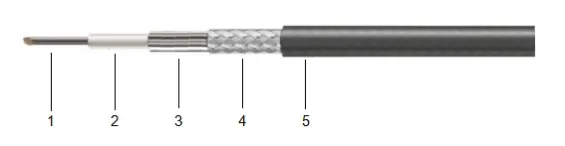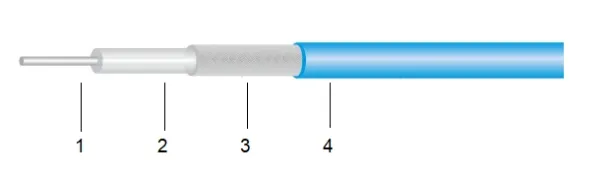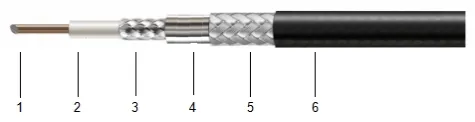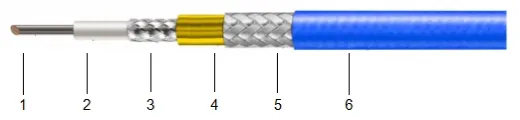
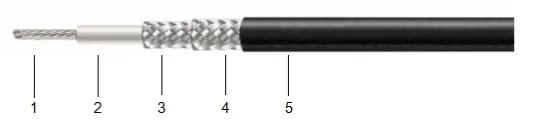
CJ Series: Multicore Low Loss Flexibile Coaxial Cable
Struggling with stiff cables causing connector damage in mobile radio systems? AO Microwave’s CJ Series multicore low-loss flexible coaxial cables are the solution. Pairing stranded silver-plated copper conductors with PTFE dielectrics, they offer superior flexibility and high velocity of propagation (81-82%) up to 18 GHz. With a 90 dB shielding effectiveness and PUR jackets (OD 5.00mm to 10.00mm), they prevent joint stress and handle harsh environments. Ideal for radio equipment.
Multicore Low Loss Flexible Coaxial Cables for Mobile & Radio Systems
Are you experiencing connection failures caused by stiff cables pulling on delicate board-level connectors? Or struggling with signal attenuation and shielding leakage in mobile radio transceivers? AO Microwave’s CJ Series multicore low-loss flexible coaxial cables are engineered to eliminate these mechanical and electrical challenges, offering a highly supple and durable RF routing solution up to 18 GHz [1.1.1].
By utilizing multi-strand conductors and high-velocity dielectrics, the CJ Series delivers direct, tangible benefits to your active radio and mobile platforms:
- Protect Delicated Connectors from Mechanical Strain: Fabricated with a stranded silver-plated copper center conductor. This multi-core design provides exceptional flexibility, allowing the cable to route effortlessly and eliminating the tension that can damage PCB-mounted connectors.
- Low Insertion Loss with High Velocity of Propagation: Features an advanced dielectric core that achieves a high velocity of propagation (Vp) of 81% to 82%. This provides remarkably low signal attenuation for a flexible stranded cable, maximizing transmitter power efficiency.
- Exceptional Electro-Magnetic Isolation (>90 dB): Protected by a double silver-plated copper wire braided shield. This dual-layer configuration provides over 95% optical coverage, blocking external EMI and ensuring clean signal paths in multi-channel systems.
- Long-Term Reliability in Harsh Environments: Housed in highly durable Polyurethane (PUR) jackets that resist UV radiation, weathering, and physical abrasion across a wide -40°C to +85°C range.
Review our detailed physical parameters and attenuation tables below to find the exact CJ Series jacket fit (from 5.00 mm for CJ500 to 10.00 mm for CJ1000) optimized to simplify your next complex system layout.

CJ Series Coaxial Cable Selection & Engineering Guidelines
When routing high-frequency coaxial lines into dynamic vehicle mounts, radio equipment bays, or mobile terminals, planning for physical softness and transmission efficiency is essential:
Matching Cable OD with Routing Spaces
The outer diameter (Jacket OD) of the CJ Series corresponds directly to its physical sizing in millimeters (ranging from 5.00 mm for CJ500 to 10.00 mm for CJ1000). For tight-space mobile applications, the thin profile of CJ500 provides high flexibility, while larger models like the 10.00 mm CJ1000 offer lower attenuation for long-distance runs.
Managing Mechanical Bending Limits
Bending a coaxial cable tightly can put stress on its physical components. Adhere to our specified static and dynamic bending limits. For permanent, fixed layouts, respect the static bend radius (e.g., 20 mm for CJ500 up to 50 mm for CJ1000). For dynamic, continuous-motion applications, use the dynamic bend limits (50 mm for CJ500 and 100 mm for CJ1000) to ensure a long mechanical lifespan.
Overcoming Critical Environmental & Physical Challenges
Mobile equipment and telecommunications transceivers operate under strict mechanical and environmental constraints. We optimize our CJ Series to resolve common integration bottlenecks:
Preventing Solder Joint Stress and Connector Shear
Standard solid-core cables are physically stiff, transferring bending stress directly to the connector's internal solder joints. During repeated movement or routing, this stress can shear the joint, causing physical failures. Our CJ Series resolves this by using an ultra-soft stranded silver-plated copper inner conductor. This multi-strand core absorbs mechanical flexing forces, preventing tension from pulling at your connector joints.
Withstanding Tough Field Environments
Outdoor coaxial runs are subjected to continuous solar radiation, humidity, and wide temperature swings. Standard jackets can crack under these conditions. AO Microwave's CJ Series is encased in highly rugged, UV-resistant Polyurethane (PUR) jackets. Operating reliably from -40°C to +85°C, PUR resists abrasion and weathering, protecting your hardware from expensive field downtime.
Target Applications & Operational Advantages
By providing low insertion loss, high shielding, and excellent flexibility, our CJ Series communication cables secure critical RF links:
Mobile Device & Vehicle Antennas
Function: Routes high-frequency GPS, cellular, and telematic antenna feeds through vehicle chassis structures.
Advantage: Symmetrical multi-strand design provides excellent flexibility (static bend down to 20 mm for CJ500), absorbing continuous road shocks without structural fatigue.
Radio Equipment Transmission Feeds
Function: Connects transceiver sub-assemblies to RF power amplifiers and filters in cabinet racks.
Advantage: Exceptional shielding effectiveness (>90 dB) prevents mutual electromagnetic interference (EMI) between adjacent cable runs.
Active System Interconnections
Function: Connects intermediate frequency (IF) and RF signals in space-limited base stations.
Advantage: High propagation velocity of 81%-82% ensures stable signal transit times and low phase noise floor.
CJ Series Coaxial Cable FAQs
Need high-performance, low-loss CJ Series Coaxial Cables?
Specify your required size (CJ500 to CJ1000), connector interfaces (SMA/Type N), overall length, and application — we'll quote in 24 hours.