
How to Choose the Right Waveguide Circulator for High-Power RF Systems
High-power waveguide circulator selection: peak vs average power, insertion loss, cooling methods, load sizing, flange compatibility, altitude derating. 10-point checklist with engineering rules.
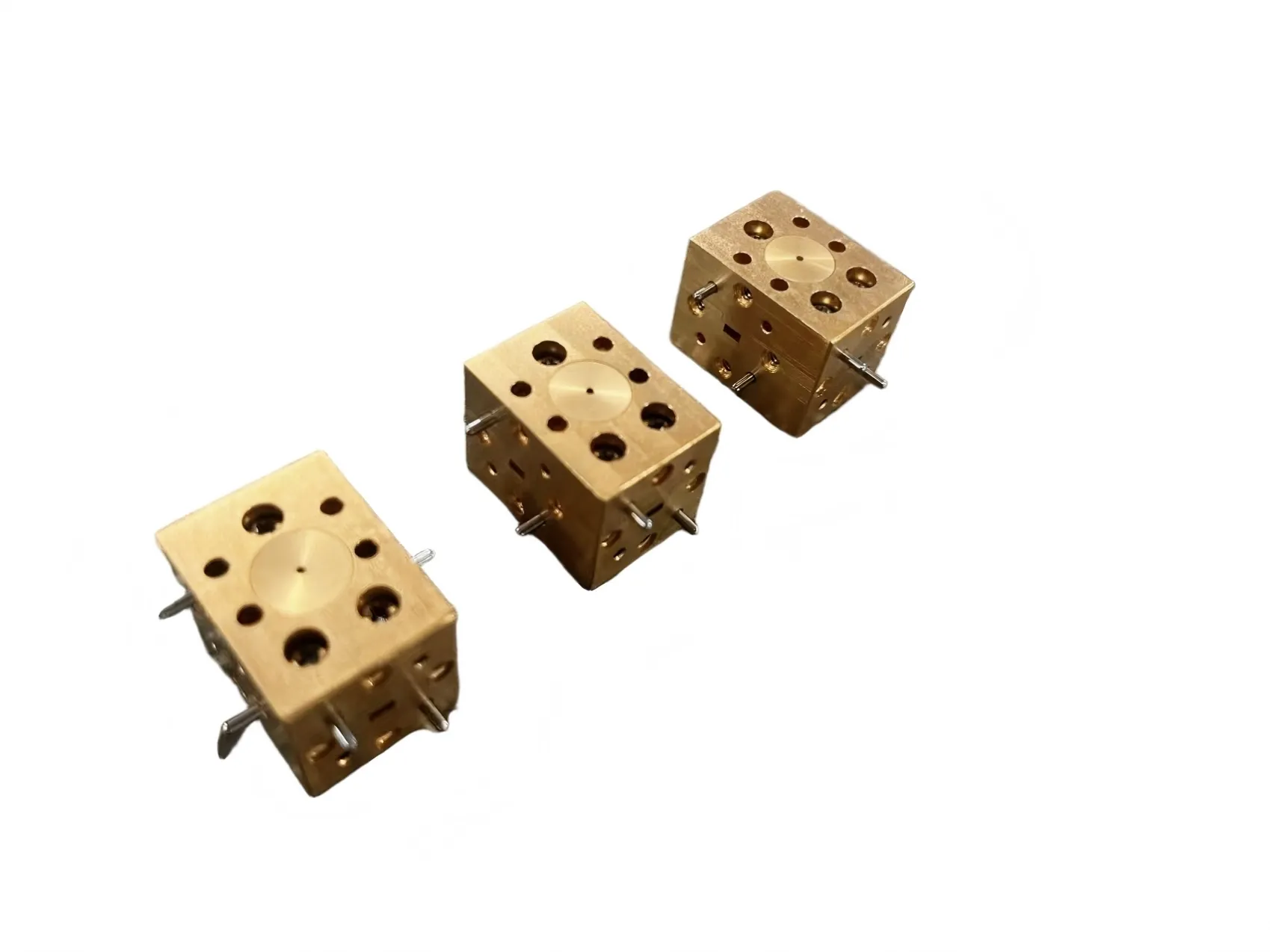
How to Choose the Right Waveguide Circulator for High-Power RF Systems
Selecting a waveguide circulator for a high-power RF system is not a catalog exercise. At kilowatt and megawatt levels, the margin between "operating within spec" and "catastrophic failure" narrows to a handful of decibels, a few degrees Celsius, or a missing derating factor buried in the application notes. The circulator that works perfectly in a 10 W test bench can arc, overheat, and destroy itself within seconds in a 10 kW transmitter—not because it was defective, but because it was specified incorrectly.
This article presents a structured selection framework for high-power waveguide circulators: the six parameters that dominate the decision, the physical limits that set the ceiling, and the environmental derating factors that turn a robust component into a liability when ignored. Every recommendation is rooted in the governing physics—breakdown voltage, thermal resistance, magnet remanence—so that the reasoning travels with you beyond any single datasheet.
The Six-Parameter Selection Framework
1. Peak Power vs. Average Power: The Most Misunderstood Distinction
No single parameter causes more high-power circulator failures than the confusion between peak and average power ratings. A circulator rated for 1 kW average power does not automatically survive 10 kW peak power—even if the average power is well within spec.
Why peak power kills: The power-limiting mechanism is fundamentally different for peak and average conditions. Average power failure is thermal: the ferrite heats up, the magnet remanence drops, isolation degrades, and the circulator fails gradually. Peak power failure is dielectric breakdown: the electric field strength at the waveguide center exceeds the ionization threshold of the filling medium, and an arc forms in nanoseconds—often before any thermal protection circuit can respond.
In a rectangular waveguide operating in TE10 mode, the peak electric field occurs at the exact center of the broad wall. For standard dry air at sea level, the dielectric breakdown threshold is approximately 3 × 10⁶ V/m (30 kV/cm). The relationship between transmitted power and peak field is:
where a and b are the waveguide broad and narrow dimensions, η is the wave impedance, fc is the cutoff frequency, and Emax is the peak electric field. As frequency approaches the cutoff, power handling drops rapidly. A WR-284 circulator (S-band, 2.6–3.95 GHz) can handle roughly 6–10 MW peak at sea level; a WR-28 version (Ka-band, 26.5–40 GHz) may handle only tens of kilowatts—not because of material differences, but because the smaller cross-section concentrates the same field into a tighter space.
2. Insertion Loss: Every 0.1 dB Matters at Kilowatt Levels
At 10 W, a 0.5 dB insertion loss means 1.1 W dissipated as heat—a rounding error. At 10 kW, 0.5 dB means over 1 kW turned into heat inside the circulator junction. That heat must go somewhere.
Insertion loss (IL) in a waveguide circulator comes from two sources: conductor loss in the waveguide walls and magnetic loss in the ferrite. At high power, ferrite loss dominates—and it is nonlinear. As the ferrite temperature rises, its magnetic linewidth broadens, increasing loss further. This creates a thermal runaway loop: loss → heat → more loss → more heat.
| Forward Power | IL = 0.3 dB | IL = 0.5 dB | IL = 0.8 dB |
|---|---|---|---|
| 1 kW | 67 W heat | 109 W heat | 168 W heat |
| 10 kW | 667 W heat | 1.09 kW heat | 1.68 kW heat |
| 100 kW | 6.67 kW heat | 10.9 kW heat | 16.8 kW heat |
For systems above 500 W average power, target IL ≤ 0.3 dB. For systems above 5 kW, anything above 0.3 dB demands active cooling—and active cooling introduces its own failure modes. The economics favor paying for a lower-loss circulator upfront rather than engineering a cooling system to compensate for a lossier one.
3. Cooling Strategy: Passive, Forced Air, or Liquid
Cooling is not an afterthought appended to the circulator selection—it is a co-decision made at the same time. The cooling method determines the effective power derating curve, the installation footprint, and the maintenance burden.
| Cooling Method | Typical Power Range | Advantages | Risks |
|---|---|---|---|
| Passive (convection/radiation) | Up to 500 W avg | Zero maintenance, no failure points | Ambient temperature directly limits power; derate ~1%/°C above 25°C |
| Forced air | 500 W – 5 kW avg | Simple, well-understood, redundant fans possible | Fan failure = circulator failure within minutes; dust accumulation degrades cooling over time |
| Liquid cooling (water/glycol) | 5 kW – 100+ kW avg | Highest heat removal density; stable junction temperature | Pump failure, leaks, corrosion, freeze risk, coolant chemistry maintenance |
For pulsed systems, the cooling requirement is set by average power, not peak. A radar transmitter delivering 1 MW peak with 0.1% duty cycle produces only 1 kW average—comfortably within forced-air territory. But if the same system operates at 10% duty cycle (100 kW average), liquid cooling becomes mandatory.
4. Termination Load Sizing: The Achilles' Heel
The waveguide load on Port 3 is the most frequently undersized component in a high-power circulator chain. The load dissipates reflected power from the antenna plus any reverse leakage through the circulator itself. At high power, even a well-matched antenna reflects enough to challenge an undersized load.
A correctly sized load must handle worst-case reflected power, not typical. If your antenna's guaranteed return loss is 15 dB (3.2% reflection), a 10 kW forward power means 320 W reflected continuously into the load. The load must be rated for that 320 W with margin—not the 50 W it sees on a good day.
For radar systems, add an additional safety factor: during antenna scan transitions, rotor movement, or ice accumulation on the radome, return loss can degrade by 5–10 dB transiently. A system that normally reflects 3% may momentarily reflect 10–30%. Size the load for that transient condition, or implement a fast-acting waveguide switch to disconnect the transmitter when reflected power exceeds a programmed threshold.
5. Flange Type and Interface Compatibility
At high power, a flange mismatch is not an inconvenience—it is a fire hazard. An air gap of 0.025 mm (0.001 inch) at a flange interface concentrates the electric field at the discontinuity. At 10 kW, this may cause localized heating. At 100 kW, it causes arcing.
The flange ecosystem splits into two major families: EIA cover flanges (UG-type, CPRF/FAP/FBP designations) and IEC grooved flanges (UBR/PDR-type, CPRG/FAM/FBM designations). They are not natively compatible without an adapter—and each adapter introduces an additional flange pair, two more gaskets, and two more potential leakage points.
Standardize around one flange family for the entire waveguide run. If the system crosses from waveguide to coaxial at any point—for example, at the LNA input or after the final power amplifier—select a waveguide to coaxial adapter that matches the flange standard used on the waveguide side. Mismatching a CPRF flange to a UBR adapter creates a mechanical interference that no gasket can seal. Cross-reference flange designations using the Standard Waveguide Flange Cross-Reference Table before placing any order.
6. Environmental Derating: Altitude, Humidity, and Vibration
Datasheet power ratings assume laboratory conditions: 25°C ambient, sea-level pressure, dry air, and a vibration-free mounting surface. Real installations deviate from all four.
Altitude: The breakdown voltage of air decreases with pressure. At 3,000 m (10,000 ft), pressure drops to roughly 70% of sea level, and the peak power handling of an unpressurized waveguide drops proportionally. High-altitude installations—mountain-top repeaters, airborne radars—must either pressurize the waveguide with dry nitrogen or derate peak power by the same factor as the pressure reduction.
Humidity: Moist air has a lower breakdown voltage than dry air. Combined with altitude, the effect is multiplicative. A tropical mountain installation at 2,500 m with 90% relative humidity can see breakdown thresholds drop to 50–60% of the sea-level dry-air value. Pressurization or hermetic sealing is mandatory in these environments.
Vibration: Ferrite is a ceramic. Sustained vibration—shipboard, helicopter, vehicle-mounted—transmits mechanical stress into the ferrite puck through the circulator housing. Shock-isolated mounting brackets and short flexible twistable waveguide sections on each port decouple the circulator from waveguide-run stress while absorbing thermal expansion.
High-Power Circulator Selection Checklist
| # | Check Item | Key Question |
|---|---|---|
| 1 | Peak power | Does the circulator's peak rating exceed the system's peak power at the lowest operating frequency? |
| 2 | Average power | Is the average power rating derated for ambient temperature, altitude, and duty cycle? |
| 3 | Insertion loss | At forward power, how many watts will be dissipated as heat? Can the cooling system remove it? |
| 4 | Isolation | At worst-case frequency and temperature, does isolation meet the receiver protection requirement? |
| 5 | VSWR | Is VSWR ≤ 1.25:1 across the full operating band, including band edges? |
| 6 | Load sizing | Does the termination load's continuous rating exceed worst-case reflected power × 1.5? |
| 7 | Cooling | Is the cooling method (passive/forced air/liquid) specified, and does it account for worst-case ambient? |
| 8 | Flange type | Are all flanges in the waveguide run from the same family (EIA or IEC)? |
| 9 | Altitude | If altitude > 1,500 m, has peak power been derated or waveguide pressurization been specified? |
| 10 | Vibration | Are shock-isolated mounts and flexible waveguide sections specified for high-vibration platforms? |
Frequently Asked Questions
Q: What is the single most common mistake when selecting a high-power circulator?
Specifying average power only and ignoring peak power. A circulator with a 500 W average rating may arc internally at 5 kW peak if the electric field at the narrowest point in the junction exceeds the breakdown threshold. Always specify both peak and average power, and verify the peak rating at the system's minimum frequency.
Q: At what power level does a waveguide circulator need liquid cooling?
Generally, above 5 kW average power, forced air becomes marginal and liquid cooling becomes the preferred approach. Between 3–5 kW, forced air can work with aggressive airflow (>500 CFM) and adequate plenum space. Above 10 kW average, liquid cooling is effectively mandatory. Pulsed systems follow the same threshold based on average power, not peak.
Q: Can I use the same circulator at sea level and at altitude?
Only if derated. The peak power handling of an unpressurized circulator drops approximately in proportion to the pressure reduction. At 3,000 m (roughly 70% of sea-level pressure), peak power handling drops to roughly 70% of the sea-level rating. For installations above 1,500 m, either derate peak power or pressurize the waveguide with dry nitrogen at 0.2–0.5 PSI above the external pressure.
Q: How do I verify that a circulator can handle my system's peak power before buying?
Request the manufacturer's peak power test data for your specific frequency and duty cycle. Reputable manufacturers test high-power circulators in a resonant ring or with a high-power pulsed source and provide S-parameter plots at rated power. A datasheet number without test data is not a guarantee. For mission-critical systems, specify a factory acceptance test at full rated peak power.
Q: Is a bigger waveguide always better for high power?
Up to a point. Larger waveguide (e.g., WR-284 vs. WR-137) handles more peak power because the cross-sectional area is larger, reducing the peak E-field for a given transmitted power. However, larger waveguide has a lower cutoff frequency, which limits high-frequency operation. A WR-284 circulator cannot operate at Ku-band (12–18 GHz) because the cutoff is around 2.08 GHz—modes above cutoff become overmoded. Select the waveguide size that covers your frequency band; within that band, the larger option handles more power.
Q: What is the difference between a circulator rated for "high power" and one rated for "ultra-high power"?
These are marketing terms, not standards, but the industry generally draws a line at 1 kW average power. Below 1 kW is "standard"; 1–10 kW is "high power" (forced air or liquid-cooled); above 10 kW is "ultra-high power" (liquid-cooled, often with water jackets integrated into the circulator housing). Confirm the actual numeric rating in watts, not the marketing label.
Market Context
The global high-power RF amplifier modules market—the systems that drive demand for high-power circulators—was valued at USD 2.4 billion in 2024 and is projected to reach USD 3.3 billion by 2030 at a CAGR of 5.7% (Market Glass, 2025). Defense radar modernization, 5G infrastructure expansion, and satellite communication growth are the primary demand drivers. As amplifiers push into higher power levels, the circulator—the gatekeeper that protects those amplifiers from reflected energy—becomes proportionally more critical. A selection error that causes a 0.3 dB excess insertion loss at 50 kW translates to 3.4 kW of unnecessary heat: enough to require an entirely different cooling architecture.
AO Microwave: High-Power Circulators from 1 GHz to 110 GHz
Every waveguide circulator we manufacture includes full S-parameter data, peak power test results, and a derating curve for your operating environment—not a generic one. We stock circulators across all standard WR sizes with passive, forced-air, and liquid-cooled configurations. Custom designs for non-standard frequencies, extended temperature ranges, and space-qualified applications are standard business. No minimum order. Engineering support from first RFQ through deployment.
Specifying a High-Power Circulator?
Send us your frequency, peak power, average power, duty cycle, and environmental constraints. Our engineering team will provide a technical review and quotation.
Request Technical Review