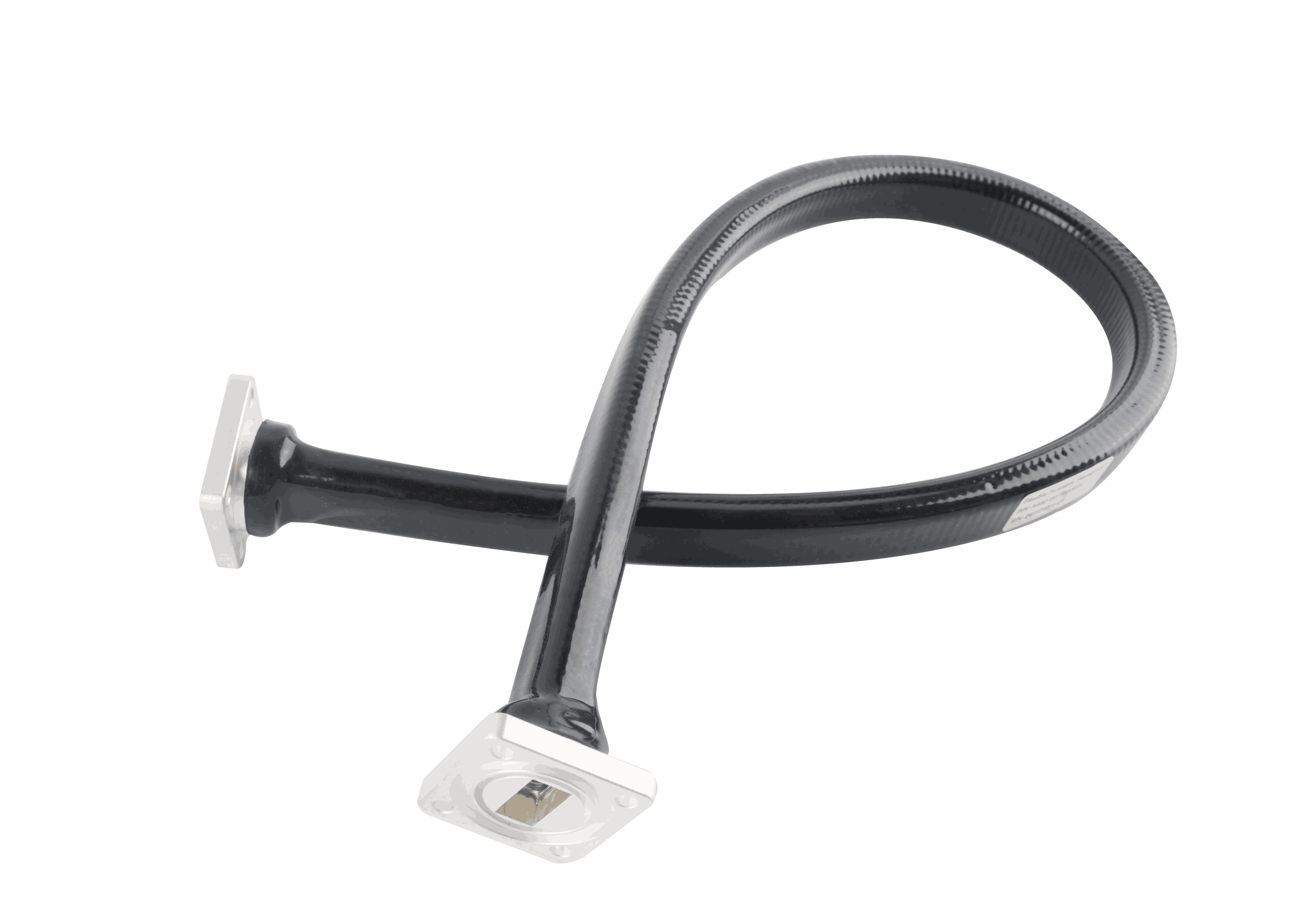
Flexible Twistable Waveguide
Flexible Twistable Waveguide allows mechanical flexibility and twist capability for easy installation in complex microwave systems. Suitable for radar modules, satellite communication equipment, aerospace systems and RF laboratories.
Flexible Twistable Waveguides for Complex Mechanical Routing
AO Microwave’s flexible twistable waveguides are designed to connect misaligned components, allowing for simultaneous bending (E-plane and H-plane) and twisting along the longitudinal axis. Constructed from a helically wound, silver-plated brass or copper alloy strip with a crimped interlocked seam, these guides allow physical flexing without collapsing. Operating up to 40 GHz, our twistable waveguides are protected by a vulcanized, weather-proof neoprene or silicone jacket, delivering a low typical static VSWR of < 1.15:1 and low insertion losses of < 0.3 dB per foot in standard Ka-band configurations.
These flexible guides are critical for isolating mechanical vibrations, compensating for thermal expansion, and enabling movement in rotating radar pedestals and mobile satcom terminals. They provide a versatile routing solution where rigid waveguide runs are impractical.
| Part No | Frequency/GHz | VSWR (Max) | IL dB/m (Max) | Average Power/KW (Max) | Peak Power/MW(Max) | Max Twist Angle deg/m | Bend Radius E/mm (Min) | Bend Radius H/mm (Min) | Flange Type |
|---|---|---|---|---|---|---|---|---|---|
| AO284-WFTXPPC | 2.60-3.95 | 1.1 | 0.11 | 4 | 2.2 | 105 | 206 | 412 | UDR32 |
| AO229-WFTXPPC | 3.30-4.90 | 1.1 | 0.15 | 4 | 1.8 | 105 | 166 | 332 | UDR40 |
| AO187-WFTXPPC | 3.95-5.85 | 1.1 | 0.16 | 3 | 1.4 | 130 | 136 | 272 | UDR48 |
| AO159-WFTXPPC | 4.90-7.05 | 1.1 | 0.18 | 2.5 | 0.6 | 155 | 116 | 232 | UDR58 |
| AO137-WFTXPPC | 5.85-8.20 | 1.1 | 0.25 | 2 | 0.56 | 185 | 100 | 200 | UDR70 |
| AO112-WFTXPPC | 7.05-10.0 | 1.1 | 0.3 | 1.5 | 0.33 | 260 | 82 | 164 | UBR84 |
| AO90-WFTXPPC | 8.20-12.4 | 1.1 | 0.4 | 1 | 0.22 | 315 | 66 | 132 | UBR100 |
| AO75-WFTXPPC | 10.0-15.0 | 1.1 | 0.5 | 0.75 | 0.18 | 365 | 54 | 108 | UBR120 |
| AO62-WFTXPPC | 12.4-18.0 | 1.15 | 0.8 | 0.4 | 0.12 | 445 | 46 | 92 | UBR140 |
| AO51-WFTXPPC | 15.0-22.0 | 1.15 | 1 | 0.2 | 0.085 | 445 | 38 | 76 | UBR180 |
| AO42-WFTXPPC | 17.7-26.5 | 1.2 | 1.2 | 0.1 | 0.045 | 630 | 30 | 60 | UBR220 |
| AO34-WFTXPPC | 22.0-33.0 | 1.2 | 1.5 | 0.085 | 0.031 | 630 | 24 | 48 | UBR260 |
| AO28-WFTXPPC | 26.5-40.0 | 1.2 | 2 | 0.075 | 0.022 | 920 | 20 | 40 | UBR320 |
| AO22-WFTXPPC | 33.0-50.0 | 1.35 | 2.5 | N/A | N/A | 920 | 18 | 38 | UG-383/U |
Flexible Twistable Waveguide Engineering Considerations
Unlike rigid routing lines, flexible twistable waveguides rely on mechanical movement to bridge misaligned layouts. Designers must plan mechanical routing based on physical flex tolerances:
Static vs. Dynamic Bending
Static Bending is utilized for fixed, permanent misalignments where the guide is bent once during installation. Dynamic Bending is required for continuous movement setups (e.g., oscillating gimbals). To prevent material fatigue and failure, dynamic layouts require a much larger minimum bend radius than static configurations.
Understanding Torsional Twisting Limits
Twisting capability is rated as a specific angle limit per physical foot of length. Forcing a twist beyond these rated limits can stress the helically wound seams, which can cause them to separate or gap. This damage leads to RF leakage, increased insertion loss, and a degraded VSWR.
Target Applications & Operational Advantages
By combining dynamic flexibility with consistent RF performance, our flexible twistable waveguides resolve mechanical and signal routing challenges across key industries:
Gimbaled Tracking & Scanning Radars
Function: Connects the stationary microwave transceiver to the continuously tilting or rotating antenna gimbal.
Advantage: Accommodates simultaneous vertical E/H-plane bends and dynamic longitudinal twists, absorbing continuous physical scanning movement without micro-cracking the metal ribbon.
Mobile Satcom Terminals (COTM)
Function: Links vehicle or vessel-mounted tracking dish antennas to low-noise blocks (LNBs) or block upconverters (BUCs).
Advantage: Dampens extreme off-road road shocks and vessel vibrations, absorbing continuous thermal expansions in harsh outdoor conditions to prevent mechanical strain on delicate mating flanges.
Airborne Avionics Assemblies
Function: Routes high-frequency signals inside tight avionics racks and aircraft nose cone radar bays.
Advantage: The lightweight construction of our silver-plated brass/copper ribbon cores combined with flexible silicone jackets allows for tight-radius routing in confined physical spaces without adding excess weight.
Overcoming Critical Twistable Design Challenges
We address the common mechanical and electrical issues frequently discussed by engineers on hardware forums:
Preventing Tube Deformation & Wrinkling during Bending
Bending raw waveguide tubing along its narrow wall puts extreme tension on the outer wall (causing thinning) and high compression on the inner wall (causing wrinkling). Physical deformation distorts the internal rectangular dimensions, leading to high reflection. We utilize precision CNC-controlled bending mandrels and split-block machining to guarantee uniform inner dimensions and a smooth internal finish, preventing VSWR degradation.
Managing Phase and Amplitude Matching
In multi-port radar feed networks or monopulse comparators, any physical path-length deviation in the E-bend alters phase matching between channels. Our production lines utilize automated coordinate measuring machines (CMM) to ensure dimensional repeatability of ±0.03 mm, enabling consistent phase and amplitude balance across multiple units.
Flexible Twistable Waveguide FAQs
Need high-performance Flexible Twistable Waveguides?
Specify your WR size, overall length, flange types, average power and pressure — we'll quote in 24 hours.