
Waveguide Circulator vs Waveguide Isolator: What's the Difference?
Waveguide circulator vs isolator: a side-by-side comparison of physics, specifications, and real-world use cases. Learn which component protects your power amplifier and which routes your signals.
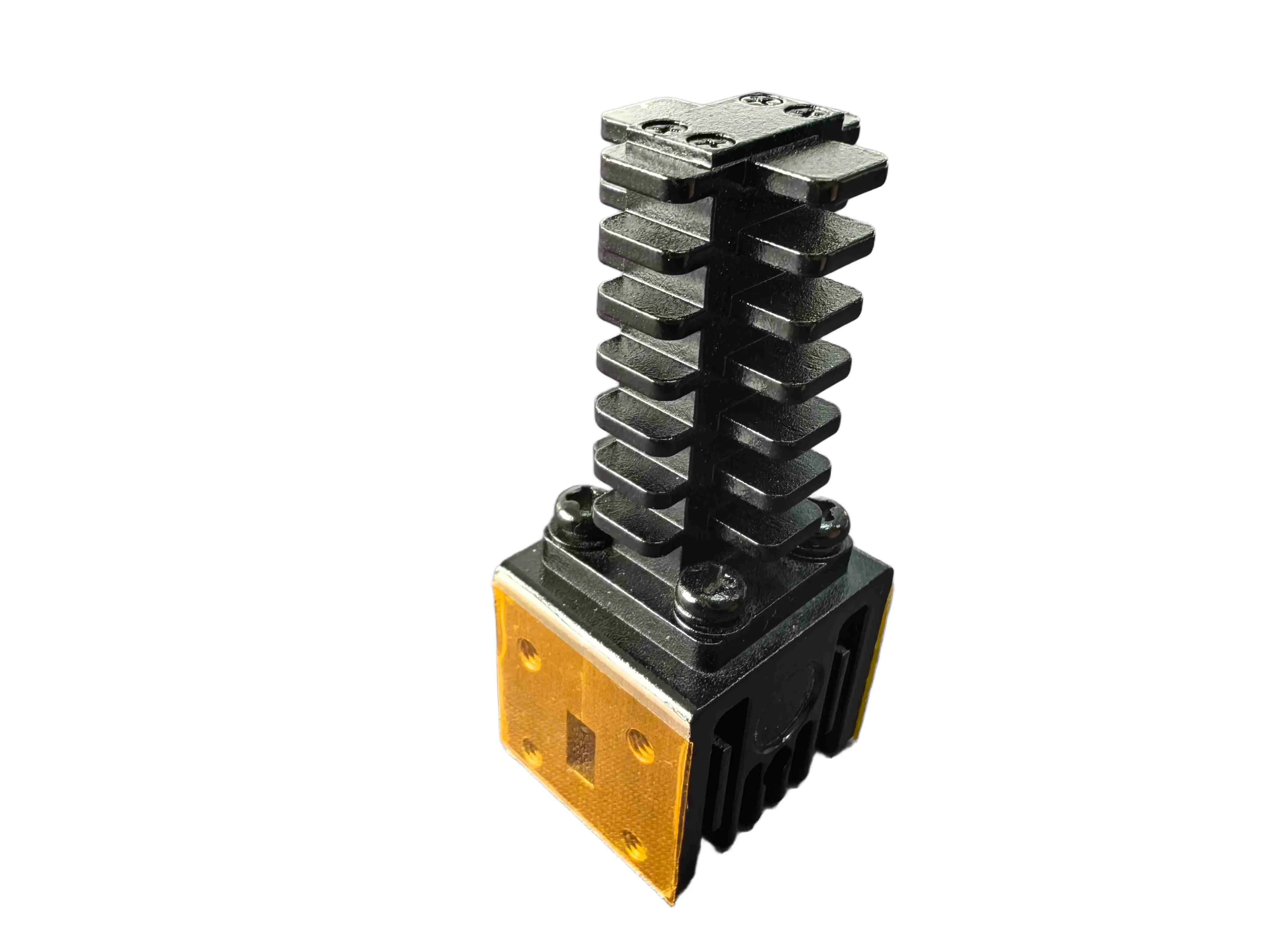
Waveguide Circulator vs Waveguide Isolator: What's the Difference?
Here is a scenario that plays out in RF labs and integration facilities every week: a procurement engineer places an order for a "waveguide isolator," the vendor ships what is technically a circulator with a terminated port, and the receiving team spends hours verifying whether the component matches the system's bill of materials. The confusion is understandable—these two devices share the same ferrite physics, look nearly identical from the outside, and are often used interchangeably in conversation. But mistaking one for the other can cost you isolation margin, add unnecessary insertion loss, or leave a power amplifier unprotected against reflected energy.
This article settles the circulator vs. isolator debate once and for all. We explain the physics that makes both devices possible, compare their specifications side by side, map out exactly when to use each, and answer the most searched questions from engineers on Reddit, Quora, and Google.
What They Are: A Side-by-Side Definition
A waveguide circulator is a non-reciprocal 3-port (or 4-port) ferrite device that routes RF energy in one rotational direction only: Port 1 → Port 2 → Port 3 → Port 1. Any signal attempting to travel in the reverse direction is strongly attenuated. A circulator by itself gives you routing flexibility—you can connect three different subsystems and let the ferrite junction manage the signal flow.
A waveguide isolator is simply a circulator with one port internally terminated by a matched waveguide load. This converts it into a 2-port device. Signals pass from Port 1 to Port 2 with low insertion loss; signals traveling from Port 2 back to Port 1 are absorbed by the internal load and dissipated as heat. The isolator gives you unidirectional protection—it is the RF equivalent of a check valve in plumbing.
How They Work: The Shared Ferrite Physics
Both devices depend on the same underlying principle: non-reciprocal Faraday rotation inside a magnetically biased ferrite puck placed at a waveguide Y-junction. When an RF wave enters the ferrite region, the strong DC magnetic field from permanent magnets causes the spinning electrons in the ferrite to interact with the RF magnetic field, forcing the wave's polarization to rotate. By tuning the ferrite dimensions and bias field strength, engineers create a phase condition where signals from one port combine constructively toward the next port but destructively toward the third—producing the unidirectional circulation.
In a circulator, all three ports are accessible and the user decides what connects to each. In an isolator, Port 3 is permanently terminated with a precision load designed to handle a specified average power—typically 1 W to 500 W, depending on the waveguide size and thermal design.
This shared physics is precisely why procurement mistakes happen: the same ferrite junction assembly can be sold as either product, with the only difference being whether Port 3 exits the housing or terminates inside it. If your datasheet does not explicitly label the device as "circulator" or "isolator," check the number of accessible ports and whether one is internally terminated.
Head-to-Head Specification Comparison
| Parameter | Waveguide Circulator | Waveguide Isolator |
|---|---|---|
| Accessible Ports | 3 (or 4) | 2 |
| Primary Function | Signal routing among ports | Unidirectional transmission + reverse-power absorption |
| Insertion Loss | 0.2–0.5 dB (lower bands) 0.5–1.0 dB (mmWave) |
0.3–0.8 dB (same ferrite junction, slight additional loss from output transition) |
| Isolation | 20–25 dB (single junction) 40+ dB (cascaded) |
20–30 dB |
| VSWR | ≤ 1.2 (input), ≤ 1.3 (output) | ≤ 1.25 |
| Power Handling (avg) | 10 W – 500 W | Limited by termination load power rating |
| Typical Use Case | Duplexer, multi-port routing, test setups | PA output protection, inter-stage isolation |
Sources: RF Essentials, industry datasheets.
When to Use a Circulator vs. When to Use an Isolator
Choose a circulator when:
- You are building a duplexer where a single antenna must handle both transmit and receive simultaneously—connect TX to Port 1, antenna to Port 2, and RX to Port 3.
- You need to route signals between three distinct subsystems, such as a calibration reference, a device under test, and a spectrum analyzer in an automated test bench.
- You are designing a reflection amplifier or other circuit that intentionally uses the third port for signal reinjection.
- Your application requires future expandability—a circulator leaves Port 3 available for adding a receiver or protection limiter later.
Choose an isolator when:
- Your sole objective is to protect a power amplifier from reflected energy. Antenna VSWR can change dynamically due to ice, physical damage, or scanning—an isolator absorbs that reflected power before it reaches expensive GaN or GaAs output transistors.
- You need inter-stage isolation between amplifier gain blocks to prevent oscillation.
- You are building a high-power transmitter chain where multiple amplifiers feed a combiner; an isolator at each amplifier output prevents load-pull interaction.
- Simplicity matters: an isolator is a drop-in 2-port component requiring no additional external termination.
In many real-world systems, both devices coexist. A typical radar front-end uses a circulator as the duplexer at the antenna port and isolators at the output of each driver and final-stage amplifier. Understanding this distinction early in the design phase prevents costly late-stage rework—especially when physical space constraints make it impossible to retrofit a 3-port circulator into a chassis designed for a 2-port isolator.
Common Interface Considerations
Whichever device you choose, the mechanical interface at each port must match the rest of your signal chain. Standard flange types—cover (CPRF/FAP/FBP), grooved (CPRG/FAM/FBM), and choke (FAE/FBE)—are available across EIA and IEC designations. For high-power applications, grooved flanges provide superior RF sealing; for general-purpose test setups, cover flanges are simpler and more common. Above 40 GHz, precision anti-cocking flanges with alignment pins are strongly recommended to prevent microscopic air gaps that cause arcing.
Our Standard Waveguide Flange Cross-Reference Table maps every WR size to its exact flange designation. We also recommend reviewing the manufacturing and RFQ guide for custom waveguide bends, twists, and assemblies that must integrate with your circulator or isolator: Looking for a Custom Waveguide Bend Manufacturer? Complete RFQ Checklist and Spec Guide. And if your system involves complex routing, read Are Hidden Routing Errors Killing Your RF System? to catch common pitfalls before they become field failures.
Frequently Asked Questions
Below are the most-searched questions from engineers on Google—answered directly.
Q: Can I use a circulator as an isolator?
Yes—connect a matched waveguide load to Port 3, and your circulator becomes a functional isolator. The load must be rated for the maximum reflected power you expect. For example, if your transmitter outputs 100 W and antenna return loss is 10 dB (10% reflection), the load must safely dissipate at least 10 W continuous. This approach is common in test labs where swapping a load is faster than procuring a dedicated isolator.
Q: What happens if I skip the isolator entirely?
Reflected power travels directly back into your power amplifier's output stage. At minimum, this degrades linearity and raises the noise floor. At worst—when the antenna presents a near-open or near-short at high power—the reflected energy destroys the amplifier's output transistors instantly. GaN devices, while robust, are not immune. A single high-VSWR event during antenna scanning or icing can cause catastrophic failure. The isolator is cheap insurance: a 0.3 dB insertion loss penalty versus a multi-thousand-dollar amplifier replacement.
Q: Do I need both a circulator and an isolator in the same system?
Very often, yes. In a radar transceiver, the antenna duplexer is typically a circulator (sharing the antenna between TX and RX), while each power amplifier stage uses a dedicated isolator at its output. This layered approach ensures that no single point of failure in the isolation chain can expose a high-power amplifier to destructive reflections. The circulator handles signal routing; the isolators handle protection.
Q: How much insertion loss does each component add to my link budget?
A single-junction circulator typically adds 0.2–0.5 dB at frequencies below 18 GHz, and 0.5–1.0 dB at mmWave bands. An isolator adds roughly the same amount—the terminated port does not meaningfully change forward-path loss. However, in a cascaded chain (circulator + two isolators), the cumulative loss can reach 1.5–3 dB. Always factor this into your link budget early. Every 0.1 dB of insertion loss is 0.1 dB less system dynamic range.
Q: Can I cascade two circulators to get more isolation?
Absolutely. Cascading two circulators (Port 3 of the first feeding Port 1 of the second) approximately doubles your isolation—from ~20 dB to ~40 dB. This is standard practice in high-power SATCOM uplinks and electronic warfare systems where a single 20 dB margin is insufficient. The trade-off is doubled insertion loss and increased physical footprint. When cascading, ensure both circulators share the same flange standard. Refer to our flange cross-reference before ordering.
Q: Are circulators and isolators available with the same flange types?
Yes. Both are manufactured with all standard waveguide flange types—cover, grooved, and choke—across EIA and IEC standards. When ordering, specify the same flange designation you use for the mating component (antenna, amplifier, or waveguide-to-coaxial adapter) to avoid mechanical mismatch. Above 40 GHz, always request anti-cocking flanges with alignment pins to guarantee flush mating and leak-proof RF seals.
Why Source Both from AO Microwave
System integrators, defense contractors, and telecom operators across North America and Europe rely on AO Microwave for industrial-grade circulators and isolators that ship without the 16–24 week lead times of legacy manufacturers:
- Full Band Coverage: 1 GHz to 110 GHz, WR-284 through WR-10, every unit verified on calibrated vector network analyzers.
- Circulator + Isolator + Load in One Order: Specify the exact configuration you need—3-port circulator, 2-port isolator, or circulator with external load for future reconfiguration—and receive matched components from a single source.
- Agile Production: Custom circulators and isolators delivered in weeks, not months, keeping your project timeline intact.
- No Minimum Order: Single prototype to 500-unit production runs. Every component custom-configured to your frequency, bandwidth, flange, and finish.
Conclusion: Know the Difference, Protect Your System
The circulator and the isolator are two faces of the same ferrite physics. The circulator routes; the isolator protects. Confusing the two is a rookie mistake that can cascade into amplifier damage, link budget erosion, and project delays. By understanding the core distinction—three accessible ports vs. two, routing vs. absorption—you can specify the right component for each position in your RF chain with confidence.
With the waveguide circulators and isolators market projected to reach USD 62.8 million by 2032 (IntelMarketResearch, 2025), driven by 5G, defense radar modernization, and satellite megaconstellations, having a supplier that delivers precision components on time is a genuine competitive edge.
Need a Circulator or Isolator? Let's Talk Specs.
Tell us your frequency band, power level, and whether you need a 3-port circulator or 2-port isolator. We'll provide a technical quote with S-parameter data—no obligation, no minimum order.
Contact Our Engineering Team