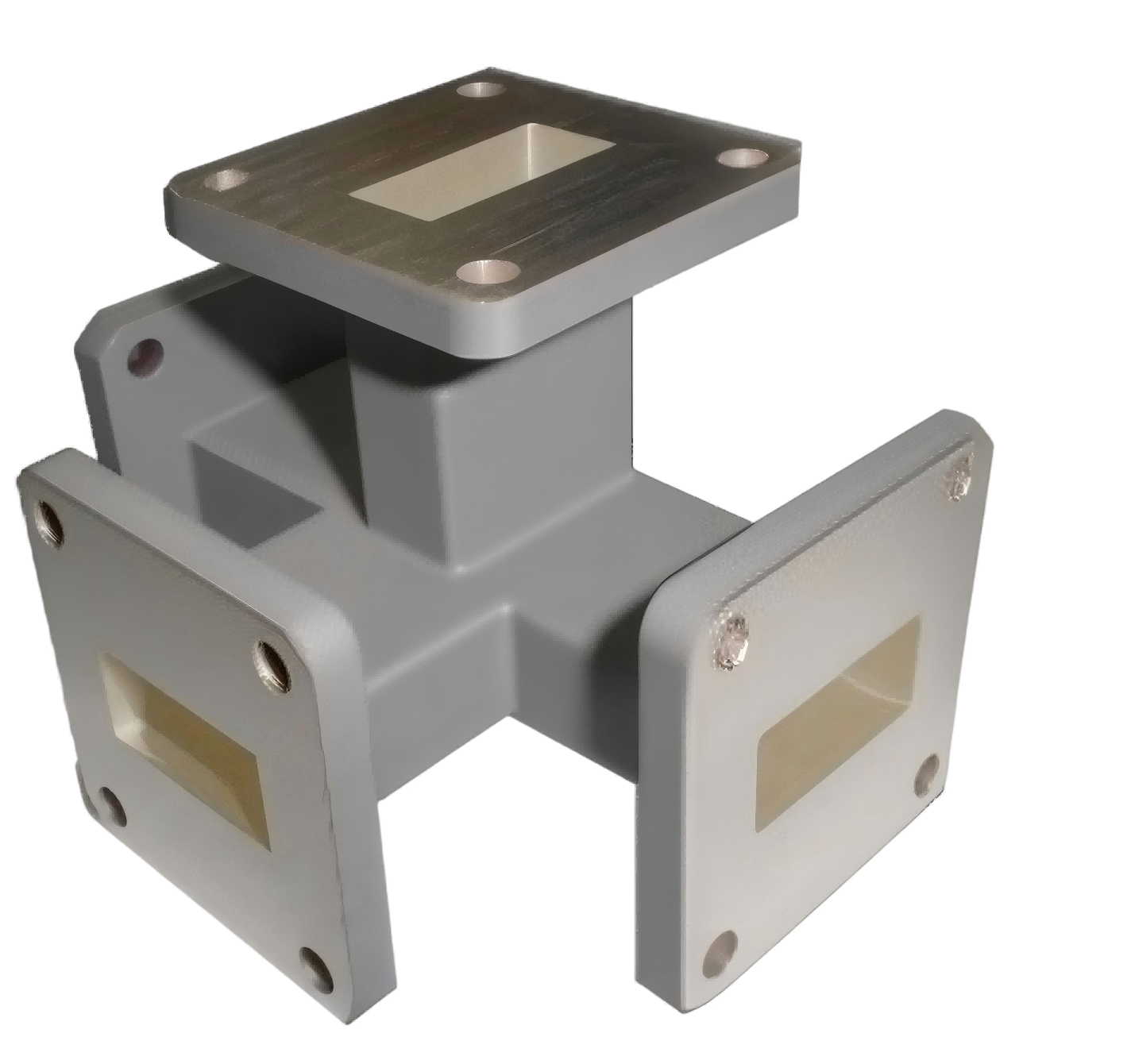
Waveguide Magic Tee
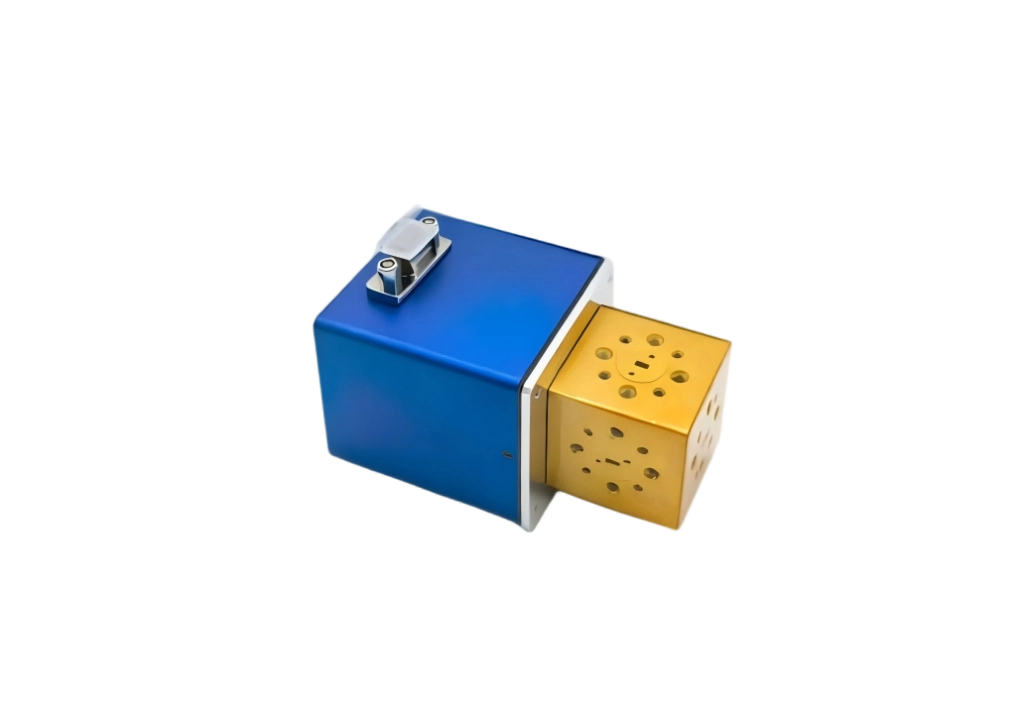
Waveguide Magic Tee is a hybrid junction used for signal splitting and combining with precise phase control. Suitable for microwave signal distribution networks, radar systems and RF measurement equipment.
Precision Waveguide Magic Tees for Balanced Power Splitting and Combining
AO Microwave’s waveguide Magic Tees (180-degree hybrid junctions) are designed to provide highly balanced power dividing and combining with high isolation. Machined from solid blocks of lightweight aluminum and copper alloys, these hybrid junctions feature silver-plated internal cavities and gold-plated flange surfaces to minimize insertion loss. Operating up to 110 GHz (WR-90 to WR-10), our Magic Tees deliver an outstanding port-to-port isolation of typically > 30 dB, an amplitude imbalance of < 0.15 dB, and a phase imbalance of < 1.5° across the band.
Integrating an E-plane branch and an H-plane branch with two collinear ports, our Magic Tees can split a single signal into two equal-amplitude, opposite-phase outputs (via E-port) or in-phase outputs (via H-port). They are essential for monopulse tracking radar comparators, impedance measurement bridges, and balanced mixer networks.
| Part No | Frequency/GHz | Bandwidth | H Plane VSWR (Max) | E Plane VSWR (Max) | IL/dB (Max) | Isolation/dB (Min) | Balance/dB (Max) | Flange Type |
|---|---|---|---|---|---|---|---|---|
| AO2300-WMTACG | 0.32-0.49 | 0.2 | 1.2 | 1.5 | 0.2 | 35 | ±0.25 | UDR3 |
| AO2100-WMTACG | 0.35-0.53 | 0.2 | 1.2 | 1.5 | 0.2 | 35 | ±0.25 | UDR4 |
| AO1800-WMTACG | 0.41-0.62 | 0.2 | 1.2 | 1.5 | 0.2 | 35 | ±0.25 | UDR5 |
| AO1500-WMTACG | 0.49-0.75 | 0.2 | 1.2 | 1.5 | 0.2 | 35 | ±0.25 | UDR6 |
| AO1150-WMTACG | 0.64-0.98 | 0.2 | 1.2 | 1.5 | 0.2 | 35 | ±0.25 | UDR8 |
| AO975-WMTACG | 0.75-1.15 | 0.2 | 1.2 | 1.5 | 0.2 | 35 | ±0.25 | UDR9 |
| AO770-WMTACG | 0.96-1.46 | 0.2 | 1.2 | 1.5 | 0.2 | 35 | ±0.25 | UDR12 |
| AO650-WMTACG | 1.13-1.73 | 0.2 | 1.2 | 1.5 | 0.2 | 35 | ±0.25 | UDR14 |
| AO510-WMTACG | 1.45-2.20 | 0.2 | 1.2 | 1.5 | 0.2 | 35 | ±0.25 | UDR18 |
| AO430-WMTACG | 1.72-2.61 | 0.2 | 1.2 | 1.5 | 0.3 | 35 | ±0.40 | UDR22 |
| AO340-WMTACG | 2.17-3.30 | 0.2 | 1.2 | 1.5 | 0.3 | 35 | ±0.40 | UDR26 |
| AO284-WMTACG | 2.60-3.95 | 0.2 | 1.2 | 1.5 | 0.3 | 35 | ±0.40 | UDR32 |
| AO229-WMTACG | 3.22-4.90 | 0.2 | 1.2 | 1.5 | 0.3 | 35 | ±0.40 | UDR40 |
| AO187-WMTACG | 3.94-5.99 | 0.2 | 1.2 | 1.5 | 0.3 | 35 | ±0.40 | UDR48 |
| AO159-WMTACG | 4.64-7.05 | 0.2 | 1.2 | 1.5 | 0.3 | 35 | ±0.40 | UDR58 |
| AO137-WMTCSG | 5.38-8.17 | 0.2 | 1.2 | 1.5 | 0.3 | 35 | ±0.40 | UDR70 |
| AO112-WMTCSG | 6.57-9.99 | 0.2 | 1.2 | 1.5 | 0.3 | 35 | ±0.40 | UBR84 |
| AO90-WMTCSG | 8.20-12.5 | 0.2 | 1.2 | 1.5 | 0.3 | 35 | ±0.40 | UBR100 |
| AO75-WMTCSG | 9.84-15.0 | 0.2 | 1.2 | 1.5 | 0.3 | 35 | ±0.40 | UBR120 |
| AO62-WMTCSG | 11.9-18.0 | 0.2 | 1.2 | 1.5 | 0.3 | 35 | ±0.40 | UBR140 |
| AO51-WMTCSG | 14.5-22.0 | 0.2 | 1.2 | 1.5 | 0.3 | 35 | ±0.40 | UBR180 |
| AO42-WMTCSG | 17.6-26.7 | 0.2 | 1.2 | 1.5 | 0.3 | 30 | ±0.40 | UBR220 |
| AO34-WMTCSG | 21.7-33.0 | 0.2 | 1.2 | 1.5 | 0.3 | 30 | ±0.40 | UBR260 |
| AO28-WMTCSG | 26.5-40.0 | 0.2 | 1.2 | 1.5 | 0.3 | 30 | ±0.40 | UBR320 |
| AO22-WMTCG | 33.0-50.0 | 0.2 | 1.2 | 1.5 | 0.5 | 30 | ±0.50 | UG-383/U |
| AO19-WMTCG | 40.0-60.0 | 0.2 | 1.2 | 1.5 | 0.5 | 30 | ±0.50 | UG383/UM |
| AO15-WMTCG | 50.0-75.0 | 0.2 | 1.2 | 1.5 | 0.5 | 30 | ±0.50 | UG385/U |
| AO12-WMTCG | 60.0-90.0 | 0.2 | 1.2 | 1.5 | 0.8 | 30 | ±0.50 | UG-387/U |
| AO10-WMTCG | 75.0-110.0 | 0.2 | 1.2 | 1.5 | 0.8 | 30 | ±0.50 | UG387/UM |
Tuning & Matching for Low-VSWR Hybrid Junctions
An unmatched Magic Tee exhibits poor VSWR at the junction ports due to severe impedance mismatches where the four waveguides meet. Because the E-plane and H-plane branches introduce localized capacitive and inductive discontinuities, matching is required to achieve low return loss.
To resolve these mismatches, AO Microwave incorporates a post-and-iris matching design inside the junction cavity. By placing an inductive iris in the E-plane branch and a metallic matching post (or cone) at the collinear junction, we cancel out the localized reactance. This split-block design is matched to ensure a low VSWR across the operating band.
Target Applications & Operational Advantages
By providing balanced power splitting with high port-to-port isolation, our waveguide Magic Tees deliver critical performance in active systems:
Monopulse Radar Comparators
Function: Combines signals from multiple feed horns to generate sum (Σ) and difference (Δ) tracking patterns.
Advantage: Exceptional amplitude balance (±0.1 dB) and phase balance (±1°) enable high-accuracy, zero-drift target tracking.
Balanced Mixer Networks
Function: Combines the local oscillator (LO) and RF signals while providing high isolation between ports.
Advantage: Low insertion loss maximizes downconversion efficiency, and high LO-to-RF isolation protects sensitive receiver components.
RF Impedance Bridges
Function: Acts as a balanced null detector to compare unknown impedances against standard references.
Advantage: High isolation between E and H ports (>35 dB) prevents source signal leakage from masking minor impedance mismatches.
Waveguide Magic Tee FAQs
Need high-isolation Waveguide Magic Tees?
Specify your WR size, required isolation (dB), average power, and flange style — we'll quote in 24 hours.