
Waveguide Limiter vs Circulator vs Isolator: Which One Actually Protects Your Receiver?
Confused by isolator vs circulator vs limiter? Only the limiter clamps incoming high-power pulses to protect your LNA. Learn which one your RF chain actually needs.
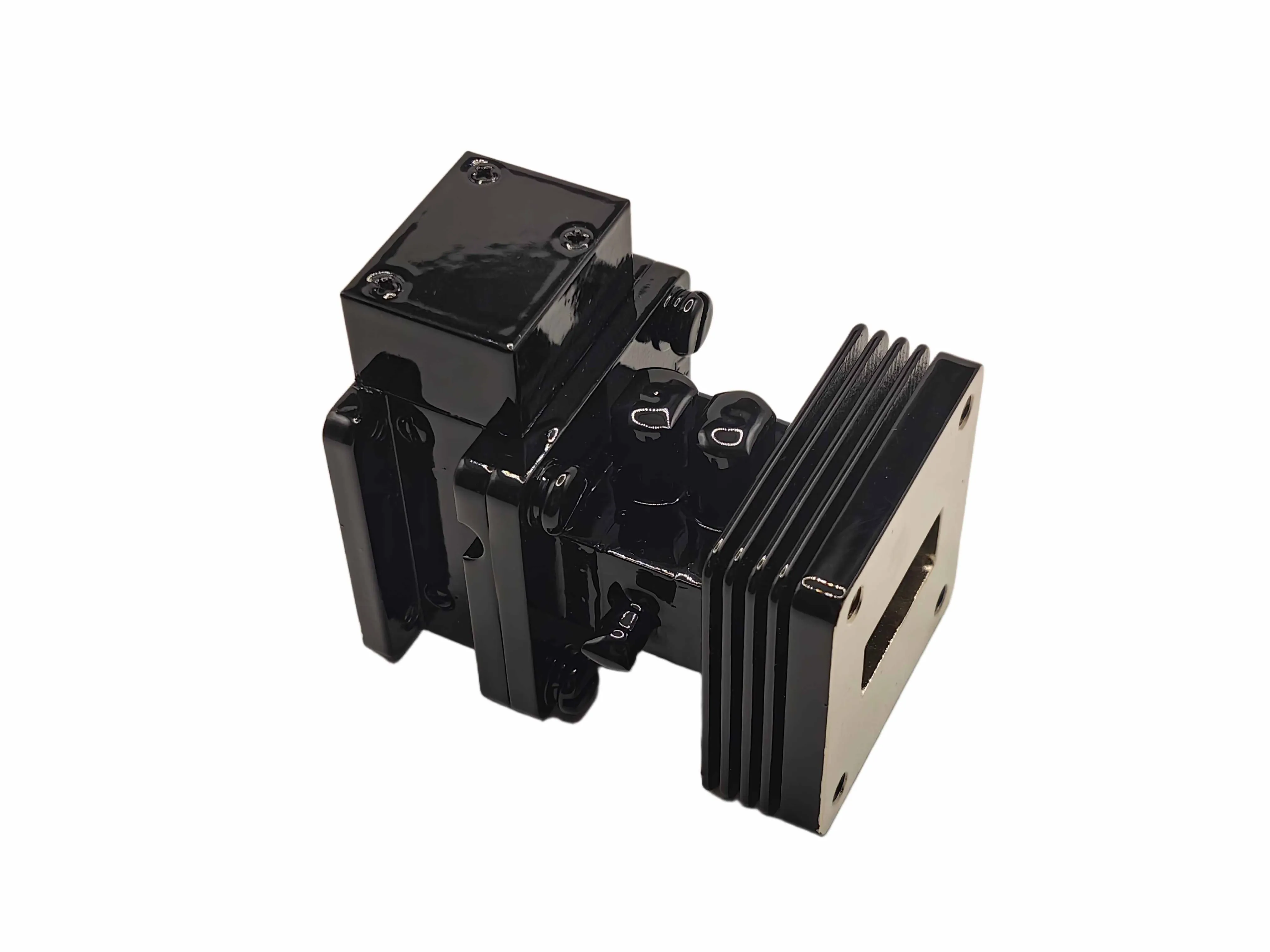
Waveguide Limiter vs Circulator vs Isolator: Which One Actually Protects Your Receiver?
Three components show up in almost every receiver-protection discussion: the waveguide limiter, the circulator, and the isolator. They are easy to confuse because all three sit in the RF path and all are sold as "protection." They protect entirely different things. Pick the wrong one and your low-noise amplifier is still exposed when the high-power signal arrives — confusing them is one of the most common and most expensive mistakes in receiver front-end design.
If your real concern is an incoming high-power signal — a nearby radar pulse, an EW threat, a co-located transmitter — only one of the three is built to handle it. Here is the distinction, drawn from how each device actually behaves in a receiver front end. For the working principle and WR90 X-band specifics, see our pillar guide on what a waveguide limiter is and how it protects RF systems.
The Isolator: It Protects the Source, Not the Receiver
An isolator is a two-port device with high reverse isolation (commonly 20 dB or more). RF passes forward with low loss but is strongly attenuated in the reverse direction. Its job is to shield a transmitter or source from reflected power and load mismatch — it sits behind an amplifier or oscillator to keep returning energy from pulling the stage into oscillation or damaging it.
Crucially, an isolator does nothing for a high-power signal arriving from the antenna side. If a strong pulse comes in through the antenna, the isolator's reverse isolation is pointed the wrong way. It is a source-protection component, not a receiver-protection component.
The Circulator: It Routes, It Doesn't Clamp
A circulator is a three-port device where energy flows in one cyclic direction: port 1 to port 2, port 2 to port 3, port 3 to port 1. The classic use is as a duplexer — separating transmitted and received signals — or as a way to route reflected energy to a termination instead of back into the source.
A circulator can keep a reflected signal away from your transmitter, and it provides port-to-port isolation. But it does not reduce the level of an incoming high-power signal. A 1 kW pulse entering the receive port still arrives at the receiver at roughly 1 kW minus only the port isolation. For receiver front-end protection against incident high power, routing is not enough — you need clamping.
The Limiter: The Only One That Clamps Incoming Power
A waveguide limiter is an active protection device. In its common form it uses a self-biased PIN diode that is transparent at low signal levels (so your weak wanted signal passes with minimal loss) but conducts and clamps when a high-power incident signal arrives. The result: the receiver sees a bounded, safe leakage level instead of the full incident power.
This is exactly what protects the low-noise amplifier and downstream mixer in a radar or EW receiver. The isolator cannot do it. The circulator cannot do it. Only the limiter is designed around the question "how much power reaches the LNA?" — and the answer it gives is "a controlled, small amount."
Where Each One Sits in the RF Chain
| Device | What it protects | How it works | Key limitation |
|---|---|---|---|
| Isolator | Transmitter / source from reflected power | Reverse isolation (20 dB+) | Pointed away from antenna-in signals |
| Circulator | Port / path separation (duplexing) | Directional 1→2→3 routing | Does not clamp incident power |
| Limiter | Receiver / LNA from incident high power | Self-biased PIN diode clamp | Only one that actually clamps |
In a typical receiver front end, the placement makes the roles obvious. The isolator or circulator lives near the source and antenna junction, handling duplexing and keeping reflected energy from disturbing the transmitter. The limiter lives immediately ahead of the LNA, because that is the only place it can intercept an incoming high-power pulse before it reaches the most fragile, most expensive stage in the chain. Protecting the source and protecting the receiver are two different problems solved by two different devices — and only one of them is a limiter.
Signal flow: antenna → duplexing / isolation stage → limiter (right before the LNA) → LNA → mixer.
A Simple Decision Rule
- Worried about reflected power damaging your transmitter? Use an isolator (or a circulator) on the source side.
- Need to separate transmit and receive paths? Use a circulator as a duplexer.
- Worried about a high-power signal arriving through the antenna and frying the LNA? Use a limiter in front of the receiver — nothing else does this job.
In practice, robust receiver front ends combine all three roles with other stages: an isolator or circulator for source/port isolation, and a limiter (often backed by a low-loss gas or solid-state element) sitting directly ahead of the LNA to clamp incident spikes. AO Microwave designs waveguide limiters across the standard bands — WR90 (X-band), WR62 (Ku-band), and others — for this receiver-protection role in radar and electronic-warfare front ends.
Frequently Asked Questions
Q: Can an isolator protect a receiver from incoming high-power signals?
No. An isolator's reverse isolation is oriented to stop reflected power from reaching the source behind it. A high-power signal arriving from the antenna goes through the isolator in its forward direction and reaches the receiver essentially unchanged. Receiver protection against incident power requires a limiter.
Q: Does a circulator limit or reduce incoming power?
No. A circulator routes energy directionally between its ports; it provides isolation between certain ports but does not clamp the level of an incident signal. A strong pulse entering the receive port still reaches the receiver at close to its full power minus the port-to-port isolation, which is far above what an LNA can survive.
Q: What does a limiter actually do to a high-power pulse?
It clamps the incident signal to a bounded leakage level. Per standard PIN-diode limiter application notes from MACOM and the Skyworks PIN Limiter Design Guide, flat-leakage levels typically land in the +20 to +30 dBm range (about 0.1 to 1 W), well below the damage threshold of the LNA behind it, while spike leakage during the first tens of nanoseconds can be higher before limiting fully engages.
Q: Why does a limiter pass the wanted signal but block the strong one?
A self-biased PIN diode is effectively transparent at low signal levels, so weak received signals pass with low insertion loss. When incident power exceeds the limiting threshold, the diode conducts and presents a low impedance that reflects/clamps the excess, capping what reaches the receiver.
Q: Should I use a limiter, a circulator, or both?
For receiver front-end protection, a limiter is mandatory to clamp incident high power. A circulator is useful separately for duplexing or port isolation, and an isolator protects the transmitter source. Robust X-band radar and EW receivers typically use the limiter ahead of the LNA plus isolation stages elsewhere in the chain.
Q: What waveguide bands are limiters made for?
Limiters follow the same waveguide standards as other components: WR90 (X-band), WR62 (Ku-band), and other EIA waveguide sizes, selected to match your receiver's operating band. For X-band radar and EW receivers, WR90 is the common choice.
Specifying a Receiver-Protection Limiter?
Tell us your waveguide band, power level, and leakage requirement. We will confirm whether a standard configuration for your band fits — and quote within 24 hours.
Contact Our Engineering Team