
What Is a Coaxial Dual-Junction Isolator, and When Should You Choose It Over a Single-Junction One?
Single-junction vs dual-junction coaxial isolator: the dual gives ~40 dB isolation but ~2x the insertion loss, size and cost. Learn when the extra isolation is worth it for your RF source.
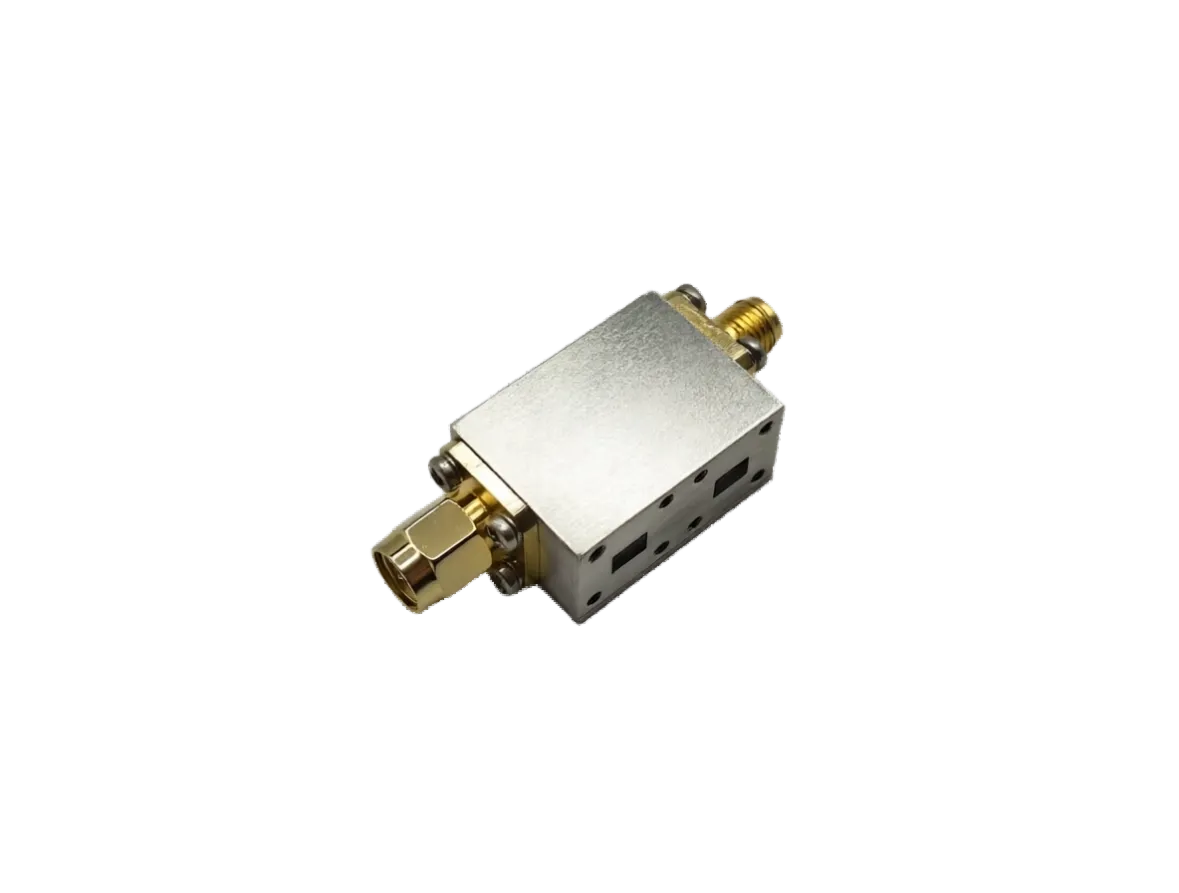
What Is a Coaxial Dual-Junction Isolator, and When Should You Choose It Over a Single-Junction One?
Every RF source — a signal generator, a VCO, a power amplifier — hates seeing its own energy bounce back. A mismatch at the load or antenna creates reverse power that degrades stability, pulls frequency, and in the worst case burns out the stage you just paid for. That is exactly what an isolator is for. But here is the catch engineers hit constantly: a standard single-junction coaxial isolator gives you around 20 dB of reverse isolation. For a lot of systems that is plenty. For others, it is nowhere near enough.
That gap is where the coaxial dual-junction isolator lives. It is the same idea built twice, and the numbers change in ways that directly affect your link budget, your board space, and your bill of materials. Below we explain what a dual-junction isolator actually is, and put it head-to-head with a single-junction part on the metrics that decide a design. If you first need the circulator-vs-isolator relationship, our circulator and isolator explainer covers the fundamentals.
What a Coaxial Isolator Does — and Why the Isolation Number Matters
A coaxial isolator is a two-port ferrite device. Forward signals pass with low loss; reverse signals are steered into an internal 50Ω termination and dissipated as heat. The non-reciprocity comes from a ferrite element under a static magnetic bias — the Faraday rotation / field-displacement effect that makes signal behavior depend on direction. The headline spec is isolation: how much reverse power is rejected.
A 20 dB isolation figure is not abstract. It represents a reverse-power ratio of roughly 100:1 under the stated test conditions (per published isolator references such as Maniron and HzBeat). So if your amplifier pushes 100 W into a load that reflects 1%, about 1 W heads back — and a 20 dB isolator knocks that down to roughly 10 mW reaching the source. That is enough for many designs. When the reflected power is higher, the load pull is more severe, or the source is especially sensitive, 100:1 stops being comfortable. At AO Microwave we see this exact trade-off on almost every PA-protection RFQ, and the answer is rarely "just buy the biggest number."
What Makes a Dual-Junction Isolator "Dual"
A dual-junction isolator is two ferrite junctions connected in series inside one housing. The cascade is the whole point: a widely cited ferrite-device patent (CN101771183A) describes a dual-junction isolator as two single-junction isolators connected in series, where each contributes about −20 dB, giving a combined −40 dB at the input-output ports. Isolation adds as you cascade, which is why a dual-junction part is often called a "high-isolation isolator."
The important subtlety: only the isolation and insertion loss change. Per multiple manufacturer notes (RFTYT, UIY), the VSWR stays the same between a single- and dual-junction part of the same band — cascading junctions does not improve or worsen the match, it only stacks the reverse attenuation.
Single-Junction vs Dual-Junction — The Numbers That Decide
| Parameter | Single-Junction Coaxial Isolator | Dual-Junction Coaxial Isolator |
|---|---|---|
| Reverse isolation | ~20 dB typical (some designs 30–45 dB) | ~40 dB typical; can exceed 70 dB in some designs |
| Forward insertion loss | ~0.3–0.5 dB | ~0.6–1.0 dB |
| VSWR | ~1.2–1.25 | ~1.2–1.25 (unchanged) |
| Size / footprint | Compact | ~2× (at least double, per the series cascade) |
| Relative cost | Baseline | ~2× (patent CN101771183A: dual costs at least 2× single) |
| Best fit | General PA/source protection, test gear, comms | Radar, EW, satcom, high-power PA, severe mismatch |
The table mirrors what vendor datasheets report: single-junction parts commonly spec ≥20 dB isolation at ≤0.5 dB loss, while dual-junction parts reach ≥40 dB isolation at ≤1.0 dB loss (Coaxwave typical specifications). UIY notes single-junction parts are often limited to 30–45 dB, whereas a dual-junction design can exceed 70 dB in dedicated high-power bands.
A dual-junction isolator is electrically two single-junction isolators in series — isolation adds, insertion loss adds too.
The Trade-Off You Cannot Avoid: More Isolation, More Loss
You do not get extra isolation for free. Cascading junctions doubles the reverse attenuation but also stacks the forward insertion loss — roughly 0.5 dB becomes about 1.0 dB. That means ~10–20% more of your forward power is turned into heat, slightly lower output, and a bit more thermal load. The flip side is the protection: at 20 dB isolation, reverse power is cut 100:1; at 40 dB, it is cut 10,000:1. The decision is never "more is better" — it is "how much reverse attenuation does my source actually need, and how much insertion loss can my link budget spare?"
When You Actually Want the Dual-Junction
Reach for a dual-junction isolator when the reflected-power threat is severe or the source is unforgiving:
- Power-amplifier output stages feeding antennas or loads that can mismatch hard — radar, electronic warfare, satcom uplinks.
- Sensitive sources such as oscillators and synthesizer chains, where even small load pull shifts frequency or phase. Higher isolation means a more stable source.
- RF test equipment, where an expensive signal source or VNA must be protected from a mismatched device under test.
The market backs this up: the Dataintelo Coaxial Isolators Market report (2025) puts single-junction parts at 48.2% of the market but notes dual-junction isolators are growing at a 7.2% CAGR — faster than single-junction — driven by carriers and defense integrators specifying premium isolation to cut receiver desensitization. When the application is mission-critical, the dual is becoming the default.
When a Single-Junction Is the Smarter Buy
Over-specifying wastes money and space. As the cascade patent notes, a dual-junction device costs at least twice a single-junction one and takes at least twice the envelope. If your system already runs with modest mismatch and 20 dB isolation keeps your source happy, the single-junction part gives you smaller size, lower cost, and less insertion loss — three wins for no loss of protection. AO Microwave's RF engineering team specs both single- and dual-junction coaxial isolators for customer applications, and the first question is always "how much reverse isolation do you really need?" rather than "what is the maximum?"
Can You Just Cascade Two Single-Junction Isolators Yourself?
Electrically, yes — that is exactly what a dual-junction isolator is. But a purpose-built dual integrates both junctions in one housing: fewer connectors, a smaller envelope, and better thermal and mechanical integration than two separate parts bolted together. Two stacked singles add extra interfaces, which means a little more total insertion loss and more potential failure points. For a bench_setup it is fine to experiment; for a production RF chain, buy the integrated dual.
How to Decide in 60 Seconds
- What is your worst-case reflected power? Estimate load VSWR × forward power.
- How much reverse power can your source tolerate? That sets the minimum isolation.
- How much insertion loss can your link budget spare? If 1.0 dB hurts, the single-junction may be the only option.
- What are your space and cost limits? Dual is ~2× on both — justify it with the threat.
Frequently Asked Questions
Q: What is a coaxial dual-junction isolator and how does it work?
It is a two-port ferrite isolator containing two ferrite junctions in series. Each junction provides non-reciprocal reverse isolation (about 20 dB), and because they are cascaded the isolation adds — a dual-junction part typically delivers around 40 dB while keeping forward insertion loss in the ~0.6–1.0 dB range.
Q: What is the main difference between a single-junction and a dual-junction coaxial isolator?
Isolation and insertion loss. A single-junction isolator gives roughly 20 dB isolation at ~0.3–0.5 dB loss; a dual-junction gives roughly 40 dB isolation at ~0.6–1.0 dB loss. The VSWR stays essentially the same. The dual is also larger and costs about twice as much.
Q: Does a dual-junction isolator have higher insertion loss than a single-junction?
Yes. Because it is two junctions in series, the forward insertion loss roughly doubles — from about 0.3–0.5 dB for a single-junction part to about 0.6–1.0 dB for a dual-junction part. That extra loss turns a little more forward power into heat and slightly reduces output power.
Q: Does the VSWR change between single and dual-junction isolators?
No. Multiple manufacturer notes confirm that cascading junctions changes the isolation and insertion loss but leaves the VSWR essentially unchanged. A single- and dual-junction part of the same band will typically show the same ~1.2–1.25 VSWR.
Q: When do I need a dual-junction isolator instead of a single-junction?
When the reflected-power threat is severe or the source is highly sensitive: PA output stages feeding mismatch-prone antennas, radar and EW transmitters, satcom uplinks, sensitive oscillators, and test setups protecting expensive signal sources. If 20 dB isolation already keeps your source stable, the single-junction is the better buy.
Q: Is a dual-junction isolator just two single-junction isolators connected together?
Electrically, yes — a dual-junction isolator is two single-junction isolators in series, which is why the isolation adds. A purpose-built dual integrates both junctions in one housing with fewer connectors and better thermal integration than two separate parts bolted together, so it is smaller and more robust than a do-it-yourself cascade.
Q: How much more does a dual-junction isolator cost?
Roughly twice as much. A widely cited ferrite-device patent (CN101771183A) states that a dual-junction isolator costs at least two times a single-junction device, and its size is at least double as well. The premium buys the extra isolation and the integrated package, not a different technology.
Specifying a Coaxial Isolator?
Tell us your frequency band, power level, and isolation requirement. We will confirm whether a single- or dual-junction configuration fits your source — and quote within 24 hours.
Contact Our Engineering TeamRelated: What Is a Waveguide Isolator and Why Is It Important in RF Systems? — the same non-reciprocal principle, applied in waveguide form for higher-power and higher-frequency chains.