
What Is Your Coaxial Adapter Body Made Of? A Buyer's Guide to Outer Conductor Materials
A client questioned a stainless adapter quote — we walked through passivated steel, brass with ternary alloy, and gold plating. This guide contrast may help RF buyers choose the right body.
What Is Your Coaxial Adapter Body Made Of? A Buyer's Guide to Outer Conductor Materials
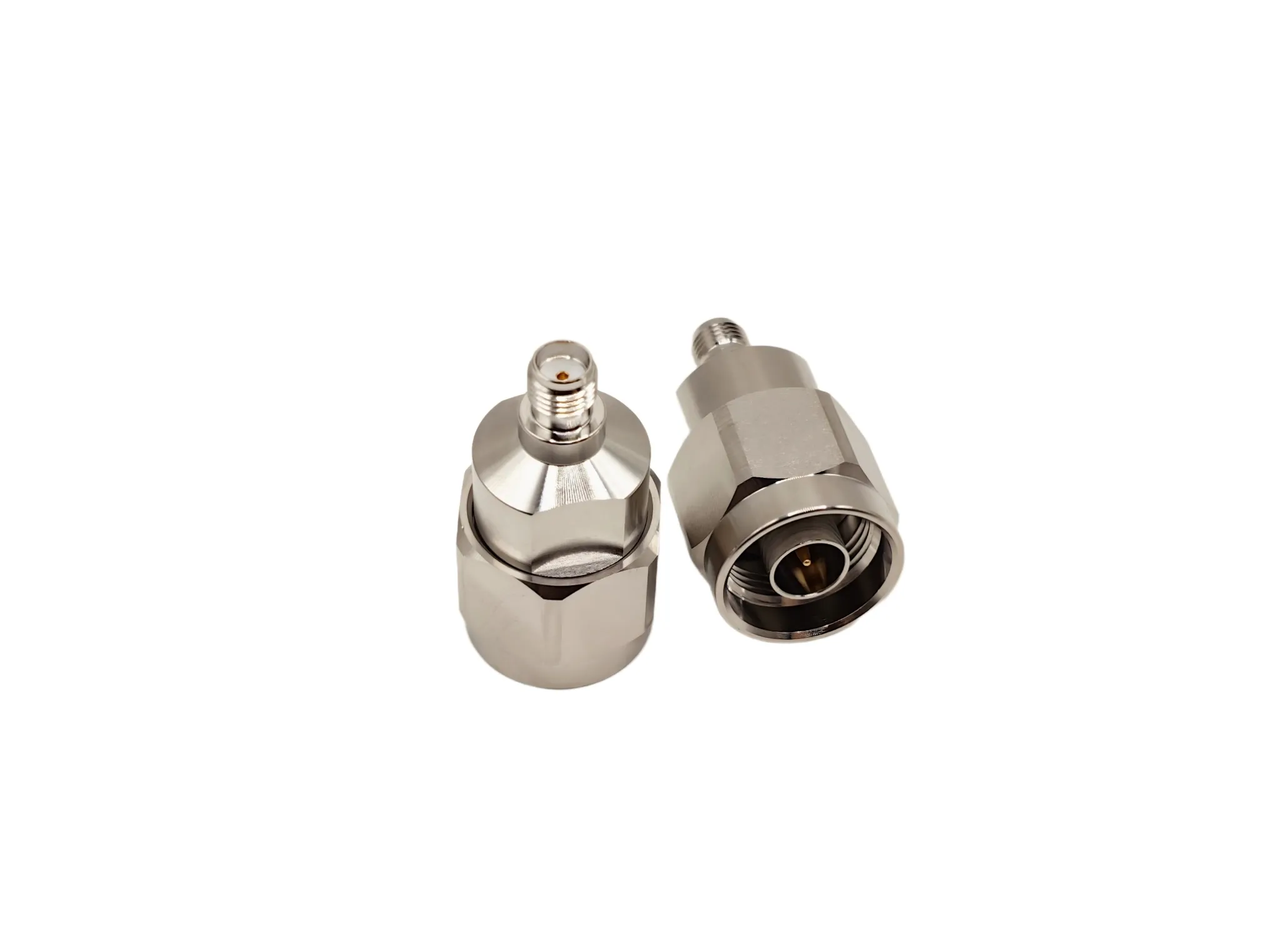
A client recently sent us a batch RFQ for SMA-to-N coaxial adapters. They knew the interfaces. They knew the frequency — DC to 18 GHz. What they hadn't considered was what the adapter body should be made of. We quoted passivated stainless steel first. The reply: too expensive. We followed up with brass body and ternary alloy plating. About 30% less, with RF performance within a fraction of a decibel. They asked a few questions about durability, checked the budget, and placed the order.
Before closing, we mentioned a third option: brass with nickel plating, for roughly half the cost of stainless. They stayed with ternary alloy. But the conversation revealed a pattern we see far too often. Buyers spec the connector interface and the frequency. They don't think about the outer conductor — the metal body that determines mechanical life, environmental tolerance, and how many mating cycles the adapter survives before VSWR starts to drift.
This article is about that body. What it can be made of — and crucially, how the connector series itself sets the baseline before you ever factor in cost or environment.
Connector Type Sets the Baseline — Before You Even Choose a Material
One of the most overlooked truths in RF adapter procurement is that connector series and body material are not independent choices. Each connector interface has an industry-conventional body material that the standard was effectively designed around — and deviating from it, even for cost, introduces real risk.
The millimeter-wave precision connectors — 2.4mm, 2.92mm (K), 1.85mm (V), and 1.0mm — are machined to micron-level tolerances on air dielectric geometries. Their center pin diameters measure a fraction of a millimeter; a few microns of dimensional drift from thermal expansion or thread wear destroys the VSWR. For this reason, the industry standard body material for these series is passivated stainless steel, period. A brass-bodied 2.4mm adapter exists only as a cost-reduced variant and is almost never used in metrology chains. The connector standard and the material are coupled.
At the other end of the spectrum, large-format connectors like N-type, 7/16 DIN, BNC, and TNC were designed in an era when brass was the default RF body material. Their mechanical tolerances are looser, their center contacts are larger, and their frequency ceilings are lower (typically ≤18 GHz for N-type, ≤7.5 GHz for 7/16). Brass with ternary alloy, gold, or nickel plating is the native material for these series. Stainless steel variants exist — and are the right call for outdoor or MIL-SPEC deployments — but they are premium upgrades, not the baseline.
SMA sits in a unique middle ground. It spans DC to 18 GHz (and up to 26.5 GHz in precision variants), and as a result its body material convention splits along the application axis. Precision SMA adapters for VNA calibration and metrology use passivated stainless. General-purpose SMA adapters for production test fixtures and bench use are overwhelmingly brass with gold or ternary alloy plating. Both are correct — in their respective contexts.
The table below maps connector series to their industry-standard body material conventions:
| Connector Series | Frequency Ceiling | Industry-Standard Body Material | Notes |
|---|---|---|---|
| 1.0mm | 110 GHz | Stainless steel passivated | No brass variant exists. Tolerance stack demands steel. |
| 1.85mm (V) | 65 GHz | Stainless steel passivated | Brass + gold available as cost-reduced variant for non-metrology use. |
| 2.4mm | 50 GHz | Stainless steel passivated | Standard. Brass + gold on request. Mechanically compatible with 1.85mm. |
| 2.92mm (K) | 40 GHz | Stainless steel passivated | Standard. Compatible with SMA thread but precision air dielectric — steel preserves concentricity. |
| SMA (precision) | 26.5 GHz | Stainless steel passivated | Metrology / VNA grade. 500+ mating cycles with torque wrench. |
| SMA (general) | 18 GHz | Brass + gold / ternary alloy | Production test, bench use, OEM integration. |
| SSMA | 40 GHz | Stainless steel passivated / Brass | Miniaturized SMA; stainless preferred above 26 GHz. |
| N-type | 18 GHz | Stainless steel passivated / Brass / Ternary Alloy | Stainless available for outdoor / MIL. Ternary alloy standard for NEX10. |
| 7/16 DIN | 7.5 GHz | Brass + nickel / gold | High-power telecom. Body never stainless — power handling is the priority. |
| BNC / TNC | 4 GHz / 11 GHz | Brass + nickel / gold | Bayonet or threaded. Nickel baseline for cost-sensitive; gold for instrumentation. |
| MCX / MMCX | 6 GHz | Brass + gold | Snap-on. Gold standard; nickel not recommended for contact reliability. |
| SMP | 40 GHz | Beryllium copper + gold (center) / Brass body | Push-on. BeCu for spring-finger center socket; outer body typically brass. |
Takeaway: If your RFQ lists a 2.4mm, 2.92mm, or 1.85mm interface, start with passivated stainless steel. The connector standard all but mandates it. Deviate only if you have a deliberate cost-versus-performance trade-off and you understand the dimensional drift you're accepting. If your RFQ lists N-type, 7/16, or BNC, brass is the baseline — your choice is which plating grade, not which metal.
Five Outer Conductor Materials, Head-to-Head
Once the connector series has narrowed the field, the remaining candidate materials compete on four axes: conductivity, mechanical durability, corrosion resistance, and cost. The table below spans all five options you'll encounter in the market:
| Outer Conductor Material | Conductivity | Hardness (HV) | Corrosion Resistance | Typical Mating Cycles | Relative Cost | PIM Behavior |
|---|---|---|---|---|---|---|
| Stainless Steel, Passivated (SUS303/304) | ~2.4% IACS | ~200 HV | Excellent (passive Cr₂O₃ layer) | 500+ | $$$$ | SUS303 weakly ferromagnetic — use SUS304/316L for PIM-sensitive |
| Brass + Gold (over nickel barrier) | ~26% IACS | ~130 HV (Au) / ~200 HV (Ni barrier) | Excellent (gold inert, nickel blocks diffusion) | 500+ | $$$ | Non-magnetic — PIM-neutral |
| Brass + Ternary Alloy (Cu-Sn-Zn white bronze) | ~26% IACS | 400–500 HV | Very Good | 300+ | $$ | Non-magnetic — PIM-neutral; low intermod < -155 dBc |
| Brass + Nickel | ~26% IACS | ~300 HV | Moderate (indoor only) | 200+ | $ | Nickel is ferromagnetic — avoid for PIM-sensitive multi-carrier systems |
| Beryllium Copper + Gold (C1720) | ~22% IACS | 360–440 HV | Excellent (gold over BeCu) | 1,000+ | $$$$$ | Non-magnetic — PIM-neutral |
Stainless Steel, Passivated
Passivation is not a coating. It is a post-machining chemical treatment (ASTM A967) that dissolves free iron contamination from the surface, allowing the metal's inherent chromium oxide (Cr₂O₃) layer to reform uniformly. The adapter body you hold is solid stainless throughout — no plating to flake, no barrier layer to wear through. Its hardness (~200 HV) is roughly triple that of bare brass, which means threads survive hundreds of torque cycles without stripping and hex flats don't round off under a wrench.
The conductivity penalty is real — stainless is approximately 40 times more resistive than brass. But in an adapter body (not the center pin), bulk resistivity has a second-order effect on insertion loss. The dominant loss mechanism in an adapter is the contact interface, not the body conduction path. At frequencies through Ku-band, a passivated stainless adapter adds 0.1–0.3 dB more insertion loss than a brass equivalent — measurable, but typically within the uncertainty budget of the cables and instruments sourcing it.
Stainless passivated is the default body material for millimeter-wave precision connectors (2.92mm, 2.4mm, 1.85mm) and the correct first recommendation for any test-and-measurement, metrology, aerospace, or outdoor-deployed adapter where mechanical integrity and corrosion survival outweigh a fraction of a decibel.
Brass + Gold (over Nickel Barrier)
Brass (C3604) is the reference substrate for RF connectors. It machines predictably, threads cleanly, and provides 10× the bulk conductivity of stainless. Gold plating over a nickel diffusion barrier delivers contact resistance below 1 mΩ, complete oxidation immunity, and a surface that mates smoothly with minimal insertion force. For precision SMA adapters in production test, for N-type adapters in indoor communication racks, and for any application where the frequency is high but the environment is benign, brass with gold is the balanced premium choice.
The mechanical limitation is the gold layer itself. Gold is soft — approximately 130 HV — and under repeated torque cycles, compression wear gradually erodes the surface. An adapter that stays connected for months will never notice. An adapter that gets swapped daily on a busy test floor will show measurable surface wear after a few hundred cycles. This is where stainless wins: the body itself is hard, not just its surface.
Brass + Ternary Alloy (White Bronze)
Ternary alloy plating — an electrodeposited Cu-Sn-Zn alloy (typically ~55% Cu / 30% Sn / 15% Zn) — is the fastest-growing body plating in the telecom RF connector market. It is non-magnetic, harder than gold (400–500 HV), lead-free, and ROHS-compliant. Its contact resistance (1–3 mΩ) is slightly higher than gold but still negligible for applications through 18 GHz. Its intermodulation performance is excellent — below -155 dBc in typical third-order measurements — making it PIM-safe for multi-carrier base station environments.
Ternary alloy has effectively become the default body plating for N-type and NEX10 connectors in cellular infrastructure. It delivers corrosion resistance that rivals gold in all but the most aggressive salt-spray environments, at roughly half the plating cost. For general-purpose adapters, production test fixtures, and indoor-to-sheltered-outdoor telecom deployments, it is the highest-value option in the lineup.
Brass + Nickel
Nickel plating on brass is the budget baseline. Nickel is hard (~300 HV), wear-resistant, and provides good oxidation protection in dry indoor environments. It is widely used for BNC and TNC adapters in instrumentation, for SMB connectors in automotive, and for compress-fit ferrules and outer bodies where the nickel serves as both corrosion barrier and mechanical wear surface.
The limitation is threefold. First, nickel is ferromagnetic — if your system is PIM-sensitive (multi-carrier cellular, satellite transponder), nickel in the signal path is a liability. Second, nickel's passive oxide layer increases contact resistance in humid conditions; for outdoor or high-humidity indoor use, nickel is not recommended. Third, nickel lacks the cosmetic and conductivity appeal of gold; it is strictly a functional, cost-first choice. For connectors that mate infrequently and live indoors — cable TV terminations, fixed infrastructure jumpers, lab equipment interconnects that sit untouched for years — nickel does the job.
Beryllium Copper + Gold
Beryllium copper (C1720, Alloy 25) is the premium option — and critically, it is used differently than the other four. In nearly all adapter designs, beryllium copper is the inner contact material (center pin and socket), not the outer body. Its anti-fatigue spring properties, 22% IACS conductivity, and ability to maintain contact force through thousands of mating cycles make it the universal choice for center contacts in precision adapters across all series.
When beryllium copper is used as a monolithic outer body — for SMP push-on connectors, for ultra-high-cycle connector savers, for cryogenic or aerospace metrology chains — it combines near-brass conductivity with hardness rivaling tool steel (HRC 36–44 after age hardening). The cost is the highest of any option, roughly 3–5× stainless steel by weight after machining. The finished part is inert and safe to handle (the beryllium safety concern applies only to machining dust during fabrication). For SMP adapters where the outer body doubles as a spring-finger retention mechanism, beryllium copper with gold plating is not a luxury — it's the engineering requirement.
Outer Conductor vs. Inner Contact: They Are Not the Same Thing
A recurring point of confusion: the adapter body (outer conductor) and the center pin/socket (inner contact) serve fundamentally different engineering functions, and they are almost never made of the same material. The outer conductor provides the mechanical structure, the ground reference path, and the RF shielding. The inner contact must combine spring elasticity with low contact resistance — and for this, across virtually all precision connector series, beryllium copper with gold plating is the standard.
At AO Microwave, our coaxial adapters pair passivated stainless steel outer bodies with gold-plated beryllium copper center contacts. The outer body handles the physical environment — torque cycles, salt spray, thermal cycling. The center contact handles the RF — spring force, contact resistance, signal integrity. Neither compromises the other.
Application-to-Material Decision Matrix
- VNA calibration, metrology lab, connector savers (2.92mm / 2.4mm / 1.85mm) → Passivated stainless steel. The connector standard demands it. The hardness protects the instrument port through 500+ daily torque cycles.
- Production test fixtures, general SMA / N-type, moderate cycles → Brass + ternary alloy or brass + gold. Indoor environment, predictable cycle counts — ternary alloy delivers 90% of gold's performance at 50% of the cost. Gold if the extra 0.1 dB matters.
- Telecom base station NEX10 / N-type, sheltered outdoor → Brass + ternary alloy. Industry standard. PIM-neutral. Weather-resistant enough for the enclosure environment.
- Indoor rack BNC / TNC, infrequent re-mating → Brass + nickel is acceptable. For instrumentation-grade BNC, upgrade to gold. Nickel is not for outdoor or humid environments.
- Shipboard, coastal, desert-deployed, MIL-SPEC N-type / SMA → Passivated stainless steel, no question. The environmental survival requirement overrides cost and conductivity.
- Aerospace payload, cryogenic, phase-critical metrology, SMP push-on → Beryllium copper + gold for the outer body where spring properties or anti-fatigue behavior is required. Otherwise stainless passivated.
- Cost-sensitive deployment, controlled indoor, low mating cycles → Brass + nickel. Accept the PIM limitation and the indoor-only constraint, and the budget stretches further.
The global RF coaxial adapter and connector market was valued at approximately USD 7.12 billion in 2023 and is projected to exceed USD 12.87 billion by 2030 (Grand View Research). As deployments scale into higher frequencies and denser installations, the material decisions made at the RFQ stage become a compounding factor in field failure rates, recalibration cycles, and total cost of ownership. A 2.92mm adapter bought with a brass body instead of stainless because it was cheaper on paper will cost more over its lifetime in replacement cycles — and in the measurement uncertainty it injects into every test it touches.
What does "passivated" actually mean for a stainless steel adapter?
Passivation is a post-machining chemical treatment (ASTM A967) that dissolves free iron particles embedded in the stainless surface from cutting tools and handling, then allows the metal's natural chromium oxide (Cr₂O₃) layer to reform uniformly and thickly. It is not a coating — the surface is still stainless steel all the way through. Without passivation, microscopic iron contamination rusts within hours in humid air, initiating pitting corrosion on an otherwise stainless part. A passivated adapter body will survive 480+ hours of salt spray testing (ASTM B117) with no visible corrosion.
Why can't I just order a brass-bodied 2.4mm adapter to save money?
You can — some manufacturers offer it. But the 2.4mm connector standard was engineered around the dimensional stability of stainless steel. The center pin on a 2.4mm connector is 0.5 mm in diameter. Brass has roughly three times the thermal expansion coefficient of stainless. A temperature swing from 20°C to 50°C — typical in a rack with adjacent equipment — shifts the concentricity of a brass body enough to measurably degrade VSWR above 40 GHz. For bench use below 26 GHz, a brass 2.4mm may work. For metrology or anything above 40 GHz, stainless is not a preference — it's an engineering requirement.
Is nickel plating ever acceptable on adapters?
Yes — in the right context. BNC and TNC adapters for indoor instrumentation use nickel plating as the standard budget finish and it performs adequately for years. The three constraints are: (1) nickel is ferromagnetic — avoid it in PIM-sensitive multi-carrier systems; (2) nickel oxide increases contact resistance in high-humidity environments, so it is indoor-only; (3) nickel-plated connectors should not be mated frequently — the oxide layer builds with each cycle. If your application is a fixed indoor interconnect that gets touched once a year, nickel is fine. If it mates daily, upgrade to ternary alloy or gold.
Why is beryllium copper labeled as an "inner contact" material rather than an outer body material?
Because in 90%+ of adapter designs, that's where it goes. Beryllium copper's defining characteristic is spring elasticity — it can flex thousands of times and return precisely to its original geometry. This makes it ideal for the center socket fingers that must grip the mating pin with consistent force across the adapter's lifetime. Gold plating over the BeCu socket provides the electrical interface at <1 mΩ contact resistance. The outer body, by contrast, needs hardness and corrosion resistance more than spring memory — which is why stainless or brass is used. The exception is SMP where the outer body itself provides the retention mechanism, and BeCu becomes the correct material for the body as well.
How does ternary alloy compare to gold plating in salt spray testing?
Gold over nickel outperforms ternary alloy in extended salt spray (ASTM B117) — gold is chemically inert and will not corrode regardless of exposure duration. Ternary alloy (Cu-Sn-Zn) will eventually show white corrosion products after 96–200 hours of continuous salt spray, depending on alloy composition and deposition quality. For indoor and sheltered-outdoor telecom environments, this is more than adequate — the adapter lives inside an IP-rated enclosure and never sees direct salt exposure. For exposed outdoor, marine, or desert-deployed applications where the connector may be directly weathered, gold or passivated stainless is the safer choice.
Does stainless steel affect PIM performance?
It depends on the grade. Standard machinable stainless (SUS303) contains sulfur for free-machining and can exhibit weak ferromagnetism at cold-worked surface regions, which generates PIM products in multi-carrier systems. For PIM-sensitive applications — cellular base stations, satellite transponders, distributed antenna systems — specify non-magnetic grades (SUS304 or SUS316L) with full passivation. Brass with ternary alloy or brass with gold plating is inherently non-magnetic and PIM-neutral, which is why ternary alloy has become the default for NEX10 and modern N-type telecom connectors.
Request a Coaxial Adapter Quote
Tell us the connector types on both ends, your frequency range, and where the adapter will be deployed. We'll quote the industry-standard material for your connector series and any cost-optimized alternatives — so you can choose based on engineering, not guesswork.
Request a Quote