
Jun 26, 2026News & Insights
Why Do RF Cable Assemblies Need Armor?
In RF and microwave communication systems, cable assemblies often operate in environments where mechanical stress, vibration, and installation damage can affect performance. Standard cables may work
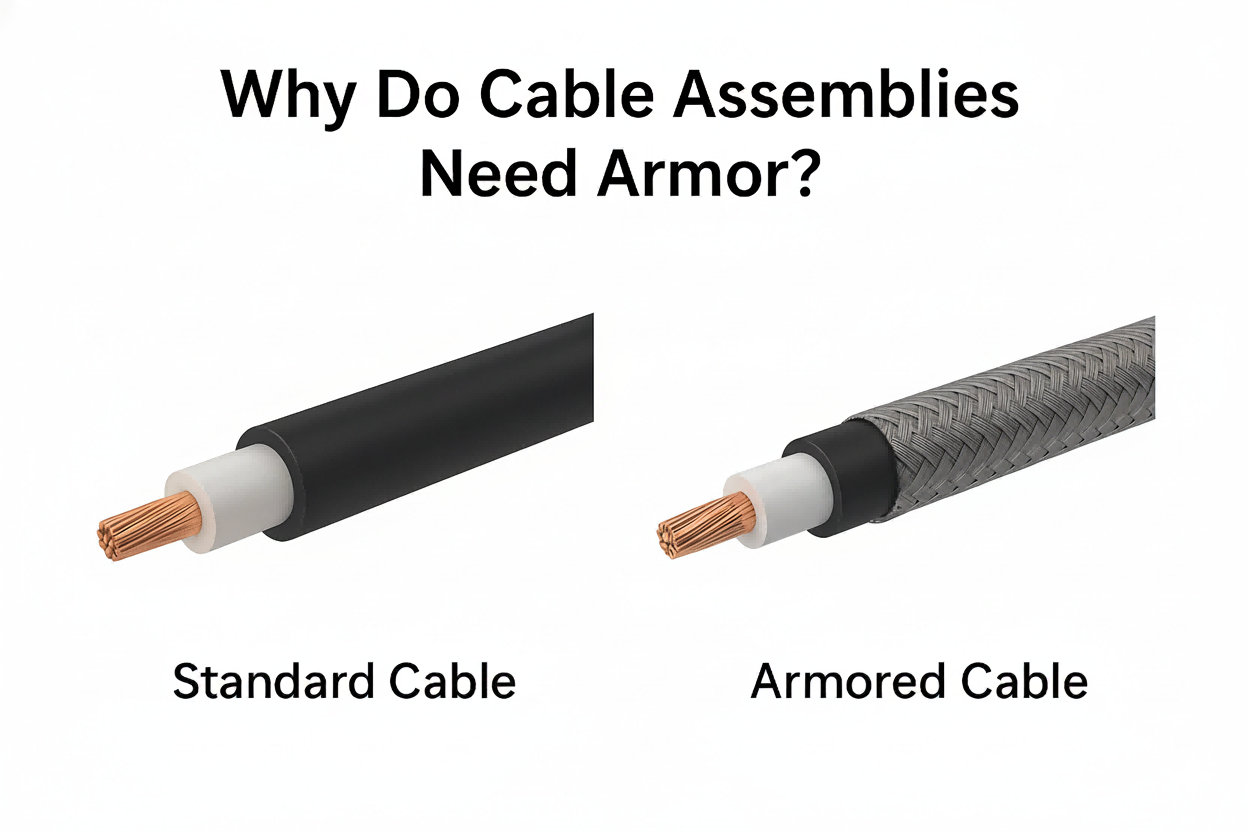
In RF and microwave communication systems, cable assemblies often operate in environments where mechanical stress, vibration, and installation damage can affect performance. Standard cables may work well in controlled conditions, but in demanding applications engineers frequently choose armored cable assemblies to improve durability and long-term reliability.
So why do RF cable assemblies need armor, and when should armored designs be used?
This article explains the key benefits of armored microwave cable assemblies and how they help protect critical RF systems.
What Is an Armored Cable Assembly?
An armored cable assembly is a coaxial or RF cable that includes an additional protective metal layer over the outer jacket. This armor layer—often made from stainless steel or reinforced metal tubing—protects the cable against mechanical damage while maintaining signal integrity.
Compared with standard RF cable assemblies, armored designs provide stronger protection against:
- abrasion and physical impact
- repeated bending and twisting
- vibration from equipment operation
- crushing or external pressure
Because of these advantages, armored microwave cable assemblies are widely used in telecom, radar, and satellite communication systems.
Key Benefits of Armored Cable Assemblies
1. Protection from Mechanical Damage
One of the most common causes of RF cable failure is external mechanical damage. Cables routed through equipment racks, outdoor antenna towers, or industrial installations can easily be scratched, crushed, or bent.
Armor provides an additional protective barrier that shields the internal conductor and dielectric layers.
For systems requiring high reliability RF cable assemblies, this protection is essential.
2. Increased Resistance to Bending and Movement
Many RF systems require cables to move during installation or maintenance. Repeated bending can weaken the cable structure and eventually cause signal degradation.
Armored designs distribute stress along the cable, helping maintain the performance of the microwave cable assembly even after repeated flexing.
3. Higher Reliability in Harsh Environments
RF systems in telecom infrastructure, satellite ground stations, and industrial test labs are often exposed to challenging environmental conditions.
These conditions may include:
- vibration from equipment
- temperature changes
- outdoor installations
- heavy mechanical loads
An armored RF cable assembly helps maintain signal stability in these environments.
4. Improved Protection During Installation
Cable damage often occurs during installation rather than during normal operation. Pulling cables through conduits or tight equipment spaces can cause hidden internal damage.
Armor reduces this risk and helps preserve the electrical characteristics of the coaxial cable assembly.
5. Longer Service Life
Because armored cables are better protected from external stress, they typically last longer than standard cable assemblies.
For system integrators and equipment manufacturers, this means:
- fewer replacements
- lower maintenance costs
- improved system uptime
In critical RF systems, these advantages are extremely valuable.
Typical Applications of Armored RF Cable Assemblies
Armored cable assemblies are commonly used in applications where reliability and durability are critical.
Telecom Infrastructure
Base stations and telecom equipment often require rugged cable solutions.
Satellite Communication Systems
Satellite ground stations use armored cables to protect connections between antennas and RF equipment.
Radar Systems
Radar installations experience constant vibration and environmental exposure.
RF Test and Measurement Systems
Laboratories and EMC testing environments require reliable microwave cable assemblies for accurate measurements.
Manufacturers such as AO Microwave provide customized armored cable assemblies designed for demanding RF and microwave applications.
Key Parameters When Selecting an Armored Cable Assembly
When choosing an armored RF cable assembly, engineers should consider several important factors.
Parameter | Importance |
|---|---|
Frequency Range | Determines RF performance |
Cable Flexibility | Important for installation |
Armor Material | Stainless steel or metal braid |
Connector Type | 2.4mm, 2.92mm, 3.5mm, SMA, N, etc. |
Environmental Conditions | Indoor, outdoor, vibration |
Proper selection ensures the cable assembly maintains both mechanical durability and electrical performance.