
Choosing a Waveguide Isolator for Radar and Satellite
How to pick a waveguide isolator for radar or satellite: band first, then power, then isolation — and when a dual-junction unit is worth it.
The short answer
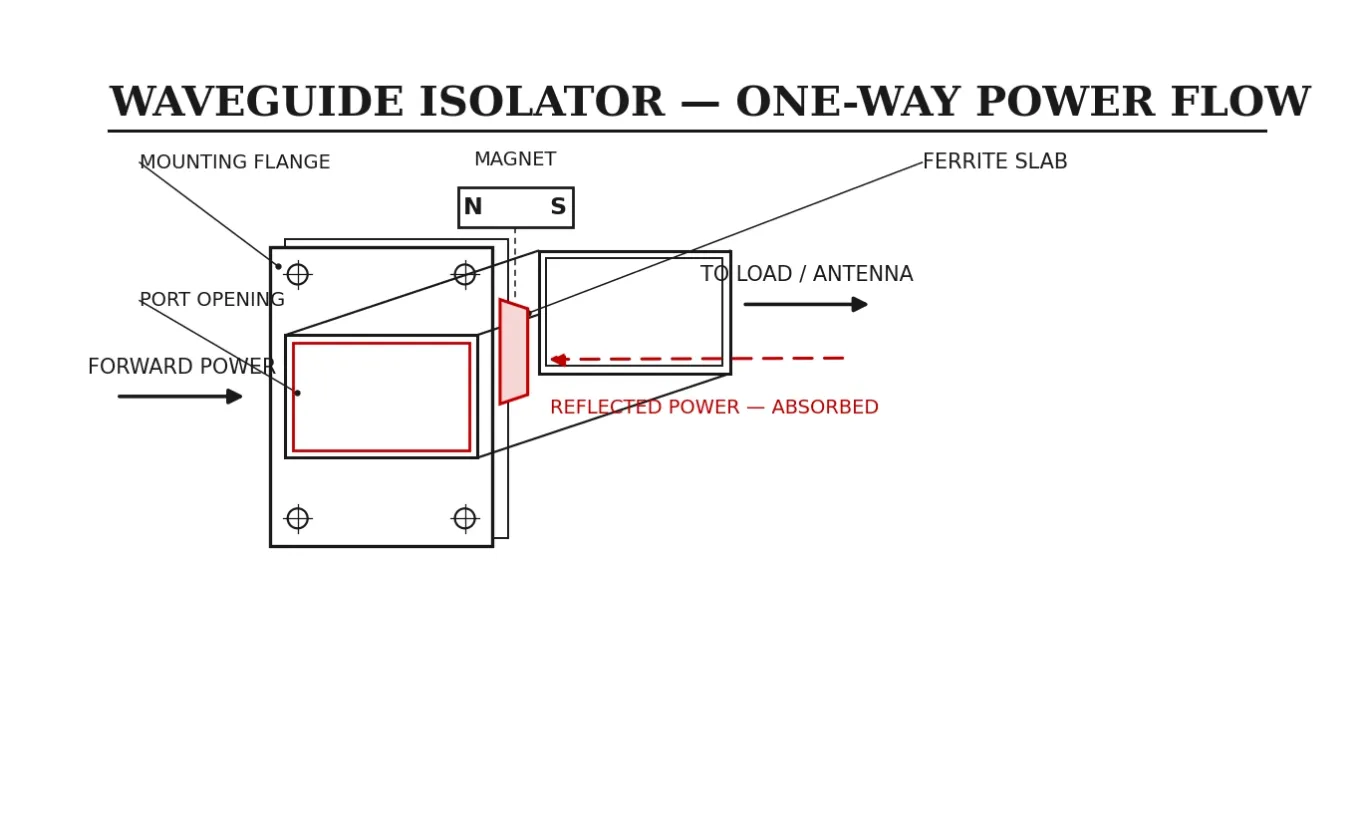
Choose in three steps: band first, power second, isolation third. The band sets the WR size; the power level decides single-junction or dual-junction; isolation, insertion loss and VSWR decide whether the part is good enough. AO's isolator 1.13–110 GHz, dual-junction isolation above 40 dB covers WR-90 to WR-10, with typical isolation above 20 dB — above 40 dB for dual-junction units — typical insertion loss below 0.25 dB and maximum VSWR of 1.2–1.3. Get the three steps right and the isolator does its job quietly: it lets power through in one direction and absorbs what comes back, so the source never sees it — see how a waveguide isolator works.
What does an isolator actually protect?
Your source — the transmitter or amplifier. Reflected power from a mismatched antenna travels back down the guide toward the source. The isolator sits in front of the source and absorbs that reflected power in its 50 Ω ceramic load, so the source never sees it. Where a port needs a separate termination, a waveguide load VSWR below 1.03:1, return loss above 35 dB does the same job: 0.32–110 GHz, WR-2300 to WR-10, VSWR below 1.03:1 and return loss above 35 dB, at 0.5–20 W, with ruggedised versions above 500 W.
Step 1 — which WR size does my band need?
The isolator covers 1.13–110 GHz, WR-90 to WR-10. Find your band in that range first — power handling follows guide size, not the other way round — and match the flange to the mating guide: UDR, UBR or UG. The body is an aluminium or copper alloy with a biased ferrite element and high-permeability steel magnetic shielding (see Isolator (microwave) for the general principle).
Step 2 — single-junction or dual-junction?
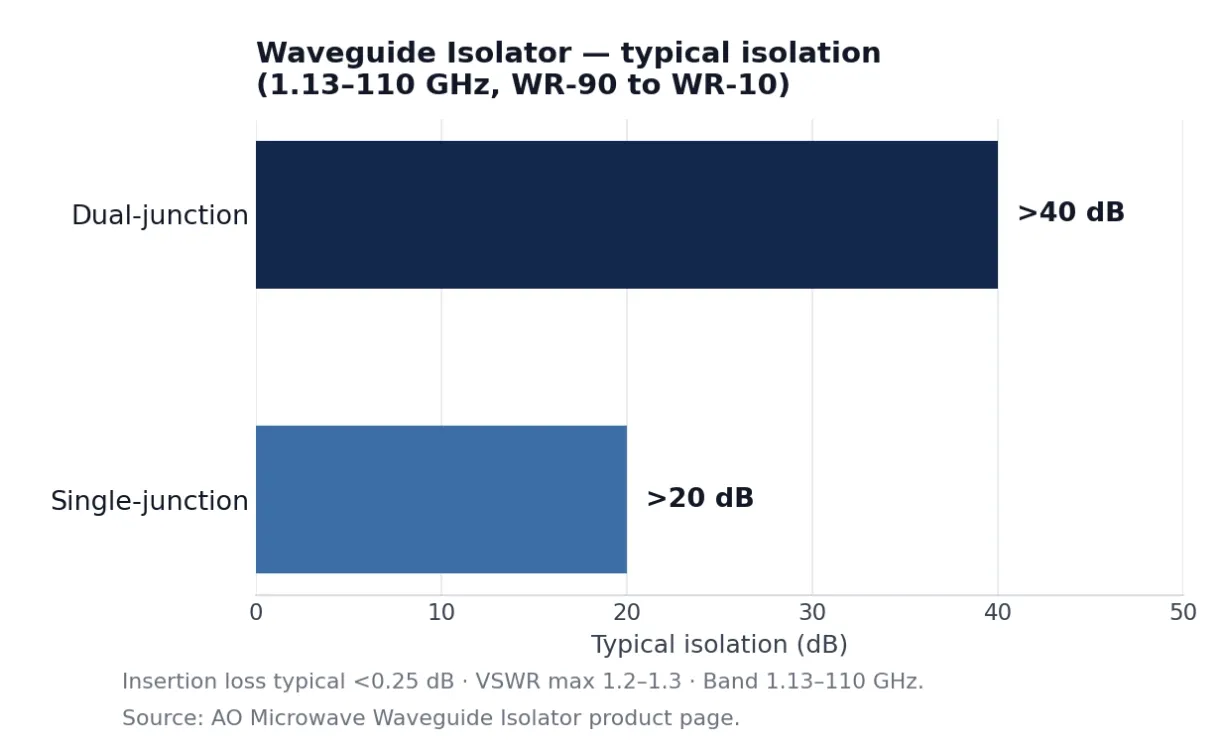
A single junction gives typical isolation above 20 dB. A dual-junction unit gives above 40 dB. Choose dual-junction when your system needs more isolation than one junction provides — a high-power transmitter facing a badly matched antenna, or a sensitive receiver behind the isolator. If 20 dB covers your worst case, a single junction is the simpler choice.
Step 3 — check the three numbers
- Isolation: typical above 20 dB, dual-junction above 40 dB.
- Insertion loss: typical below 0.25 dB — what you pay in the forward direction.
- VSWR: maximum 1.2–1.3 — how well the isolator itself is matched.
Check the parts around it the same way: the companion circulator covers 1.13–110 GHz with 3 or 4 ports, isolation above 20 dB, insertion loss below 0.25 dB and VSWR below 1.20:1; the load that terminates a port gives VSWR below 1.03:1 and return loss above 35 dB.
Radar, satellite or test — what changes?
- Radar: the isolator protects the transmitter from the antenna's reflection. Work out the worst-case reflection first, then decide single or dual junction on the isolation number.
- Satellite ground station: the chain runs continuously, so the same three numbers apply with no shortcuts — and the load that absorbs reflected power must be sized for the power it will actually see (0.5–20 W, ruggedised versions above 500 W).
- Test and measurement: the isolator protects the source while you measure, and the same check applies: band, isolation, insertion loss, VSWR.
A short selection checklist
- Write down your band — the WR size follows from it (WR-90 to WR-10, 1.13–110 GHz).
- Decide single-junction or dual-junction from the isolation you need (>20 dB or >40 dB).
- Check insertion loss (<0.25 dB typical) and VSWR (max 1.2–1.3).
- Match the flange (UDR/UBR/UG) and confirm the termination: load VSWR <1.03:1, return loss >35 dB.
- Check the whole chain, not one part — circulator, load and isolator each have their own rating.
Frequently Asked Questions
Not Sure Which Isolator Fits Your Radar or Satellite System?
Tell us your band, your power and how much isolation you need — we'll point you to the right one. A quick question costs nothing.
Ask an EngineerQuotes within 24 hours · No MOQ for standard items