
How Do I Test a Waveguide Assembly Before Installation?
A waveguide assembly should be tested before it goes in. Five acceptance checks — inspection, VSWR, loss, leakage, and records — with AO's pass lines.
The short answer
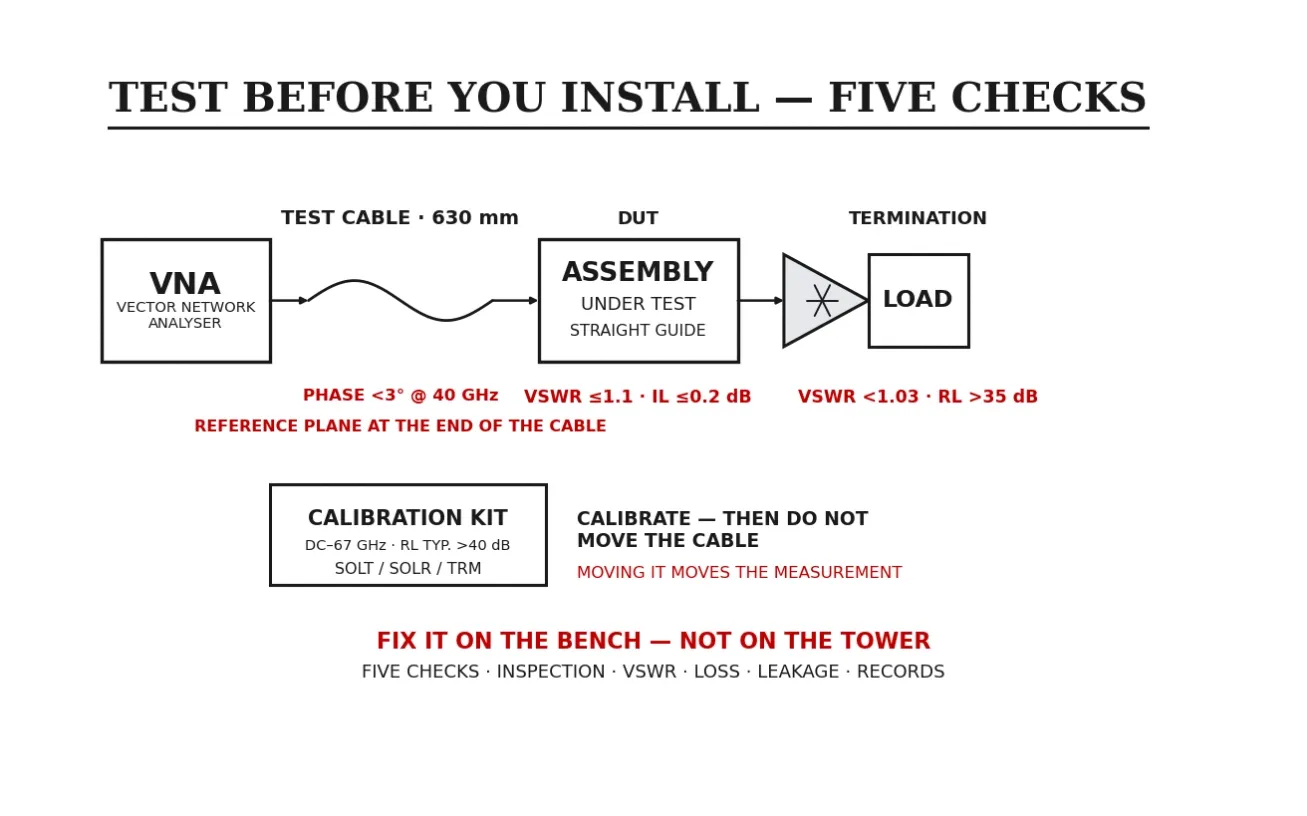
Test it before it goes in — five checks, in order: incoming inspection, VSWR, insertion loss, leakage, and records. Each check has a pass line taken from AO's own published figures, so there is nothing to argue about on the day: a straight waveguide section is rated VSWR ≤1.1 (typically <1.05:1) and insertion loss ≤0.2 dB; a waveguide load is rated VSWR <1.03:1 with return loss over 35 dB; a coaxial calibration kit is rated return loss typically over 40 dB. If a check fails, fix it on the bench — not on the tower, not in the chamber, and not after the system is live.
Step 1 — Incoming inspection: look before you measure
Open the box and check the part against the order: the right WR size, the right flange type, no dents, no damaged plating, no bent pins or scored flange faces. Check that every section, bend, adapter and load in the assembly is the one you ordered, and that nothing is missing. A surprising share of "test failures" are parts that were never the right parts — and this step costs minutes, while a wrong part installed costs days.
Step 2 — VSWR: does the assembly match?
Measure VSWR with a vector network analyser, with the test cable and load in place. Judge the result against the ratings of the parts in the assembly: straight waveguide sections are rated VSWR ≤1.1, typically <1.05:1; a waveguide load used as the termination is rated VSWR <1.03:1 with return loss over 35 dB. Use the site's VSWR and return loss conversion table to convert between the two — they are the same measurement in different units. If the VSWR is high, check the flanges before you blame the parts: a poorly seated flange looks exactly like a bad component on a VNA.
Step 3 — Calibrate first, and then do not move the cable
Calibration moves the reference plane to the end of the test cable, so the measurement starts where the assembly starts. AO's calibration kits DC–67 GHz, return loss typically over 40 dB cover DC–67 GHz with return loss typically over 40 dB, termination VSWR <1.029–<1.17 and adapter VSWR <1.04–<1.23, using SOLT, SOLR or TRM methods. But calibration only holds while nothing moves: moving the test cable after calibration moves the measurement (see the Siglent RF cable selection guide). That is why the cable matters — the 630mm VNA test cable phase stability under 3° at 40 GHz is rated phase stability <3° @ 40 GHz and amplitude stability ±0.05 dB when moved. Calibrate, then keep the cable still, then measure.
Step 4 — Insertion loss: compare against the parts' own ratings
Measure the insertion loss of the assembly and compare it with the ratings of the parts in it — a straight waveguide section is rated insertion loss ≤0.2 dB. There is no single published pass value for a whole assembly, because every assembly is a different chain of parts; the honest check is part by part, against each part's own rating. If the measured loss is clearly above the parts' ratings, look for the cause before installing: a damaged section, a bad flange joint, or a wrong adapter will all show up here first.
Step 5 — Leakage and records: the two steps people skip
Leakage: check every flange joint by seating, torque and eye. Seat each flange squarely, torque the bolts to the manufacturer's specification, and look for gaps, damaged gaskets or scored faces. AO publishes no leakage test method and no leakage pass value in dB — so this step is a physical inspection, not a decibel number, and this article does not invent one. Records: write down the measured VSWR and insertion loss, the serial numbers, the test date, who tested, and which calibration kit was used, and keep the record with the assembly. The record is what turns "we tested it" into something you can prove six months later.
The acceptance checklist (tick each one off)
- Incoming inspection passed — right parts, no damage.
- VSWR measured and inside the parts' ratings (straight waveguide ≤1.1, typically <1.05:1; load <1.03:1, return loss >35 dB).
- Calibration done with a kit rated return loss typically >40 dB, cable not moved after.
- Insertion loss measured and consistent with the parts' ratings (straight waveguide ≤0.2 dB).
- Flanges seated, torqued and visually checked; results recorded and filed.
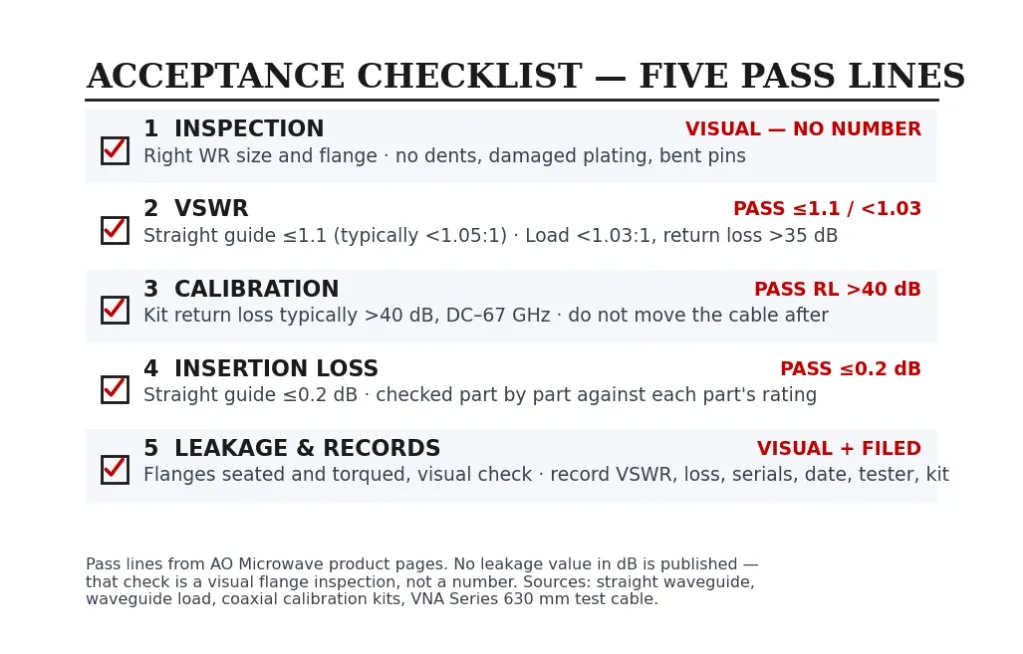
Pass lines are from AO's published product pages; leakage has no published dB value — it is a visual check, not a number.
Frequently asked questions about waveguide assembly testing
Q: What VSWR counts as a pass?
Judge the assembly against the ratings of the parts in it. Straight waveguide sections are rated VSWR ≤1.1, typically <1.05:1; a waveguide load used as the termination is rated VSWR <1.03:1 with return loss over 35 dB. Use the site's VSWR-vs-return-loss table to convert between the two — they are the same measurement in different units.
Q: Why calibrate before every test?
Calibration moves the reference plane to the end of the test cable, so the measurement starts where the assembly starts — and moving the cable after calibration moves the measurement. The 630mm VNA test cable is rated phase stability <3° @ 40 GHz and amplitude stability ±0.05 dB when moved; that stability is what your measurement depends on.
Q: How do I check for leakage?
Physically, not in decibels. Seat each flange squarely, torque the bolts to the manufacturer's specification, and look for gaps, damaged gaskets or scored faces. AO publishes no leakage test method and no leakage pass value, so this article gives no dB number for leakage — if a joint fails the visual check, re-seat or replace it before installing.
Q: What records should I keep?
The measured VSWR and insertion loss, the serial numbers of the parts, the test date, who tested, and which calibration kit was used — kept with the assembly. The record is what turns "we tested it" into something you can prove months later, when the assembly is already installed and nobody remembers the numbers.
Not Sure Your Assembly Will Pass Acceptance?
Tell us what you're testing — we'll point you to the right kit and cable. A quick question costs nothing.
Ask an EngineerQuotes within 24 hours · No MOQ for standard items