
How to Choose a Phase-Stable VNA Test Cable
A VNA test cable is part of the instrument, not an accessory. Choose by frequency, length and bend — and never move it after calibration.
The short answer
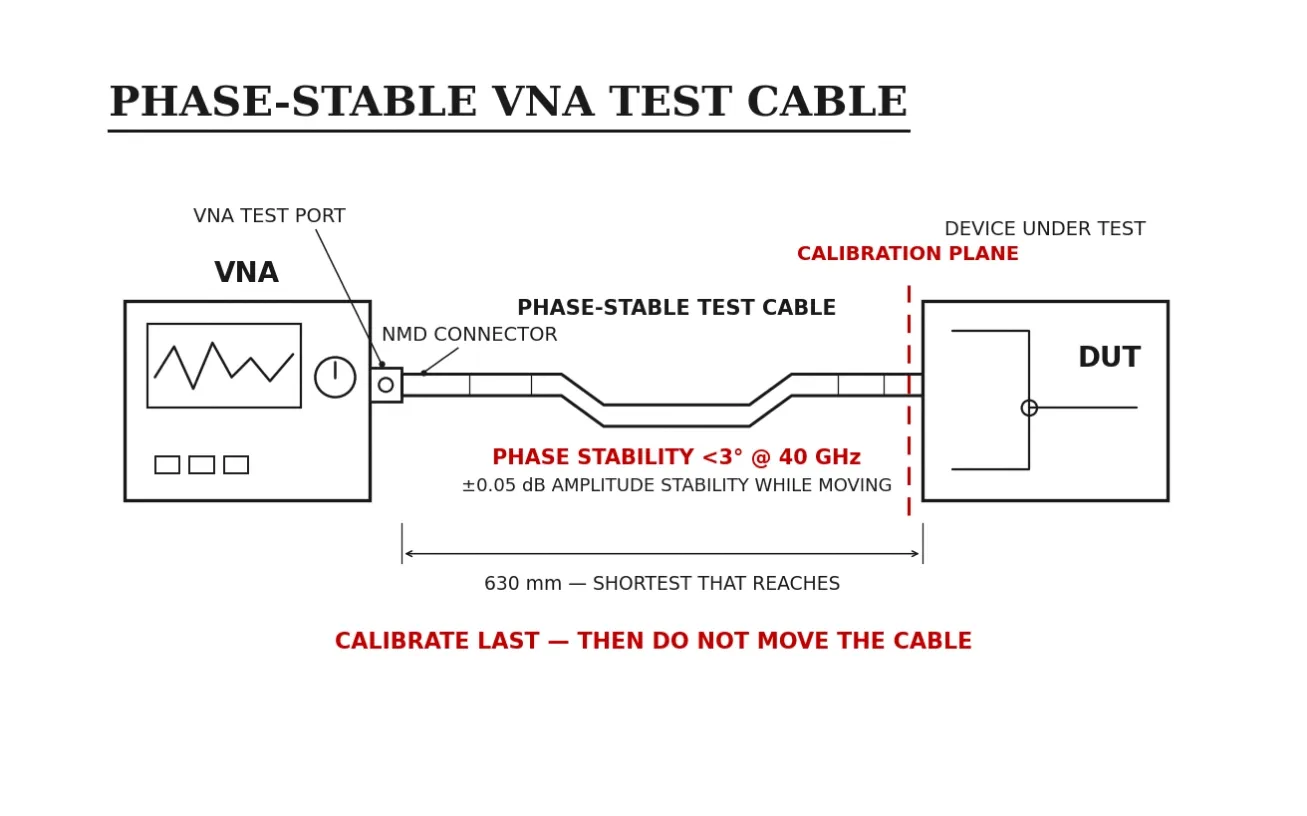
Your test cable is part of the instrument, not an accessory. A vector network analyser measures through the cable, so the cable's own phase and amplitude stability become part of the measurement. Choose by three things: the top frequency you must reach, the length you actually need, and how much the cable will move during the measurement. AO's VNA test cables reach 50 GHz; the 630 mm cable holds phase stability below 3° at 40 GHz, the 1000 mm cable below 5°.
Why does moving the cable after calibration ruin the measurement?
Calibration moves the reference plane to the end of the cable — that is the calibration kit's job. Once calibrated, moving the cable moves the reference plane with it, and the measurement drifts. That is why test cables carry stability ratings at all: the 630 mm cable is rated amplitude stability ±0.05 dB while moving and phase stability below 3° at 40 GHz. The rule is simple: calibrate with the cable in its final position and then do not move it. If you must move it, recalibrate.
Tektronix's guide to improving VNA measurement accuracy with quality cables and adapters makes the same point: movement after calibration behaves like drift, which calibration cannot correct.
630 mm vs 1000 mm — what you trade for length
The 630 mm cable reaches 50 GHz with phase stability below 3° at 40 GHz, amplitude stability ±0.05 dB while moving, ePTFE dielectric, heavy-duty stainless-steel armour, and NMD and 2.92 mm/2.4 mm interfaces. The 1000 mm cable also reaches 50 GHz, with phase stability below 5° at 40 GHz (90° envelope), shielding above 90 dB to 50 GHz, multilayer stainless-steel armour, ePTFE dielectric, a metrology-grade 2.4 mm NMD connector and SMA/2.92 mm/2.4 mm options — and about 60% more insertion loss than the 630 mm cable. Longer reach costs insertion loss and stability, so choose the shortest cable that reaches the device under test and buy length only when the bench layout forces it.
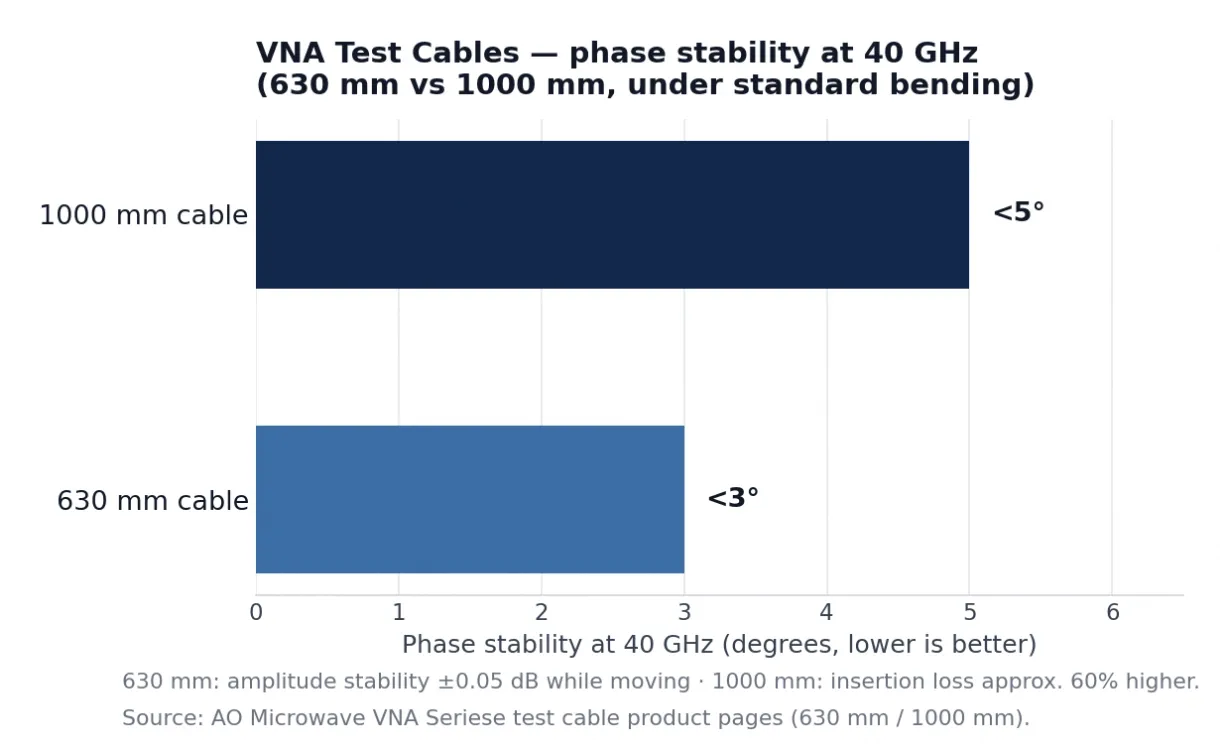
Phase stability at 40 GHz: 630 mm cable below 3°, 1000 mm cable below 5°. The 630 mm cable also holds amplitude stability of ±0.05 dB while moving; the 1000 mm cable has about 60% more insertion loss. Source: AO Microwave VNA Seriese test cable product pages.
What about the calibration kit — and a general-purpose cable?
The calibration kit is what puts the reference plane at the cable end: DC–67 GHz, return loss typically above 40 dB, open phase accuracy ±0.85°–±6.0°, termination VSWR below 1.029–1.17, with SMA, 3.5 mm, 2.92 mm, 2.4 mm, 1.85 mm and N interfaces. Match the kit's interfaces to your cable and your VNA. If the job is not VNA testing but a general phase-stable run, the CA series is the wider option: up to 67 GHz, 50 Ω, velocity factor 80–83%, shielding above 90 dB, phase stability below 5° at 40 GHz (180° envelope), ePTFE dielectric, silver-plated copper tape plus silver-plated copper wire braid, outer diameter 1.50–12.00 mm.
A short selection checklist
- Top frequency: both VNA test cables reach 50 GHz; the CA series reaches 67 GHz.
- Length: shortest that reaches — the 1000 mm cable costs about 60% more insertion loss than the 630 mm.
- Movement: if the cable moves during the measurement, the 630 mm cable's <3° at 40 GHz and ±0.05 dB matter most.
- Connector: match NMD / 2.92 mm / 2.4 mm / SMA to the VNA test port and the device under test.
- Calibrate last, then do not move the cable — or recalibrate after moving it.
Frequently Asked Questions
Not Sure Which Test Cable Fits Your VNA Setup?
Tell us your VNA, your top frequency and how far the cable has to reach — we'll point you to the right one. A quick question costs nothing.
Quotes within 24 hours · No MOQ for standard items