
What Is a Waveguide Circulator and How Does It Work?
What is a waveguide circulator? Learn how ferrite materials enable non-reciprocal RF routing, protect amplifiers, and allow duplexing in microwave systems.
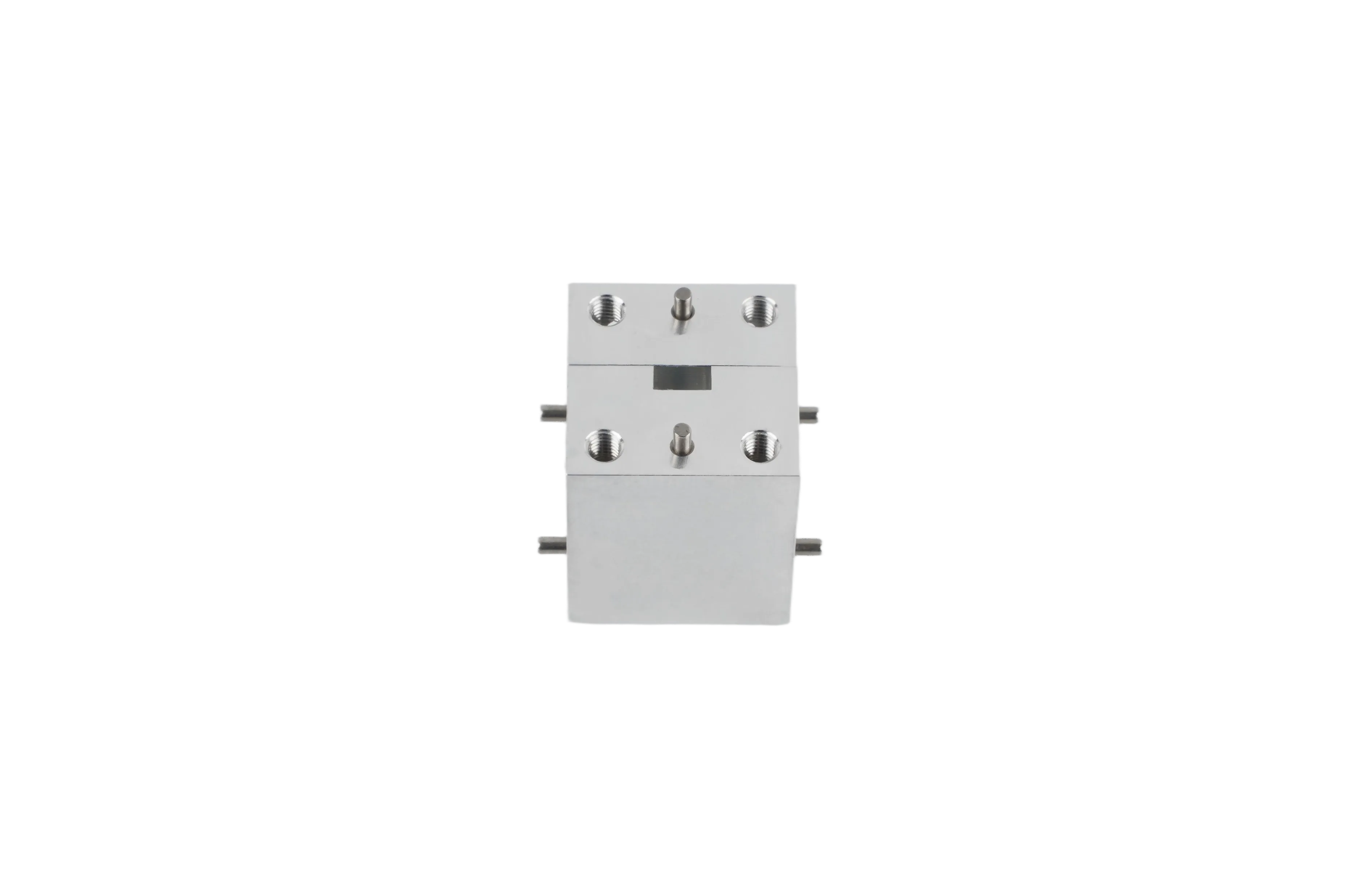
What Is a Waveguide Circulator and How Does It Work?
A waveguide circulator is a non-reciprocal passive microwave device that routes RF signals directionally between ports. Signals travel from Port 1 to Port 2, Port 2 to Port 3, and Port 3 back to Port 1, while reverse-direction signals are heavily attenuated. This one-way routing makes circulators indispensable for protecting transmitters, isolating receivers, and enabling simultaneous transmit and receive operation on a shared antenna.
Take a typical radar installation. The transmitter might push 10 kW through the waveguide to the antenna, and microseconds later, the receiver listens for faint return echoes through the same path. Without a circulator between them, transmitter leakage would destroy the receiver's sensitive front end. One component prevents that catastrophe and makes the entire architecture viable.
This article covers what a waveguide circulator is, how the ferrite junction creates directional signal flow, the specifications that matter most, how circulators compare to isolators, and how to select the right one for your frequency band and power level.
What Is a Waveguide Circulator?
A waveguide circulator is a multi-port passive RF device that directs electromagnetic energy unidirectionally (typically Port 1 → Port 2 → Port 3 → Port 1) using a magnetized ferrite core. Reverse-direction signals are isolated rather than passed, enabling simultaneous transmit and receive functions on a shared antenna.
A standard unit has three ports arranged symmetrically around a central ferrite junction. The 3-port waveguide circulator is by far the most common configuration, though 4-port variants exist for specialized applications. Each port connects to a waveguide transmission line, and the device's non-reciprocal behavior ensures that energy entering one port exits only at the next port in the clockwise (or counterclockwise) direction.
The property that matters most is isolation. A signal entering Port 1 exits at Port 2 with minimal loss, but a signal trying to travel backward from Port 2 to Port 1 encounters high attenuation, typically 20 dB or more. This directional behavior is what makes the device valuable in RF systems where you need to protect sensitive components from reflected power.
For detailed specifications and available configurations, visit the AO Microwave waveguide circulator product page.
How Does a Waveguide Circulator Work?
The operating principle comes down to one phenomenon: Faraday rotation in a magnetized ferrite.
Inside the circulator junction, a ferrite puck sits at the center. Common materials include yttrium iron garnet (YIG), nickel-zinc (NiZn), and magnesium-manganese (MgMn) ferrite. An external permanent magnet applies a static magnetic bias field perpendicular to the ferrite disc. When an electromagnetic wave passes through this biased ferrite, its plane of polarization rotates. This rotation is non-reciprocal: the direction of rotation depends on the direction of wave propagation, not on the field orientation alone. The underlying physics of this Faraday rotation effect in ferrite circulators has been extensively documented in microwave engineering literature, including the seminal treatment in the circulator entry in standard RF references.
That non-reciprocity is what makes the device work. By carefully shaping the junction geometry and matching the ferrite properties to the operating frequency, engineers create constructive interference for the forward direction (Port 1 → Port 2) and destructive interference for the reverse direction (Port 2 → Port 1). The result is a device that passes forward signals with minimal loss while heavily attenuating reverse signals.
In S-parameter terms, the behavior is unambiguous:
- S21, S32, S13 ≈ 0 dB (signal passes with minimal loss)
- S12, S23, S31 ≈ −20 to −40 dB (reverse signal is heavily attenuated)
The ferrite material and bias field must be selected for the target frequency band. YIG offers excellent performance at microwave frequencies, while NiZn and MgMn ferrites are often chosen for higher-frequency applications or where cost optimization matters. The bias magnet strength also varies with frequency: lower frequencies require stronger fields, which is why L-band circulators tend to be physically larger than their millimeter-wave counterparts. At mmWave frequencies, the same precision manufacturing requirements that apply to waveguide bends also govern circulator junction quality.
Understanding waveguide tube sizes and their frequency ranges helps contextualize why circulator dimensions vary so dramatically across bands.
Key Waveguide Circulator Specifications
Five parameters dominate the spec sheet. Knowing the typical ranges and what high-end performance looks like helps you separate marketing claims from engineering reality. For verified, in-production examples, the industry's published data is the most reliable benchmark: RF Lambda's WR90 waveguide circulator (8–12.4 GHz) specifies 20 dB isolation, while Mega Industries' waveguide circulators reach 28 dB at 915 MHz on high-power designs. Pasternack's WR-75 model (10–15 GHz) is a frequently cited mid-band reference.
- Isolation: The attenuation between reverse-direction ports. Typical commercial circulators deliver ≥20 dB. RF Lambda's WR90 waveguide circulator (8–12.4 GHz) specifies 20 dB isolation, and Mega Industries' WR975 high-power circulator achieves 28 dB at 915 MHz. High-end lab-grade units reach ≥40 dB.
- Insertion loss: The forward-direction signal attenuation. Typical values are ≤0.3 dB. The Mega Industries WR975 achieves 0.15 dB typical insertion loss at 915 MHz while handling 75 kW CW.
- VSWR: The impedance match quality. Typical ≤1.25; high-end designs reach ≤1.10. The Mega Industries WR975 reports VSWR as low as 1.04.
- Frequency band: Coverage spans from L-band (1–2 GHz) through W-band (75–110 GHz). The specific WR waveguide size determines the operating band.
- Power handling: Ranges from a few watts in compact units to tens of kilowatts CW in high-power models. Pasternack's WR-75 circulator (10–15 GHz) handles moderate power levels, while Mega Industries' WR975 is rated for 75 kW CW.
| Specification | Typical | High-End | Verified Example |
|---|---|---|---|
| Isolation | ≥20 dB | ≥40 dB | RF Lambda WR90: 20 dB (8–12.4 GHz) |
| Insertion Loss | ≤0.3 dB | ≤0.15 dB | Mega Industries WR975: 0.15 dB typ. |
| VSWR | ≤1.25 | ≤1.10 | Mega Industries WR975: 1.04 |
| Frequency | L–W band | — | 1–110 GHz coverage |
| Power (CW) | Watts | 75 kW+ | Mega Industries WR975: 75 kW CW |
To translate VSWR values into return loss figures, refer to our VSWR vs. Return Loss reference table.
Waveguide Circulator vs. Isolator
These two devices share the same ferrite junction. The difference is whether the third port is terminated or left accessible.
A waveguide circulator is a 3-port device where all ports are available for connection. A waveguide isolator is the same circulator with the third port terminated in a matched 50 Ω load, effectively converting it into a 2-port device that allows signal flow in only one direction. The terminated port absorbs any reflected energy that would otherwise exit the third port.
| Feature | Waveguide Circulator | Waveguide Isolator |
|---|---|---|
| Ports | 3 (all accessible) | 2 (3rd port terminated) |
| Signal flow | Port 1→2→3→1 | Port 1→2 only |
| Typical use | Duplexing, multi-port signal routing | Protecting sources from reflections |
| Flexibility | Higher (3 active ports) | Simpler integration (2 ports) |
When to choose which:
- Choose a circulator when you need to route signals between three active ports. The classic case is sharing one antenna between a transmitter and receiver (duplexing), or routing a signal through a test chain with a detector on the third port.
- Choose an isolator when you need to protect a signal source from reflected power. The terminated third port absorbs reflected energy, preventing it from reaching the source. This is standard practice in amplifier chains, oscillator outputs, and any source sensitive to load mismatch. For systems that combine circulators with flexible seamless waveguide runs, the isolator configuration often simplifies the routing layout.
The ferrite junction works identically in both configurations. The isolator simply trades a port for convenience and often costs less to integrate.
Common Waveguide Circulator Applications
Waveguide circulators show up wherever RF systems need directional signal control. Here are the four most common use cases.
Radar T/R isolation. In pulsed radar systems, the transmitter and receiver share a single antenna. A circulator routes the high-power transmit pulse to the antenna while directing the faint received echo to the receiver, preventing the transmit signal from reaching the receiver's front end. Standard waveguide circulator isolation of ≥20 dB is typically sufficient for this application. Without the circulator, you would need separate transmit and receive antennas, which doubles the mechanical complexity and cost of the radar installation. Avoiding common routing errors in waveguide systems is especially critical in radar setups where the circulator sits close to the antenna feed.
Satellite communication. Ground stations use circulators to separate uplink and downlink signals on the same waveguide run. The circulator directs the transmit signal to the antenna feed while routing the received signal to the low-noise amplifier chain. A satcom ground station handling a Ku-band uplink at 14 GHz and a downlink at 12 GHz relies on the circulator for physical signal separation, even though the two signals occupy different frequency bands.
EMC testing. Test setups frequently route signals through circulators to direct reflected power away from sensitive signal generators or amplifiers. A circulator between an amplifier and a test antenna prevents reflected energy from damaging the amplifier output stage when the device under test presents a poor match.
5G mmWave and phased arrays. As 5G systems push into millimeter-wave frequencies, circulators play a role in T/R module design and beam-forming networks. At these frequencies, waveguide-based circulators offer lower loss than coaxial alternatives, making them attractive for high-performance phased array systems.
In any of these applications, the waveguide run connecting the circulator to other components matters as much as the circulator itself. Quality E-bends and H-bends maintain the signal integrity that the circulator is designed to protect. For straight runs, our straight waveguide sections are manufactured to the same precision standards.
How to Choose a Waveguide Circulator
Selecting the right circulator comes down to four engineering decisions.
- Frequency band determines WR size. The operating frequency dictates the waveguide size. WR90 covers 8–12.4 GHz (X-band), WR75 covers 10–15 GHz, and WR975 covers the 915 MHz ISM band. The circulator must match the WR size of your waveguide run. This is non-negotiable: an unmatched junction will not perform.
- Isolation requirement is application-driven. Radar systems typically need ≥20 dB, which standard commercial circulators provide. Laboratory measurement setups may require ≥40 dB for sensitive measurements. Match the isolation spec to your system's tolerance for leakage between ports.
- Power handling: specify CW and peak. A circulator rated for 100 W CW may handle much higher peak power in pulsed operation, but you must verify this with the manufacturer. For high-power applications like industrial heating at 915 MHz, units such as the Mega Industries WR975 handle 75 kW CW.
- Insertion loss affects your link budget. Every 0.1 dB of insertion loss reduces your system's effective radiated power. In a tight link budget, the difference between a 0.3 dB circulator and a 0.15 dB circulator matters. Calculate the impact on overall system performance before specifying.
Also consider the flange interface. Mismatched flanges create discontinuities that degrade VSWR and can undo the performance advantage of a quality circulator. For reference on standard flange types and compatibility, see the flange information page. For guidance on selecting the broader set of waveguide components that work alongside your circulator, our waveguide bend selection guide covers system-level considerations.
Frequently Asked Questions
Q: What is the difference between a waveguide circulator and an isolator?
A waveguide circulator is a 3-port device where all ports are accessible and signals route directionally (Port 1→2→3→1). An isolator is the same device with the third port terminated in a matched 50 Ω load, converting it to a 2-port device that passes signals in only one direction. Circulators are used for signal routing and duplexing; isolators protect signal sources from reflected power.
Q: What frequency bands do waveguide circulators cover?
Waveguide circulators cover frequencies from L-band (1–2 GHz) through W-band (75–110 GHz). The specific frequency range is determined by the waveguide size (WR designation). For example, a WR90 circulator typically covers 8–12.4 GHz, while a WR975 unit operates at 915 MHz. Manufacturers such as Mega Industries cover 56 MHz to 45 GHz across their product line.
Q: How much isolation does a typical waveguide circulator provide?
Typical commercial waveguide circulators provide ≥20 dB isolation. RF Lambda's WR90 circulator (8–12.4 GHz) specifies 20 dB, and Pasternack's WR-75 model (10–15 GHz) offers 18 dB minimum. High-end lab-grade units achieve ≥40 dB. The Mega Industries WR975 reports 28 dB isolation at 915 MHz.
Q: Can waveguide circulators handle high power levels?
Yes. Small WR-size circulators typically handle tens to hundreds of watts. High-power units handle significantly more: the Mega Industries WR975 circulator is rated for 75 kW CW at 915 MHz. Power handling scales with waveguide size and thermal design, so larger WR sizes generally support higher power.
Need a Waveguide Circulator for Your RF System?
AO Microwave engineers can help you match the right circulator to your frequency band, isolation requirement, and power level. Send us your spec sheet and get a fast, technical response.
Contact Our Engineering Team