
Double-Ridged Horn Antenna or Standard Gain Horn Antenna: Which One Does Your Test Bench Need?
Double-ridged horn antenna or standard gain horn antenna? Compare bandwidth, gain behavior, VSWR and beamwidth side by side, and pick the right antenna for EMC testing and ranges.
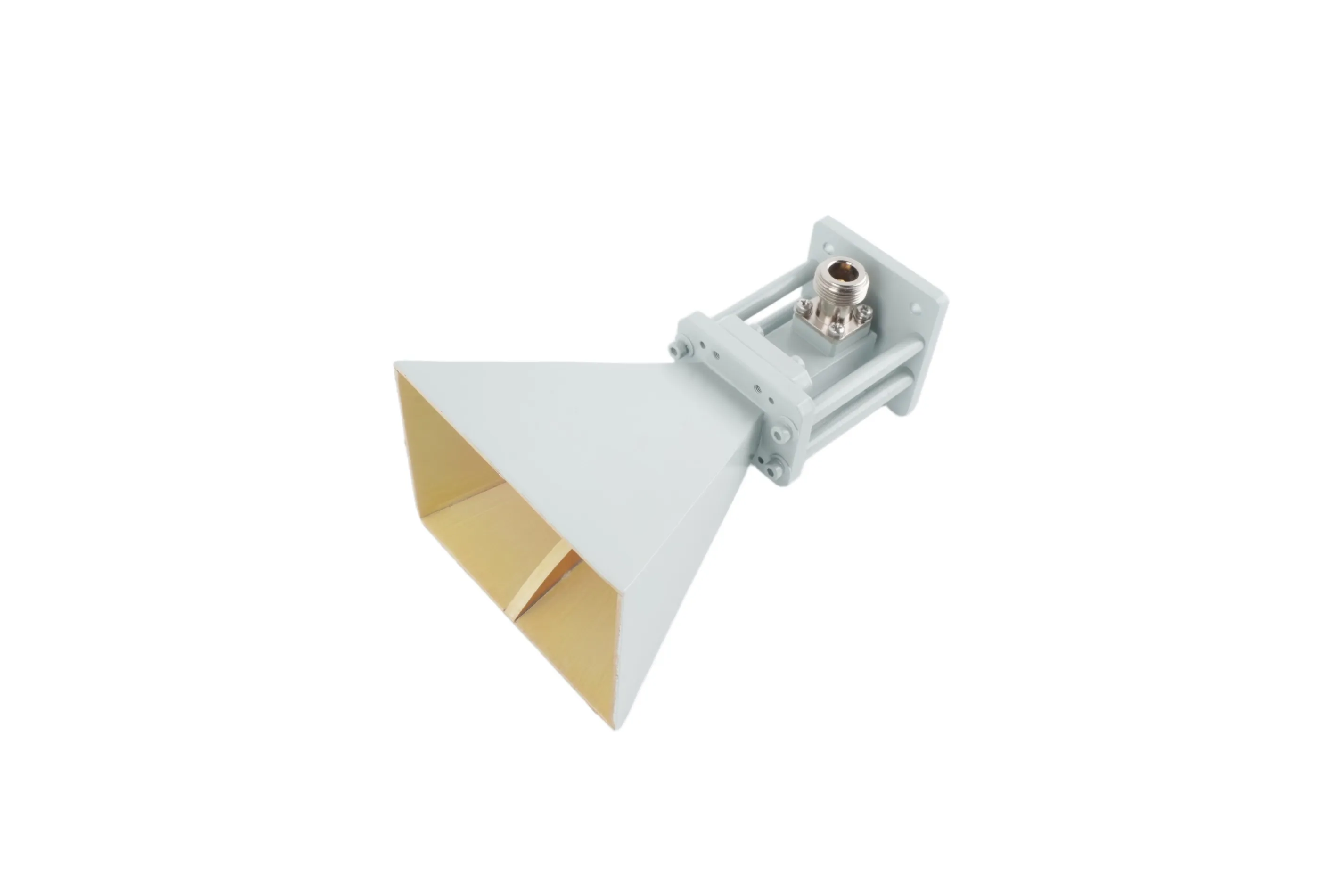
Double-Ridged Horn Antenna or Standard Gain Horn Antenna: Which One Does Your Test Bench Need?
Both are horns, both are calibrated, and both will show up in a quotation as "gain horn." They are not the same instrument. A standard gain horn antenna is a measuring reference: one band, a flat and well-known gain you transfer calibration through. A double-ridged horn antenna is a wideband workhorse: many octaves in one aperture, with gain that climbs across the band. Pick by the job the antenna has to do, not by the word "horn" in the description, because the wrong choice shows up later as a chamber you cannot calibrate or a bench that needed three antennas instead of one.
The Two Instruments Side by Side
| Attribute | Standard gain horn antenna | Double-ridged horn antenna |
|---|---|---|
| Primary job | Gain reference and calibration transfer | Generate or receive a field across octaves |
| Bandwidth | One waveguide band per horn | Multi-octave, up to 18:1 and beyond |
| Gain behavior | Flat and known across the band | Rises with frequency (6 to 18 dBi on 1-18 GHz) |
| VSWR | Low, tightly specified | 2.0:1 to 2.5:1 max, model dependent |
| Beamwidth | Narrow, predictable pattern | Wide at low band, tightening to 10-20 degrees up high |
| Calibration role | The transfer standard itself | Calibrated per unit, used as the working antenna |
| Typical bench | Antenna range, gain measurement, chamber calibration | EMC immunity and emissions, radar simulation, EW |
What a Standard Gain Horn Antenna Is Actually For
A standard gain horn antenna exists to be believed. Its gain is flat across its band and known well enough that another antenna's gain can be measured against it by substitution: you measure the standard, swap in the antenna under test, and the ratio is the answer. That is why every credible antenna range and EMC chamber keeps a set of them, and why calibration schemes such as ANSI C63.5 and IEEE-291 are written around them.
The cost of that believability is bandwidth. A smooth-wall horn passes one mode over roughly a 1.5:1 span, so covering L through Ku band means a drawer of horns, one per waveguide size. AO Microwave builds the family in three mechanical styles: a WG port version for direct flange mounting, a built-in connector version for cable-fed benches, and a split connector version where the interface is serviced separately. Same electrical job, three mounting realities.
What a Double-Ridged Horn Antenna Is Actually For
A double-ridged horn antenna exists to cover ground. Two internal ridges capacitively load the dominant mode and open the single-mode span from about 1.5:1 to many octaves, so one 1-18 GHz horn replaces the whole stack of narrowband horns that band would otherwise demand. That is what makes it the default generating antenna for radiated immunity work under IEC 61000-4-3, a practical receive antenna for emissions pre-scans, and the standard illuminator for radar target simulation and EW direction finding. The ridge mechanics behind that span, and what the physics costs you in gain curve and VSWR, is the subject of our primer on what a double-ridged horn antenna is and how it covers 0.1 to 40 GHz.
The trade is written into the physics. Because the aperture is fixed while the wavelength shrinks, gain climbs across the band: the 1-18 GHz models run from roughly 6 dBi at 1 GHz to about 18 dBi at 18 GHz. You do not get to quote one gain number and walk away. You use the calibrated gain curve for the unit, and you size amplifiers and field targets at the worst frequency, not the flattering one.
The Beamwidth Trap
Gain and beamwidth trade against each other, and in a chamber that trade is money. A 16 dBi horn at 18-40 GHz throws a 10 to 20 degree beam. Point that at a test volume from 3 m and you have a hot spot in the middle and nothing at the edges, which fails the uniformity the standard asks for. The fixes all cost: move the antenna back and you need more amplifier power for the same field, buy a bigger chamber, or add a turntable and scanner to average the exposure.
The wide-beam end of the double-ridged family behaves differently. The 1-18 GHz models open from about 30 to 80 degrees, which is why they illuminate a 3 m test volume evenly at modest power. When you compare horns, compare beamwidth at your highest test frequency, at your actual distance, against the uniformity your standard demands. Peak gain on a datasheet is the least useful number on the page.
How to Choose, in Order
1. If you are measuring another antenna's gain, buy a standard gain horn antenna. Nothing else substitutes for a known reference in the substitution method.
2. If you are generating a field across octaves, buy a double-ridged horn antenna. Immunity testing per IEC 61000-4-3, emissions pre-scans and radar simulation all want bandwidth first.
3. If your bench does both, expect to own both. The standard gain horn antenna transfers calibration; the double-ridged horn antenna does the daily work. That split is normal in a compliance lab, not a duplication.
4. Below 1 GHz, think again. Double-ridged models reach down to 0.1 GHz, and the 0.1-1 GHz model covers a decade that no standard gain horn antenna in the same aperture will touch. For emissions-only work lower still, a log-periodic may serve better than either horn.
5. Above 18 GHz, let the connector decide. 2.92 mm holds to 40 GHz; N and SMA do not. Matching the band to the interface is covered band by band in the double-ridged horn antenna selection guide.
Where Neither Horn Is the Right Answer
Some jobs want gain without the ridge compromise. For point measurements inside a single octave, the wideband horn family pairs octave bands with VSWR as low as 1.5:1 and gains from 15 to 20 dBi, which suits antenna ranges and calibration work where a predictable, higher-gain pattern matters more than a decade of coverage. The honest summary: standard gain horn antennas define gain, double-ridged horn antennas cover bands, wideband horn antennas concentrate power inside one octave. Most mature benches end up with at least two of the three.
Frequently Asked Questions
Q: Can I use a double-ridged horn antenna to measure antenna gain?
A: Only with its own calibrated gain curve, and even then it is the working antenna, not the reference. Gain varies across a multi-octave band, so you are dividing by a curve rather than a constant. For substitution measurements, a standard gain horn antenna with flat, known gain remains the cleaner instrument.
Q: Why does a standard gain horn antenna cost more per band than a double-ridged horn antenna?
A: You are buying flatness and traceability, not bandwidth. Each horn covers one waveguide band, so a multi-band bench needs several, and each unit carries a calibration history. A double-ridged horn antenna spreads one design across many octaves, which is cheaper per gigahertz covered but gives you a gain curve to manage instead of a single number.
Q: Which horn should I use for EMC radiated immunity testing?
A: A double-ridged horn antenna, chosen so its lowest frequency sits below the lowest frequency in your test plan. For the legacy IEC 61000-4-3 range of 80 MHz to 6 GHz, a 0.6-6 GHz model covers the whole band from one aperture; broader plans push into the 1-18 GHz models.
Q: Do I need both horns on one bench?
A: Usually yes, if the bench both measures and tests. The standard gain horn antenna carries the calibration transfer under ANSI C63.5 and IEEE-291 practice; the double-ridged horn antenna generates and collects the fields. Labs that only run immunity sweeps can skip the standard gain horn antenna; labs that publish gain measurements cannot.
Q: What VSWR do the two families achieve?
A: Standard gain horn antennas hold low, tightly specified VSWR because they operate over a narrow band where matching is easy. Double-ridged models specify 2.0:1 to 2.5:1 maximum across the band as the price of multi-octave coverage, with the 18-40 GHz models typically better than 1.50:1. The VSWR and return loss table shows what each figure costs you in reflected power.
Q: Which horn works for emissions measurements below 1 GHz?
A: A double-ridged model that reaches down far enough. The 0.1-1 GHz and 0.6-6 GHz models cover the region where standard gain horn antennas run out of aperture, and the 0.1-1 GHz part goes a full decade below where most horn catalogs start.
Not Sure Which Horn Your Bench Needs?
Describe what you measure and what you generate: the frequency range, the field strength or gain you need, and the distance you work at. We will confirm the antenna, the connector and the calibration data, and return a recommendation with a datasheet within 24 hours.
Contact Our Engineering Team