
How Do You Choose a Double-Ridged Horn Antenna: 1-18 GHz vs 2-18 GHz vs 18-40 GHz?
Choose a double-ridged horn antenna: 1-18 vs 2-18 vs 18-40 GHz. Match gain, beamwidth and connector to your EMC standard. N/SMA/2.92 mm. Quote in 24 h.
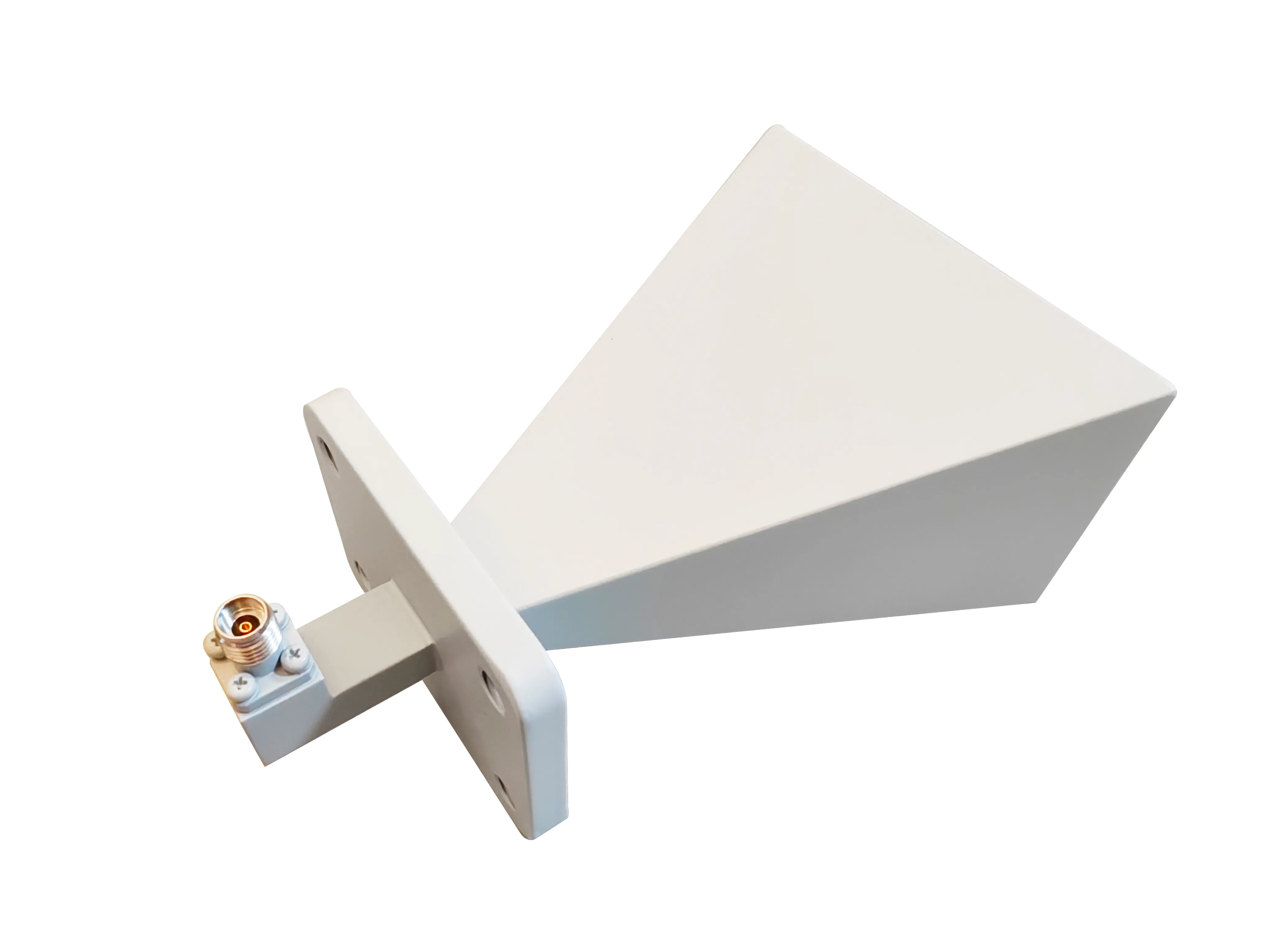
How Do You Choose a Double-Ridged Horn Antenna: 1-18 GHz vs 2-18 GHz vs 18-40 GHz?
Three double-ridged horn antennas can look nearly identical on a datasheet and still belong in three different labs. The short answer: pick 1-18 GHz if anything in your test plan lives between 1 and 2 GHz, pick 2-18 GHz if your work starts at S band and you want more gain from the same bench slot, and pick 18-40 GHz when your standard or your product runs above K band.
This guide works through the decision the way a test engineer makes it: band contents first, the gain you give up second, then the standards that force the answer. All three antennas come from the same AO Microwave double-ridged horn family, so the trade-offs below are real engineering differences rather than positioning.
Start with your lowest frequency, not your highest
The first question is not how wide a band you can afford. It is the lowest frequency your test plan or your product has to cover, because that single number eliminates two of the three options.
The 1 to 2 GHz decade looks narrow on a chart, but it is crowded. Under IEEE Std 521-2019 that decade is L band, and for many programs it holds GPS L1 at 1575.42 MHz, GSM 1800, LTE bands 1 and 3 around 1.71 to 1.98 GHz and the lower part of UMTS 2100. Choose the 2-18 GHz horn and all of it falls outside your coverage.
The gap bites hardest in EMC work. IEC 61000-4-3, the radiated immunity test most commercial products eventually run, spans 80 MHz to 6 GHz at levels from 1 V/m to 30 V/m, and it calls for coverage from 800 to 960 MHz and again from 1.4 to 6.0 GHz to prove immunity to digital radio telephones. If your chamber has to show a field at 1.4 GHz, the 2-18 GHz horn cannot generate it, whatever its gain.
The three horns, side by side
| Model | Band | VSWR max | Avg gain | 3 dB beamwidth | Connector |
| AO1G18G-DRHA10NK | 1-18 GHz | 2.0 | 10 dBi | 30° to 80° | N female |
| AO1G18G-DRHA10SK | 1-18 GHz | 2.0 | 10 dBi | 30° to 80° | SMA female |
| AO2G18G-DRHA10SK | 2-18 GHz | 2.5 | 10 dBi | 20° to 50° | SMA female |
| AO8G40G-DRHA152.92K | 8-40 GHz | 2.5 | 15 dBi | 10° to 30° | 2.92 mm female |
| AO18G40G-DRHA162.92K | 18-40 GHz | 2.5 | 16 dBi | 10° to 20° | 2.92 mm female |
Read the VSWR column as a maximum across the band, not a mid-band best case. Ask about gain at the band edges too, because gain sags toward the low end of a multi-octave horn and that is where your field strength is thinnest.
What those seven extra decibels of gain actually buy
The 2-18 GHz horn delivers roughly 10 dBi average against 10 dBi for the 1-18 GHz part. Seven decibels is a factor of five in power, and on a radiated immunity bench that is the difference between a modest amplifier and a serious one.
Run the arithmetic for a common requirement: 10 V/m at 3 m, which is test level 3 in IEC 61000-4-3. In free space the field relates to radiated power as E = sqrt(30 · P · G) / d, so 10 V/m at 3 m needs about 30 W of effective radiated power. Through a 10 dBi horn the amplifier has to deliver roughly 3 W at the antenna port. With the 17 dBi horn, about 0.6 W does the same job. Broadband amplifiers that stay linear across several octaves are expensive, and the smaller one is far easier to keep out of compression.
There is a catch, and it shows up the first time you calibrate a field. Gain and beamwidth trade against each other, so a higher-gain horn lights a narrower volume. That can push you into a longer test distance, a larger uniform field area and a bigger chamber. Gain you cannot use is just a narrower antenna, which is why the narrow beam suits antenna measurement and radar cross-section work, where you isolate a single target.
Above 18 GHz, three things change that are not the horn
The connector. Type N is rugged and forgiving but grows uncomfortable near its upper limit, and SMA does not belong at 40 GHz. A 2.92 mm (K) connector is the standard choice there, and it is smaller, so mating torque and cable strain matter more than on an N-type bench. If your setup is built around SMA you will be adding adapters, and each one inserts loss and a return-loss discontinuity where the antenna's match is weakest. Our buyer's guide to coaxial adapter body materials explains why two adapters of the same shape behave differently above 18 GHz.
The cable. Loss climbs with frequency, so a run that costs a decibel at 6 GHz can cost three at 18 GHz and more further up. Phase stability matters more here than at lower bands, because the antenna gets moved and re-aimed between measurements and phase shift from flexing turns into calibration error. That is the theme of our article on what phase-stable cable assemblies do for a 40 GHz chain.
The calibration. Gain and antenna factor data usually ship with the horn, and above 18 GHz that data is only as good as the connector repeatability on the day you use it. For more on how a connector's frequency rating constrains you, see our note on connector families and their ratings.
Match the horn to the standard you have to pass
Most horn purchases are driven by a compliance program, and that program already contains the answer. The pressure behind that testing keeps growing: The Business Research Company puts the EMC shielding and test equipment market at USD 8.27 billion in 2025, rising to USD 10.8 billion by 2030 at 5.4 percent compound growth.
- IEC 61000-4-3, commercial radiated immunity: 80 MHz to 6 GHz at 1 to 30 V/m, with dedicated coverage of 800 to 960 MHz and 1.4 to 6.0 GHz for radio telephone immunity. An 18 GHz horn is already more than enough.
- MIL-STD-461 RS103, military radiated susceptibility: 2 MHz to 40 GHz at levels reaching 200 V/m at 1 m. This is the standard that puts an 18-40 GHz horn on your bench, often the 8-40 GHz model so you are not swapping antennas mid-sweep.
- RTCA DO-160 Section 20.5 (airborne, 100 MHz to 18 GHz) and ISO 11452-2 (automotive components, 80 MHz to 18 GHz) both stop at 18 GHz.
- 5G FR2 device testing: 3GPP TS 38.104 defines FR2-1 from 24.25 to 52.6 GHz, with n258 at 24.25-27.5 GHz, n257 at 26.5-29.5 GHz, n260 at 37-40 GHz and n259 at 39.5-43.5 GHz. An 18-40 GHz horn covers the first three completely and the lower part of n259.
If your requirement sits in a narrow window rather than a decade, a pyramidal wideband horn usually returns more gain for the same aperture. The wideband horn family pairs octave bands with VSWR as low as 1.5:1 and gains from 15 to 20 dBi. When you need the ridge, the double-ridged horn family runs from 0.1 to 40 GHz across thirteen models with N, SMA and 2.92 mm interfaces.
Five questions to put in your RFQ
- What is the lowest frequency in our test plan or product spec? Answer this before you look at gain.
- What field strength at what distance? That pairing sizes the amplifier and tells you whether extra gain pays for itself.
- Are the VSWR, gain and beamwidth figures maxima or edge values across the band, rather than averages or mid-band best cases?
- Which connector and mounting hardware, and does the unit ship with gain and antenna factor calibration data? ANSI C63.5 covers antenna calibration from 9 kHz to 40 GHz.
Frequently asked questions about double-ridged horn antennas
Q: What is the difference between a 1-18 GHz and a 2-18 GHz double-ridged horn antenna?
Coverage and gain. The 1-18 GHz horn reaches down through 1 to 2 GHz, which includes GPS L1, GSM 1800 and LTE bands 1 and 3, with 10 dBi average gain and wide 30° to 80° beams. The 2-18 GHz horn gives up that decade but returns roughly 10 dBi with a narrower 20° to 50° beam. If nothing in your program lives below 2 GHz, the narrower horn is usually the better instrument.
Q: Can one double-ridged horn antenna both transmit and receive?
Yes. These are linear polarized, bidirectional antennas, so one horn serves radiated emission measurements as a receive antenna and radiated immunity testing as a transmit antenna. Check power handling before planning a high-level susceptibility test, because MIL-STD-461 RS103 levels can reach 200 V/m at 1 m.
Q: Why do 18-40 GHz horns use 2.92 mm connectors instead of N or SMA?
Connector families have frequency limits that are easy to overlook. Type N is commonly used to around 11 to 18 GHz and SMA to 18 GHz, while 2.92 mm (K) is rated to 40 GHz. Above 18 GHz the 2.92 mm interface is the practical choice, and it is mechanically smaller, so mating torque and cable strain matter more than on a Type N bench.
Q: Is higher gain always better in a double-ridged horn antenna?
No. Gain and beamwidth trade against each other, and an EMC chamber needs a field that stays uniform across the test volume. A narrower beam can force a longer test distance and a larger chamber for the same uniformity. Higher gain pays off in radiated susceptibility work, where it cuts amplifier power, and in antenna measurement, where you isolate one target.
Q: What does the ridge in a double-ridged horn antenna actually do?
Two flared metal ridges run along the internal walls and work as an impedance matching structure. They lower the cutoff frequency of the dominant TE10 mode while keeping the higher-order mode cutoffs high, which is what lets one horn span several octaves instead of one. Good designs also manage the higher-order modes that would otherwise split the beam toward the top of the band.
Q: Do I need calibration data with a horn antenna?
For compliance work, yes. Ask for gain against frequency and antenna factor data tied to the serial number, and check that it covers the full band you will use. ANSI C63.5 covers antenna calibration from 9 kHz to 40 GHz. Without that data you can still make relative measurements, but you cannot defend an absolute field strength.
Not sure which band your test plan really needs?
Tell us the lowest frequency you must cover, the field strength and distance you work at, and the standard you are testing to. Our engineering team will confirm the horn, connector and mounting and send a quotation with a gain curve within 24 hours.