
What Causes PIM in 5G Antenna Systems?
Passive intermodulation is not a broken part — it is a nonlinear one. What causes PIM in 5G antenna systems, and how to keep it out of your receive band.
The short answer
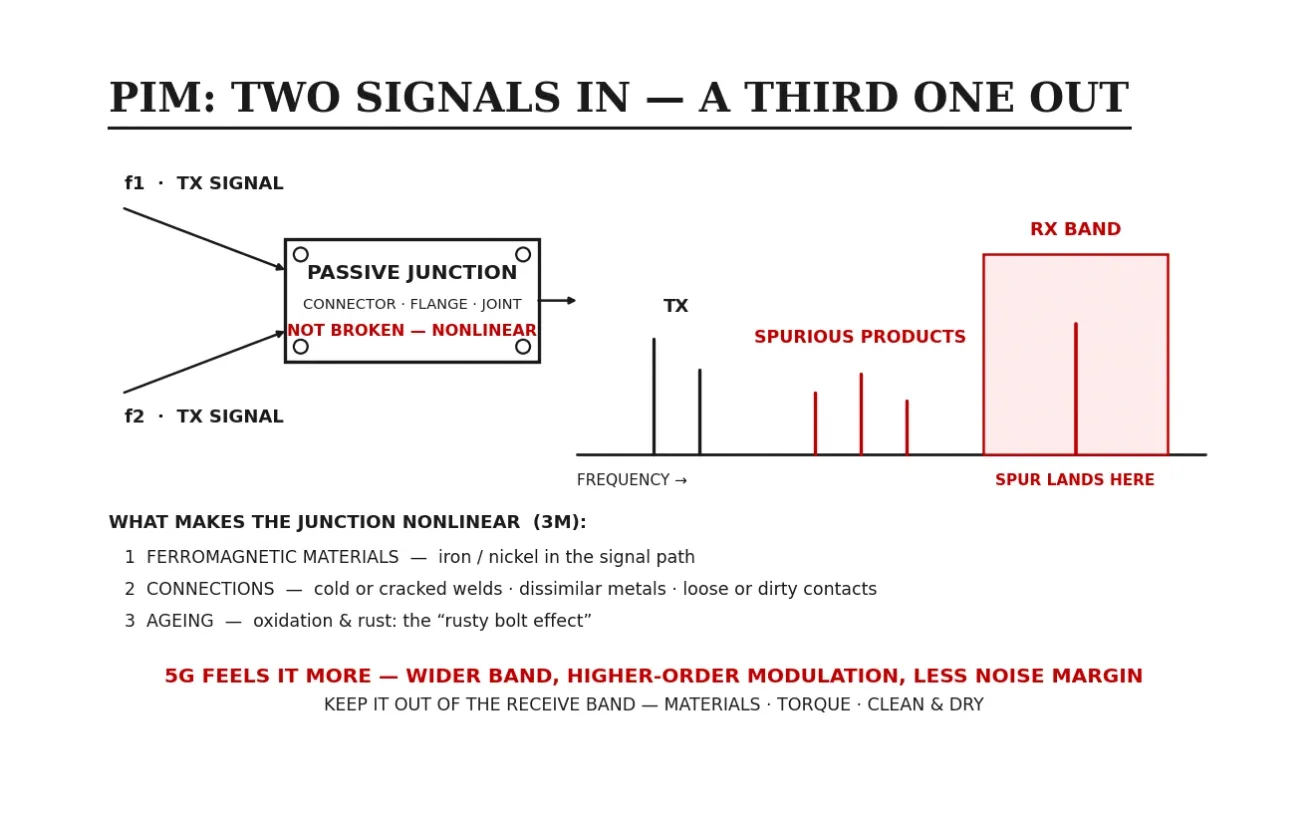
Passive intermodulation (PIM) is what happens when two or more strong signals mix inside a passive component and create new, unwanted signals — spurious products that can land right in your receive band. The part is not broken; it is nonlinear. Any passive junction can do it: a connector, a cable, a waveguide joint, a bolted flange. And 5G is more sensitive to it than 2G or 3G — wider bandwidth and higher-order modulation leave less room for noise, so the same intermodulation products hurt more, and the problem gets worse over time as joints age (per 3M).
What causes it — three groups
Materials. Ferromagnetic materials in the signal path are the classic PIM source. If a part in the chain contains iron or nickel, it can generate intermodulation even when it is brand new and perfectly tight. The first selection rule is therefore a materials rule: keep ferromagnetic materials out of the signal path.
Connections. Most PIM in the field comes from joints, not from parts. The causes 3M lists are cold welds and cracked welds, dissimilar-metal junctions, and loose or contaminated contacts. Two different metals pressed together, a connector that was never torqued to specification, a contact with dirt or moisture on it — each of these is a small nonlinear junction, and each one mixes the signals passing through it.
Environment and ageing. Oxidation and rust turn a good joint into a bad one over time — the field name for this is the "rusty bolt effect": a corroded bolt or flange behaves like a nonlinear device and generates intermodulation. That is why PIM gets worse with age, and why a system that passed its tests on day one can fail them a year later. Keep joints dry, clean and protected, and re-check them on a schedule, not only when something goes wrong.
Why 5G feels it more
Two reasons, both from 3M. First, 5G uses wider bandwidth and higher-order modulation, which leaves less noise margin — the same spurious product that a 2G receiver could ignore can sit above a 5G receiver's noise floor. Second, the problem grows with time: joints oxidise, coatings wear, and the intermodulation level climbs. A 5G antenna system therefore needs the PIM thinking done at selection and installation time, not at fault finding time — by then the cost is a site visit and a rework, not a design choice.
For the wider picture, see our overview of 5G network RF design challenges.
The prevention checklist — selection and installation
- Materials first. Avoid ferromagnetic materials in the signal path; check the material of every part you add to the chain.
- Torque to specification. A connector torqued to the manufacturer's specification is a clean, stable contact; an under-torqued one is a future PIM source.
- Clean and dry. Keep contacts clean and dry, and protect outdoor joints from moisture and corrosion.
- Do not mix metals. Avoid dissimilar-metal junctions in the signal path wherever you can.
- Shielding matters. Shielding keeps outside signals out of the cable — the CA Series cable is rated shielding >90 dB, with silver-plated copper tape plus silver-plated copper wire braid; the VNA Series test cable (1000mm) is rated shielding >90 dB to 50 GHz with multilayer stainless-steel armour. Check the shielding figure on the cable you choose.
- Watch the twist. A flexible twist waveguide is a useful part — rated 2.60–50.0 GHz, VSWR 1.10–1.35:1, insertion loss 0.11–2.50 dB/m, maximum twist angle 105–920 degrees per metre — but Microwaves101 notes that twist waveguide is not recommended for low-PIM applications. That guidance comes from Microwaves101, not from an AO product page: if your application is PIM-sensitive, think twice before putting a twist section in the signal path.
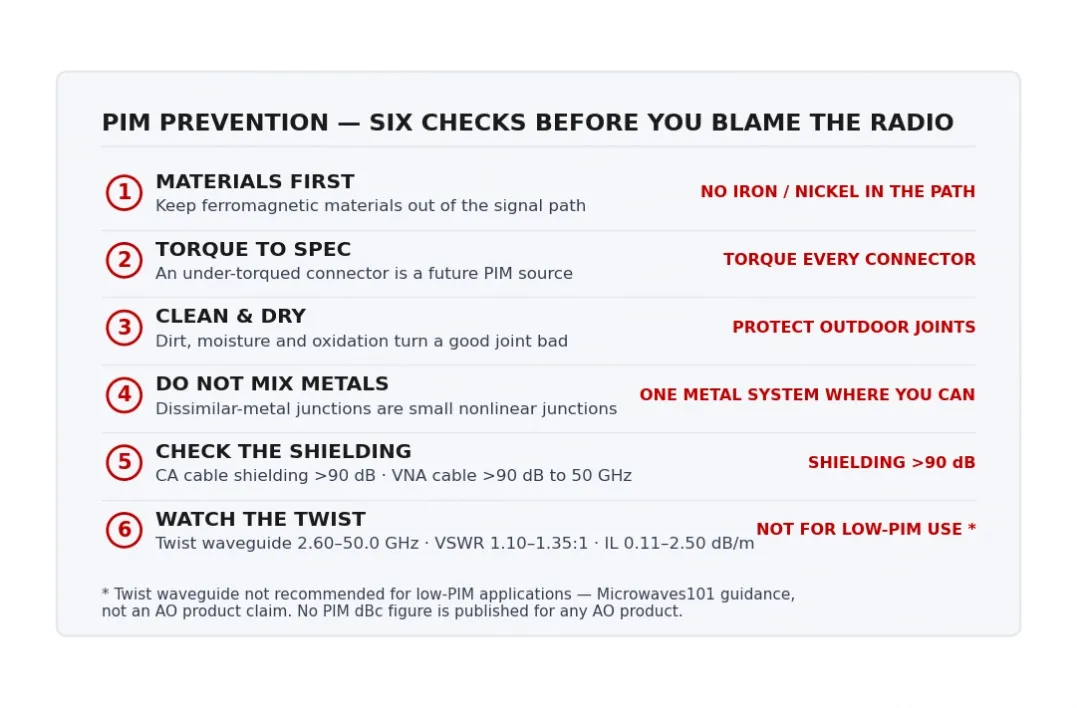
Shielding figures are from AO's published product pages; twist waveguide is not recommended for low-PIM applications (Microwaves101).
Frequently asked questions
Q: Can PIM be eliminated completely?
No. PIM comes from the physics of passive junctions — materials, contacts and ageing — so it can be reduced, not eliminated. The honest goal is to keep it below the level that hurts your receiver: choose non-ferromagnetic materials, torque connections to specification, keep joints clean and dry, and check the shielding figure on the cable you use. Manage it; do not promise to remove it.
Q: Why is 5G more sensitive to PIM than 2G or 3G?
Because 5G uses wider bandwidth and higher-order modulation, which leaves less noise margin — the same spurious product that a 2G receiver could ignore can sit above a 5G receiver's noise floor, per 3M. And the problem grows with time, as joints oxidise and coatings wear, so a 5G system needs the PIM thinking done at selection time, not at fault-finding time.
Q: What is the "rusty bolt effect"?
It is the field name for PIM caused by a corroded or oxidised metal joint — a rusty bolt or flange that behaves like a nonlinear device and generates intermodulation. That is why PIM gets worse with age and why a system that passed on day one can fail a year later. Keep joints dry, clean and protected, and re-check them on a schedule.
Q: Do I need a special low-PIM cable?
AO publishes no PIM measured value for any product and has no dedicated low-PIM cable series, so this article gives no PIM figure to shop by. Choose on the figures that are published — the CA Series cable is rated shielding >90 dB, for example — and on installation practice: clean, torqued, dry joints with no ferromagnetic parts. If AO publishes PIM test data later, this article can be updated with it.
Not Sure PIM Is Hiding in Your Antenna System?
Tell us your band and setup — we'll point you to the right parts. A quick question costs nothing.
Ask an EngineerQuotes within 24 hours · No MOQ for standard items
