
Why Precision Manufacturing Is Critical for Millimeter-Wave Waveguide Bends
mmWave waveguide bend precision: why surface roughness >0.4 μm adds 38–86% loss at 94 GHz. Compare CNC, EDM & electroforming tolerances by frequency.
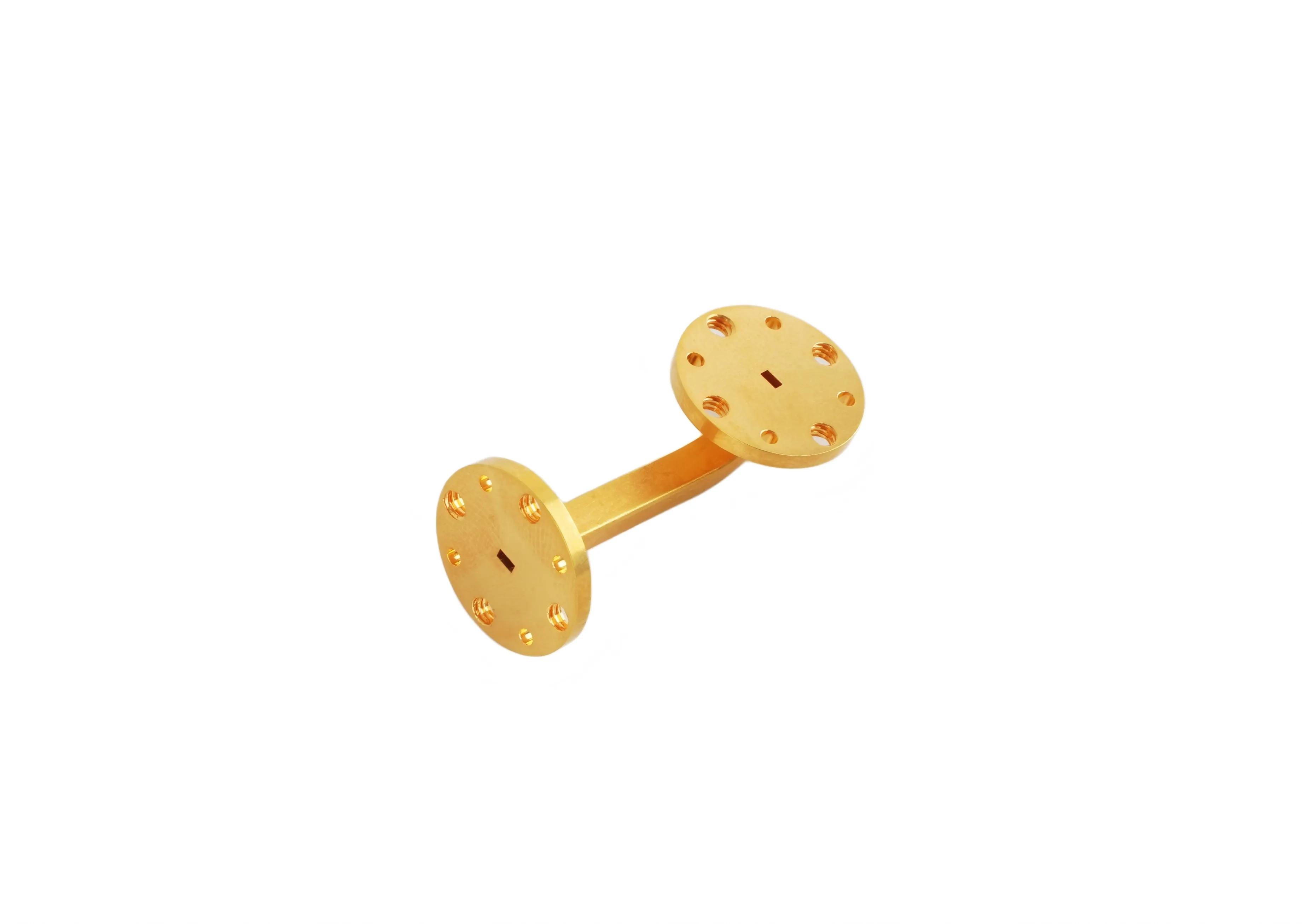
Why Precision Manufacturing Is Critical for Millimeter-Wave Waveguide Bends
At 94 GHz, a surface scratch you can't see with the naked eye can add 86% more signal loss. At 30 GHz, that same scratch is negligible. That's the precision cliff — and it bites hardest where your signal bends.
If you're building mmWave systems — 5G backhaul, satcom ground stations, defense radar — you already know the frequencies. 30 to 300 GHz. What's easy to miss: waveguide bends face a precision problem that straight sections don't. Curvature amplifies every deviation. A 10 μm error in a straight WR-10 run is one thing. That same error on a curved inner radius? Much worse. (We covered precision in mmWave loads in a previous piece — bends are a different animal entirely.)
The mmWave Precision Cliff: Why Tolerances That Work at Lower Frequencies Fail Above 30 GHz
Skin Depth Shrinks, and So Does Your Margin for Error
At microwave frequencies, current flows in a thin layer on the inner surface of a waveguide. The skin depth formula — δ = 1/√(πfμ₀σ) — tells us that this layer shrinks as frequency rises. In copper, the skin depth at 30 GHz is roughly 0.38 μm. By 94 GHz, it drops to 0.21 μm. That's less than a quarter of a micron.
Now consider surface roughness. A commercially machined waveguide bend typically has an Ra (arithmetic average roughness) of 1.6 μm. When that roughness exceeds skin depth by 4× to 8×, current can no longer flow efficiently along the surface. Loss spikes — the numbers are in the table below.
| Ra (μm) | Additional Loss at 94 GHz |
|---|---|
| 0.1 | +5% |
| 0.4 | +38% |
| 0.8 | +72% |
| 1.6 | +86% |
For standard rectangular waveguide dimensions like WR-10, the internal wall Ra must stay below 0.4 μm (instrument grade). Commercial-grade Ra of 0.8–1.6 μm adds 38–86% more insertion loss at these frequencies — a penalty that compounds through every bend in the signal path.
Three Dimensions of Precision in mmWave Waveguide Bends
Precision in a waveguide bend comes down to three things: dimensional tolerance, surface finish, and flange alignment. Get any one wrong and the whole assembly underperforms. Here's what each one means at mmWave frequencies.
Dimensional Tolerance: When Microns Move Cutoff Frequencies
The cutoff frequency of a rectangular waveguide is defined by fc = c/(2a), where a is the broad-wall dimension. In WR-10 waveguide (2.54 mm aperture), that dimension is critical. A ±10 μm manufacturing error shifts the cutoff frequency by approximately 300 MHz — a number independently confirmed by NIST's dimensional traceability work on WR-15 waveguide standards. The same ±10 μm error in a WR-28 waveguide (with its larger 7.112 mm aperture) is proportionally negligible — but WR-28 at 26 GHz still cares about tolerances, just not as much.
Maintaining the a and b dimensions through a curved section is harder than through a straight section. The tool path is more complex, and the curvature introduces dimensional drift — particularly at the inner radius where the material is compressed — that doesn't occur in precision straight waveguide sections. Whether you're routing signal through waveguide E-bends or waveguide H-bends, the waveguide dimensional tolerance through the curved section demands tighter process control than any straight section of the same waveguide size.
Surface Roughness: The Hidden Attenuation Multiplier
The Hammerstad-Jensen model quantifies how waveguide surface roughness at mmWave frequencies drives attenuation: αrough/αsmooth = 1 + (2/π)×arctan(1.4×(Ra/δ)²). The surface roughness data above comes from this model, validated against measured results in the literature (source: Surface Roughness on Microwave Transmission Line Performance, MDPI 2023).
A 10 cm WR-10 straight section shows roughly 1.0 dB difference between commercial and instrument-grade surface finish. Bends are worse — the current path around the curvature is more complex, and polishing the inner wall of a bend is harder because curvature prevents consistent tool contact, especially at the inner radius where current density peaks.
Flange Alignment: Where Microns Become Decibels
Flange precision matters at every junction, but bends introduce an additional failure mode. Standard UG flanges offer ±10 μm alignment accuracy; IEEE Std 1785.1 precision flanges tighten that to ±3 μm (source: IEEE 1785.1, RF Essentials).
A 0.1 mm flange gap increases loss from 0.01 dB to 0.1 dB — a 10× jump. A 0.1 mm lateral alignment offset adds 0.05 dB per junction. Small numbers. Until you count the junctions. A typical mmWave system has a dozen or more, and the loss compounds.
Bend flanges carry uneven mechanical stress. The curvature creates a moment arm that can push flanges out of alignment under thermal cycling or vibration — more so than straight-section flanges. A bend that passes QA at room temperature can drift out of spec in the field, and thermal cycling or a few hundred hours of vibration is all it takes. For a deeper look at how these routing and bend alignment problems compound across a full waveguide run, see our earlier analysis.
What Imprecise Bends Cost Your mmWave System
This isn't theory. ADM Microwave replaced standard-tolerance waveguide components in a Ka-band ground station and measured 0.3 dB/m less loss across the run. In a system with multiple bends, that 0.3 dB is the difference between closing the link budget — and explaining to your program manager why you can't. For more on how hidden routing errors compound these losses, see our analysis of common signal loss problems in waveguide bends.
In 5G mmWave base stations, each bend's 0.1 dB precision difference compounds across the entire waveguide run. A system with eight bends can see nearly a full decibel of total loss variance depending on manufacturing grade. That hits coverage range and throughput directly.
In defense radar, phase consistency of ±2° across the array requires batch-to-batch manufacturing precision consistency. An industrial waveguide bend that drifts in dimensional tolerance from one production lot to the next introduces phase errors that degrade beam steering accuracy. If you've ever had a phased array that looked great on paper and mysteriously underperformed in the anechoic chamber, check the bends first.
Manufacturing Methods and Their Precision Limits
So what can each process actually deliver? A recent precision AM benchmark for mmWave waveguide components highlights where additive manufacturing fits into the picture — but for production bends, three processes dominate. The short version:
| Method | Dimensional Tolerance | Surface Roughness (Ra) | Best For |
|---|---|---|---|
| CNC Precision Milling | ±5–10 μm | 0.4–0.8 μm | Production mmWave bends (mainstream) |
| Wire EDM | ±1 μm | 0.2–0.4 μm | Instrument-grade bends |
| Electroforming | ±2–5 μm | <0.4 μm | Ultra-precision internal surfaces |
At AO Microwave, we machine waveguide bends from WR-28 through WR-10 on CNC mills with process controls designed for mmWave tolerances. The surface finishes and dimensional accuracy match what the frequency demands. The pricing doesn't carry an aerospace premium. Our straight waveguide sections benefit from the same process control — because straight or curved, the micron budget is the same. When rigid bends won't fit your routing, flexible seamless waveguide alternatives offer another path — though they trade some precision for installability.
Choosing the Right Precision Level for Your mmWave Application
Below 40 GHz, commercial grade works. Above 75 GHz, you need instrument grade. (If you're still deciding between E-plane vs. H-plane bend trade-offs, that choice is independent of precision grade — both geometries need the same surface finish at a given frequency.) Here's the decision framework:
| Parameter | Commercial Grade | Standard Grade | Instrument Grade |
|---|---|---|---|
| Aperture Tolerance | ±50 μm | ±10–25 μm | ±5 μm |
| Surface Roughness (Ra) | 0.8–1.6 μm | 0.4–0.8 μm | <0.4 μm |
| Flange Flatness | Standard UG | Enhanced | IEEE 1785.1 Precision |
| Typical Return Loss | 25–30 dB | 30–35 dB | 35–40 dB |
| Best Frequency Range | Up to 40 GHz | 40–75 GHz | 75–110+ GHz |
For more detail on return loss specifications and how they translate to VSWR, see our reference table. And for guidance on selecting the right bend type for your signal path, see our waveguide bend selection guide.
Frequently Asked Questions About mmWave Waveguide Bend Precision
Q: What surface roughness (Ra) do I need for a 94 GHz waveguide bend?
For a 94 GHz millimeter-wave waveguide bend (WR-10), you need an Ra below 0.4 μm — ideally 0.2 μm or lower. At 94 GHz, the skin depth in copper is only ~0.21 μm, meaning the mmWave signal penetrates only that far into the conductor. Any surface roughness significantly larger than this depth forces current over a longer, rougher path, increasing loss by 38–86% depending on the Ra value.
Q: How does bend curvature make precision harder than straight sections?
Start with the tool path. Cutting a curve means your CNC bit changes direction continuously — holding ±5 μm through that is nothing like a straight pass. Then there's polishing. Try buffing the inside of a curved tube and you'll understand: the tool can't hold consistent contact, especially at the inner radius where current density peaks. Finally, there's the mechanical problem nobody talks about: bend flanges sit under uneven stress from the curvature's moment arm. Thermal cycle that assembly a few dozen times and your room-temperature alignment is gone.
Q: Do I always need instrument-grade precision for mmWave applications?
No. Commercial grade (Ra 0.8–1.6 μm, ±50 μm aperture) is sufficient for frequencies up to about 40 GHz. Standard grade (Ra 0.4–0.8 μm, ±10–25 μm) covers the 40–75 GHz range effectively. Instrument grade (Ra <0.4 μm, ±5 μm, IEEE 1785.1 precision flanges) is necessary at 75 GHz and above, where skin depth drops below 0.25 μm and even small tolerance deviations cause significant performance degradation.
Q: What's the cost difference between commercial and instrument-grade waveguide bends?
Instrument-grade bends typically cost 2–3× more than commercial grade, driven by the need for Wire EDM or electroforming, precision flange machining to IEEE 1785.1 tolerances, and more extensive quality testing. However, for systems operating above 75 GHz, the cost premium is far less than the performance penalty of using underspecified components. The waveguide components market is projected to grow from $2.1B in 2025 to $3.8B by 2034 (CAGR 6.8%) — reflecting exactly this trend: mmWave adoption is pushing everyone toward higher-precision components, whether they planned for it or not.
What This Means for Your Next Spec Sheet
Bottom line: match your tolerance grade to your frequency. Below 40 GHz, commercial grade works. Above 75 GHz, you need instrument grade — and a supplier who can prove batch-to-batch consistency, not just a clean first article. At AO Microwave, we've measured the difference: a WR-10 bend with 0.8 μm Ra versus 0.2 μm — same geometry, same flange, same test setup. The rougher one loses an extra 0.4 dB at 94 GHz. Every time.
Need Precision-Manufactured mmWave Waveguide Bends?
Tell us your frequency and application. We'll spec the right tolerance grade — no upselling to instrument grade if you're at 28 GHz.
Contact Our Engineering Team