
Waveguide vs Coax Above 40 GHz: When to Switch?
Coaxial cable works above 40 GHz — but the trade-offs tip. Four checks to tell whether your system has crossed the line to waveguide.
The short answer
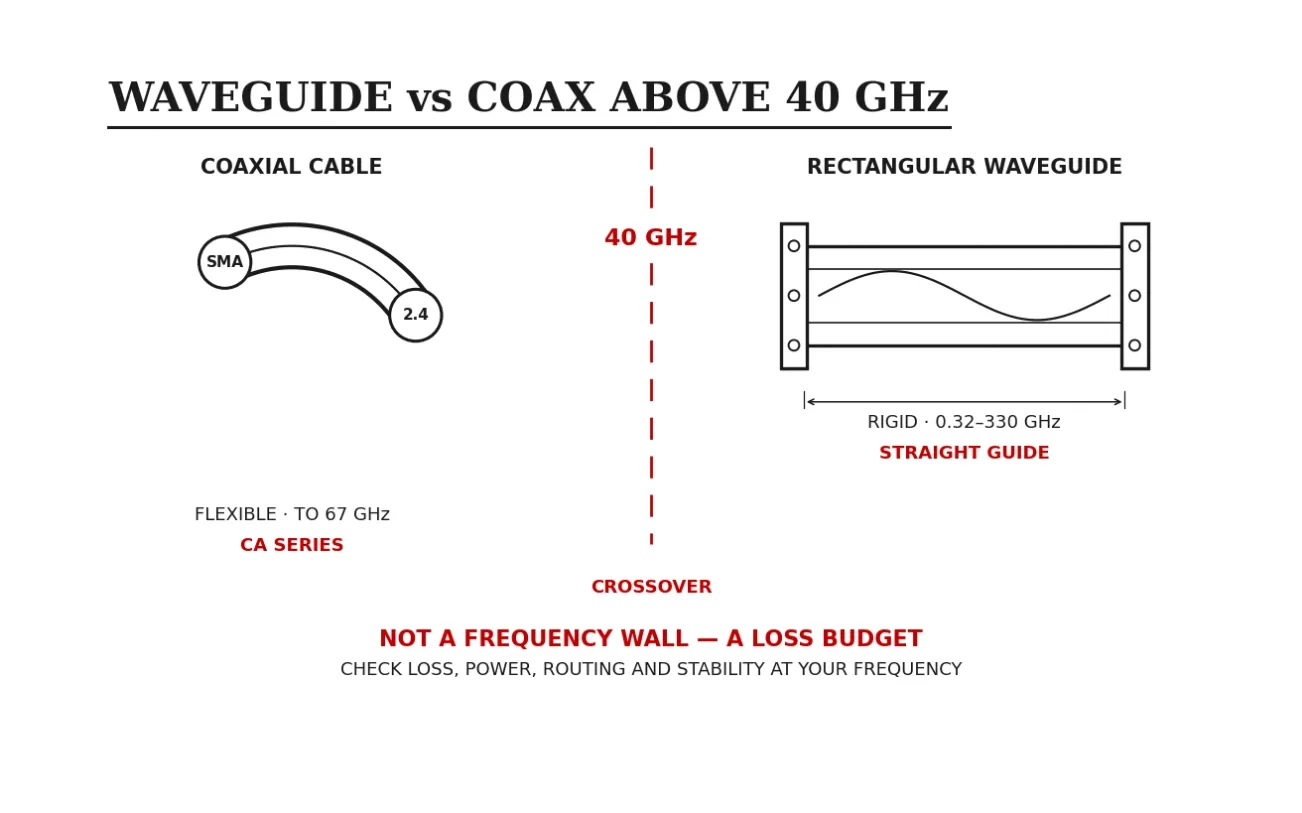
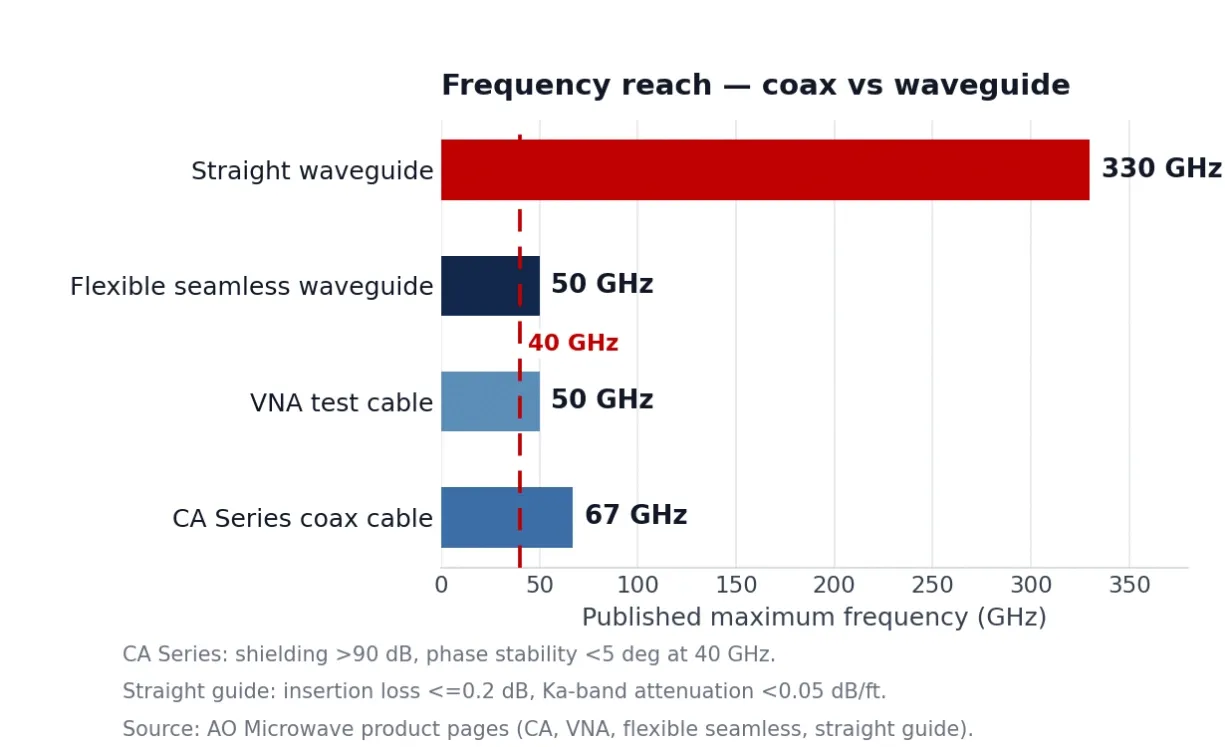
Coaxial cable does not stop working at 40 GHz. AO's CA Series cable runs to 67 GHz and the VNA test cable to 50 GHz, so coax above 40 GHz is real and shipping. What changes above 40 GHz is the price you pay for staying with coax: the loss budget gets tighter, the connectors get smaller, and keeping the assembly stable gets harder. Waveguide, by contrast, stays low-loss at these frequencies — a straight waveguide section is rated insertion loss ≤0.2 dB with VSWR typically <1.05:1, and Ka-band attenuation under 0.05 dB/ft. So the right question is not "does coax work at 40 GHz?" but "what is staying with coax costing me?" — and the answer is a loss budget, not a frequency.
Four checks to tell whether you have crossed the line
- Frequency and loss budget. Work out the loss your link can afford, then check it against real numbers. On the waveguide side the site publishes them: straight waveguide covers 0.32–330 GHz with insertion loss ≤0.2 dB and Ka-band attenuation under 0.05 dB/ft; flexible seamless waveguide covers 2.60–50.0 GHz with insertion loss 0.08–4.10 dB/m. On the coax side, ask for the candidate's insertion loss at your exact frequency and length before deciding.
- Power. Check the power rating of the exact part you plan to use, not a rule of thumb. The site's general waveguide-vs-coax comparison covers the power point in full; this article does not repeat it.
- Bend and routing. If the run must bend, flex or move, compare a flexible waveguide against coax on loss, not on habit. Flexible seamless waveguide covers 2.60–50.0 GHz at 0.08–4.10 dB/m — a waveguide option where the run is not straight. Where the run is straight, rigid waveguide gives the lowest loss.
- Stability and shielding. Hold the coax candidate to its published figures: the CA Series cable is rated shielding >90 dB and phase stability <5° @ 40 GHz; the VNA test cable is rated shielding >90 dB to 50 GHz. If your application needs phase stability through movement, check that rating on the candidate — do not assume it.
The checklist: still coax, or time to switch?
You are probably still fine with coax if all four of these are true: the run is short; the loss budget fits with margin; the cable's published figures (CA Series to 67 GHz, shielding >90 dB, phase stability <5° @ 40 GHz) meet the need; and the routing needs the flexibility coax gives. If any one of them fails — the loss budget is already tight, the run is long, the phase has to stay stable while things move, or the power rating does not fit — price the waveguide option before you commit to coax.
Most systems above 40 GHz are mixed — and that is fine
Very few systems are all-waveguide or all-coax. The usual answer is waveguide where loss matters, coax where flexibility matters, and a waveguide-to-coaxial adapter between them. Design the crossover deliberately: put the adapter where the loss budget can afford it, and check the adapter's own rating the same way you check everything else. A mixed system chosen on purpose beats a pure system chosen by habit.
Frequently asked questions
Q: Is 40 GHz a hard boundary?
No. The CA Series cable runs to 67 GHz and the VNA test cable to 50 GHz, so coax works above 40 GHz. Forty gigahertz is a rule of thumb, not a wall: the crossover is where your loss budget, power, routing and stability needs stop being met by coax. Check the numbers for your frequency and length, not the headline frequency.
Q: How much loss does waveguide save?
Use the published figures. Straight waveguide is rated insertion loss ≤0.2 dB with Ka-band attenuation under 0.05 dB/ft and VSWR typically <1.05:1; flexible seamless waveguide is 0.08–4.10 dB/m over 2.60–50.0 GHz. Compare those with the coax candidate's loss at your exact frequency and length — the site publishes no per-band coax loss table, so ask for that figure before deciding.
Q: Can I mix waveguide and coax in one system?
Yes — most systems above 40 GHz do. Use waveguide where loss matters, coax where flexibility matters, and a waveguide-to-coaxial adapter between them. Put the adapter where the loss budget can afford it and check its rating like any other part. A mixed system chosen on purpose beats a pure system chosen by habit.
Q: When should I stay with coax above 40 GHz?
Stay with coax when the run is short, the loss budget fits with margin, the cable's published figures meet the need — CA Series to 67 GHz, shielding >90 dB, phase stability <5° @ 40 GHz — and the routing needs the flexibility coax gives. If any of those fails, price the waveguide option before committing.
Not Sure Whether Your System Has Crossed the 40 GHz Line?
Tell us your frequency and loss budget — we'll point you to the right one. A quick question costs nothing.
Ask an EngineerQuotes within 24 hours · No MOQ for standard items